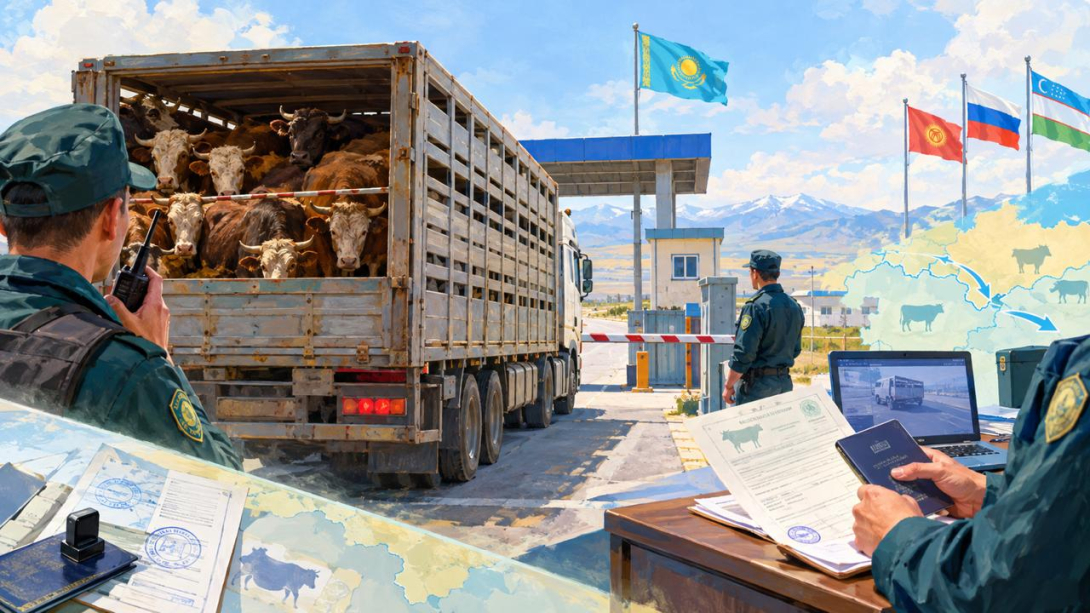
The Border Service of the National Security Committee (NSC) has confirmed the entry of a lorry with 80 bulls through the Zhaiysan checkpoint, yet customs still does not know where the livestock came from or why no transit declaration could be found for the vehicle. The agencies meanwhile assure that there have been no similar cases in the Turkistan Region, but FBRK sources tell of a similar problem in the Zhambyl Region, where veterinary documents for the export of livestock, by their account, can simply be bought.
WHAT HAPPENED AT THE KAZYGURT POST
Not long ago, FBRK reported on a letter from the Department of State Revenue (DSR) for the Turkistan Region, according to which, on 29 July 2026, a lorry with 80 head of bulls with a total weight of 17,850 kg arrived at the Kazygurt post. The carrier had a CMR consignment note, an invoice and a Georgian export declaration, but without customs stamps.
The most unusual thing was discovered in the electronic system. On the day of the detention, Berkut, where the crossing of the border by transport is recorded, did not show the entry of this vehicle. Later the record did appear after all: the lorry supposedly entered through the Zhaiysan checkpoint (CP) in the Aktobe Region on 18 July. The DSR called this a possible entry of fictitious data.
To clarify the situation, FBRK sent requests to the Committee of State Revenue (CSR) and the Border Service of the NSC.
WHAT THE NSC AND CSR REPLIED
The NSC replied briefly. The agency said that the passage of the vehicle was carried out in accordance with the Law "On the State Border of the Republic of Kazakhstan", and on all other matters the agency recommended applying to the CSR.
It was from there that the detailed reply came.
The CSR said that the DSR's materials had been reviewed and passed to the Border Service of the NSC to check the circumstances of the border crossing and the data in Berkut. The Border Service, in turn, replied to the CSR that the lorry had entered from Russia through Zhaiysan with 80 head of livestock. This confirms the record that the DSR deemed suspicious, but does not close the questions for customs itself.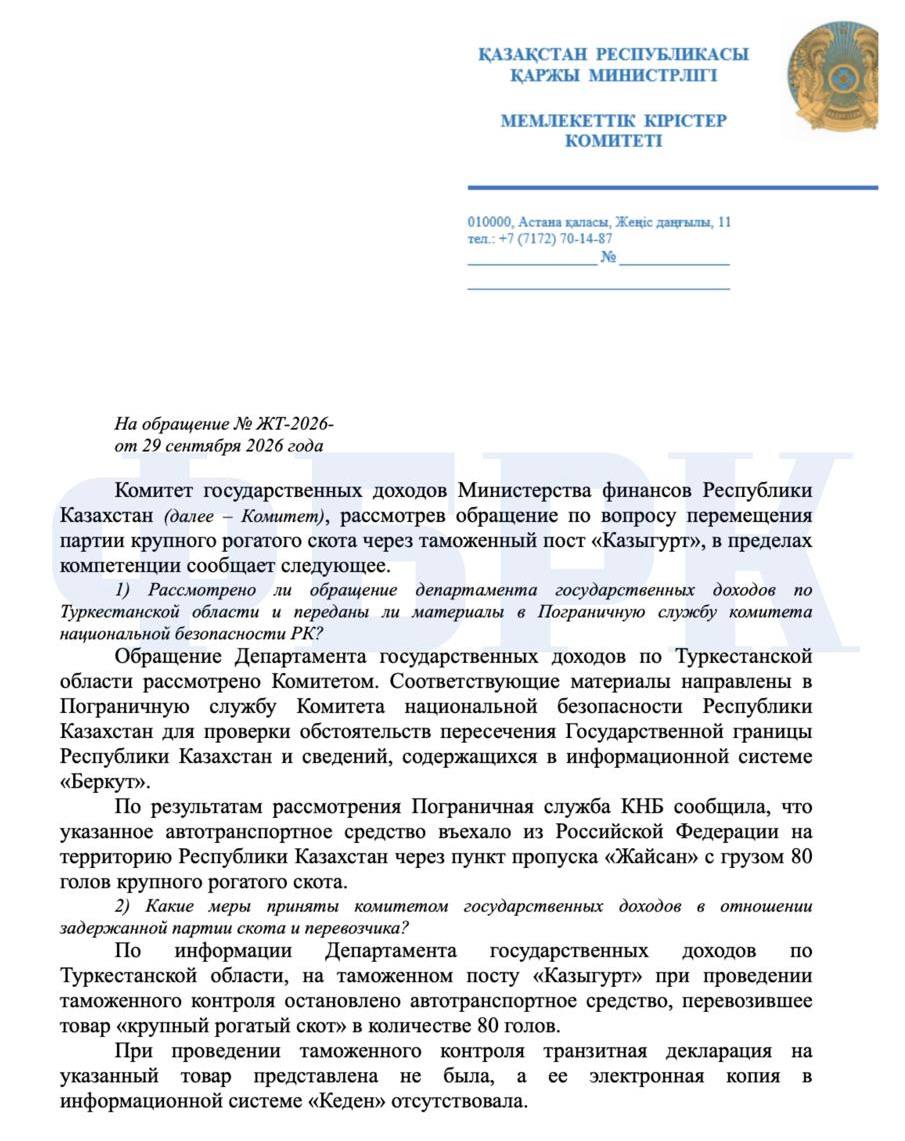
No electronic copy of the transit declaration was found in the Keden system either. At present it is being checked where the livestock came from and how it was brought in. One of the aims of the check is to rule out the export of livestock subject to a ban under the guise of livestock previously imported from Russia. Until the check is completed, the bulls are being kept at a private livestock base. The CSR promised to decide on measures regarding the goods and the carrier based on its outcome.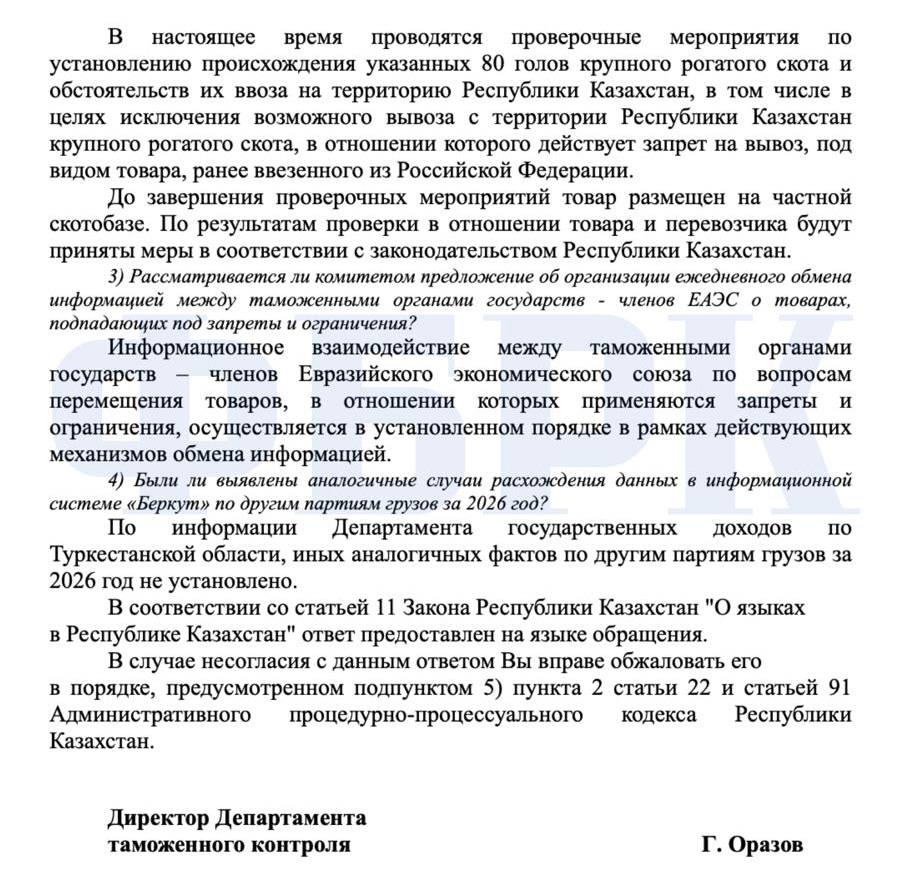
WHAT REMAINED OFF CAMERA
The CSR's reply leaves several questions unclear at once. The DSR's proposal for a daily exchange of information between the customs services of the countries of the Eurasian Economic Union (EAEU) was neither supported nor rejected by the committee. It merely said that the exchange of data on prohibited and restricted goods is proceeding "in the established manner" under the existing mechanisms, and did not specify whether it would be daily.
The statement about "similar cases" also requires a caveat. The CSR referred to the DSR's data for the Turkistan Region. No other consignments with discrepancies in Berkut for 2026 were identified there specifically.
WHAT FBRK SOURCES SAY
Meanwhile, FBRK sources point to another region. By their account, a similar problem exists in the Zhambyl Region too, where veterinary documents for the export of livestock, including small ruminants, can be purchased from vets without any difficulty. Russian certificates, they claim, are sold next to the Kordai checkpoint.
Moreover, the Kyrgyz veterinary service, according to FBRK sources, records every consignment passing through, while in Kazakhstan, according to their information, there is no such recording. Some of the livestock from Kyrgyzstan, they add, is supposedly sent on to Uzbekistan and Tajikistan.
If this information is correct, then in all likelihood the border counts livestock unevenly: on one side the consignment is recorded, on the other they trust the paper, potentially bought from a vet. Customs and border guards, it appears, cannot check this. The final word remains with the Ministry of Agriculture (MA), within whose remit veterinary control falls. The question for the agency is simple: who in Kazakhstan counts the livestock leaving the country, and does anyone count it at all?