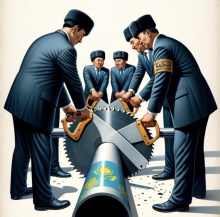
An online petition has appeared on the official petition platform epetition.kz entitled "For the growth of people's incomes! For the development of industry!". Based on the context of the statement, the petition's author is likely an employee of one of the enterprises in the Kazakh automotive industry, speaking out in opposition to the campaigners for the abolition of the recycling fee. However, the appearance of such a petition was quite expected.
For several years now, opponents of the recycling fee have been accusing the government of Kazakhstan of lobbying for the interests of domestic car manufacturers. Given that defending the interests of local producers is almost the duty of the government, it would be surprising if the Kazakh authorities gave the 'green light' to foreign goods. In this regard, accusations of 'lobbying' look more like speculation than protecting the interests of Kazakh industries.
According to data from the Kazakhstan Automobile Union, in January-February 2024, domestic enterprises produced more than 20,000 vehicles worth over 294.8 billion tenge, which is 16.4% higher than the production figures for January-February 2023. Behind these figures are tens of thousands of workers and domestic specialists with higher education, and behind them are their families.
The Kazakh automotive industry is only just beginning to develop, and in the long term, its growth requires significant investment and patience. For years, Kazakhstan has been called a raw materials country, and there is a chance to shed this label and move towards full-scale production, but this would mean blocking the 'grey schemes' of import prevalent in our country, the schemes for 'divvying up' state subsidies for agricultural machinery leasing, and other associated corrupt opportunities.
Cars imported into Kazakhstan from Georgia, the UAE, Armenia, and Russia often have a number of defects: they may be damaged, stolen, or have mismatched VIN codes. Such vehicles go unregistered for years, being resold through third parties.
Undoubtedly, the introduction of the recycling fee on cars in 2016 and on agricultural machinery in 2019 was implemented incorrectly, with significant errors and shortcomings. Today, the government has improved the mechanism, eliminated unnecessary processes, and reduced tariffs.
It is possible that over time the mechanism may change again. However, this is not a unique global practice, but a fairly common procedure implemented in many countries. The main task in introducing the recycling fee is to use it rationally and fairly.