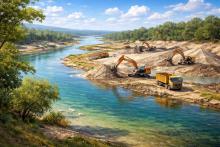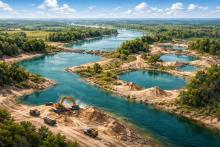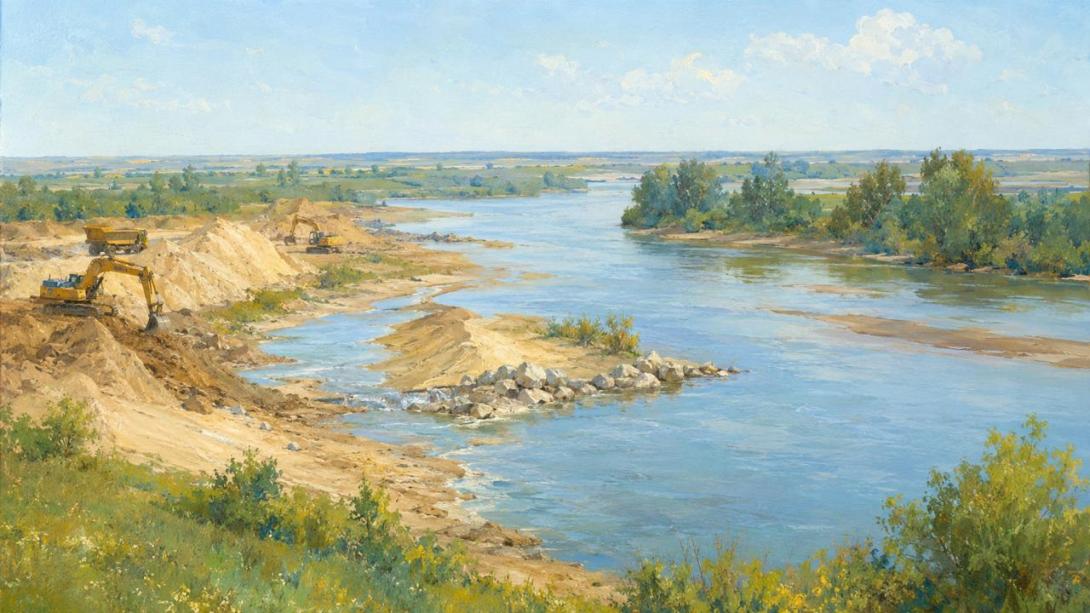
Ministry of Water Resources and Irrigation of the Republic of Kazakhstan has responded to an official request from the FBKK regarding the situation with quarries in the floodplain of the Ilek River in the Aktobe region. This is the first response from the relevant ministry that contains specific data on inspections, fines and legal grounds - after local executive bodies had previously essentially thrown up their hands.
WHAT HAPPENED
For several months now, the FBKK has been consistently monitoring the situation surrounding sand extraction in the Ilek floodplain. We have established that along the river from Aktobe to Martuk, at least 50 land allotments for sand extraction and sand and gravel mix have been identified, and the quarries of companies such as PGS Bestamak LLP and PGS-Karatogai LLP are located in the water protection zone of the river or directly in its riverbed.
By sending an official request to the regional akimat, the FBKK editorial team found out that the Department of Entrepreneurship and Industrial-Innovative Development and the Department of Natural Resources and Regulation of Nature Management of the Aktobe region simply passed responsibility back and forth to each other. As it turned out, neither authority commissioned a comprehensive assessment of the impact of the quarries on the hydrological regime of the river, and the question of carrying it out is only being considered by the regional akimat.
At the same time, we turned to the Ministry of Water Resources and Irrigation, since it is within its competence to regulate water protection zones and approve work on water bodies.
WHAT INSPECTIONS HAVE ALREADY BEEN CARRIED OUT AND WHAT FINES HAVE BEEN IMPOSED
Unlike the regional departments, the ministry provided specific results of inspections carried out by the Zhaiyk-Caspian Basin Inspectorate for the Protection and Regulation of Water Resources Use. 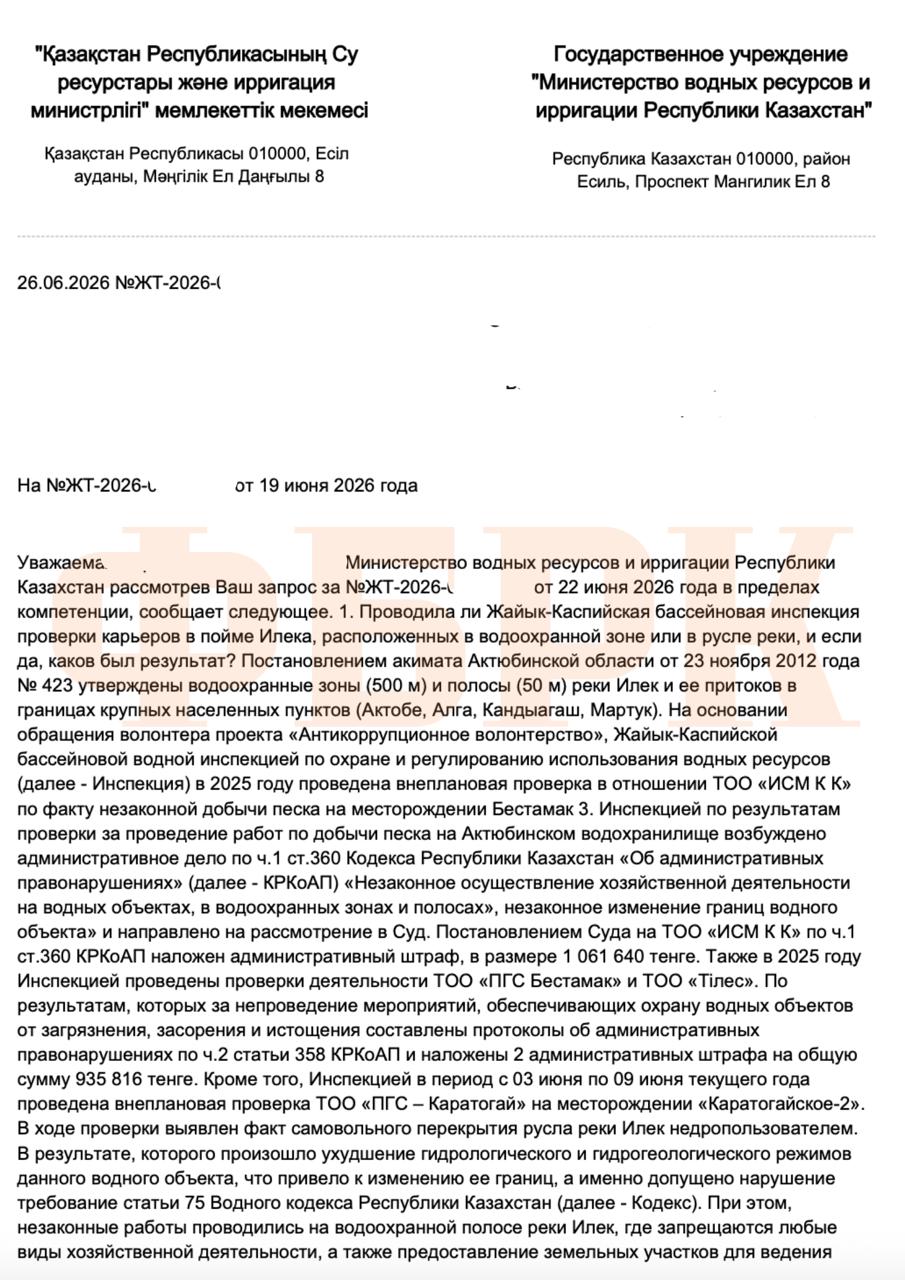
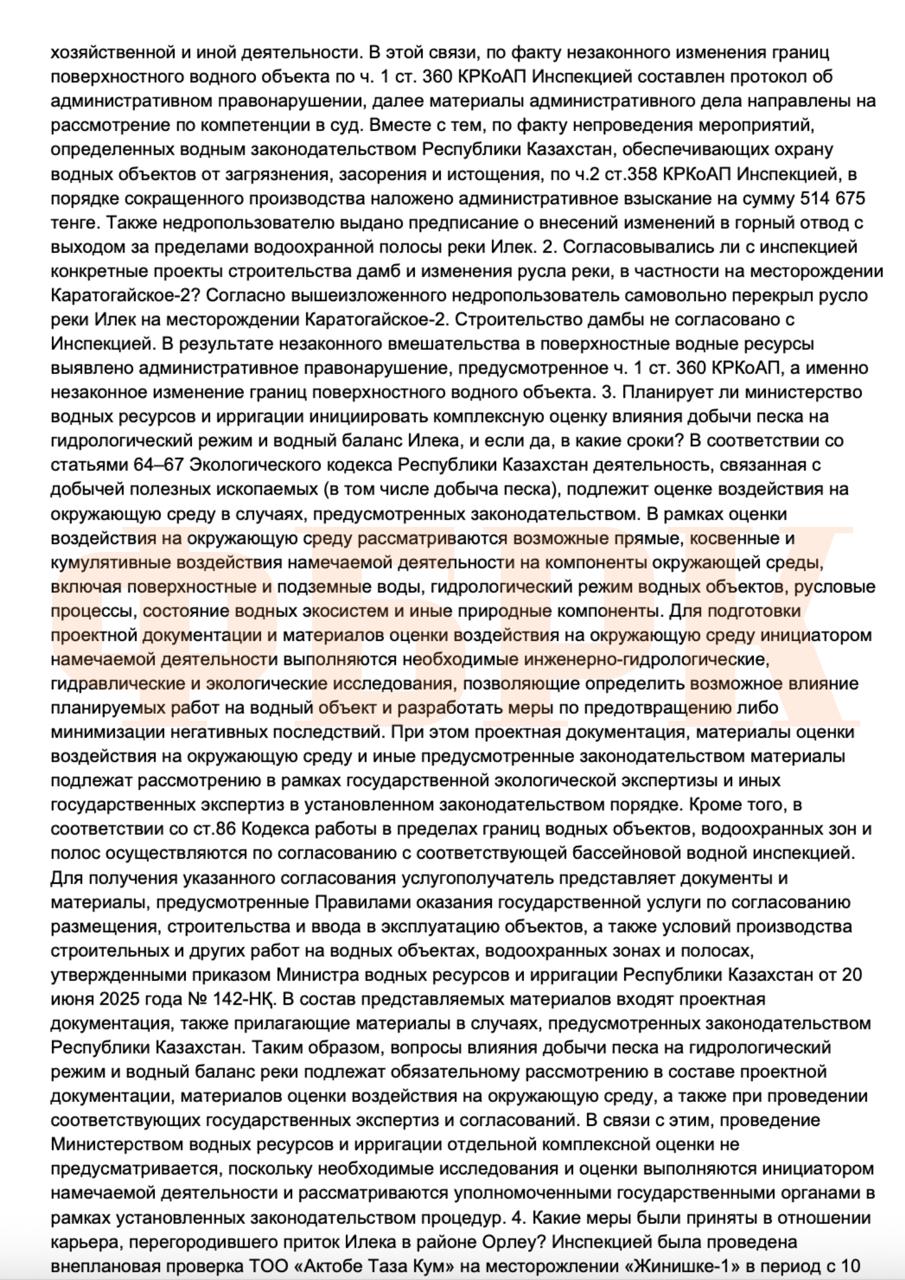
For example, following a complaint from a volunteer of the “Anti-Corruption Volunteering” project in 2025, the inspectorate conducted an unscheduled inspection of ISM K K LLP regarding the illegal sand extraction at the Bestamak 3 deposit. The court imposed an administrative fine on the company - over 1 million tenge under Part 1 of Article 360 of the Administrative Code of the Republic of Kazakhstan (“Illegal carrying out of economic activities on water bodies, in water protection zones and strips, illegal alteration of boundaries of a water body”).
In the same year, 2025, the inspectorate checked PGS Bestamak LLP and Tiles LLP - as a result, protocols were drawn up under Part 2 of Article 358 of the Administrative Code of the Republic of Kazakhstan for “failure to carry out measures to protect water bodies from pollution, clogging and depletion”, and two fines were imposed totalling approximately 936 thousand tenge.
A separate section of the ministry's response concerns the Karatogaiskoye-2 deposit, which is being developed by PGS – Karatogai LLP. The quarry of this particular company had previously been a source of discontent for local residents. There, a dam blocked the riverbed of the Ilek in several places at once.
The ministry confirmed that during an unscheduled inspection from 3 to 9 June 2026, the inspectorate established the fact of unauthorised blocking of the riverbed by the subsoil user, which led to a deterioration of the hydrological and hydrogeological regime of the water body. The work was indeed carried out in the water protection strip, where any type of economic activity is prohibited. For failing to carry out environmental protection measures, a penalty of 515 thousand tenge was imposed on the company. The subsoil user was also issued an order to amend the mining allotment, excluding the area extending beyond the water protection strip.
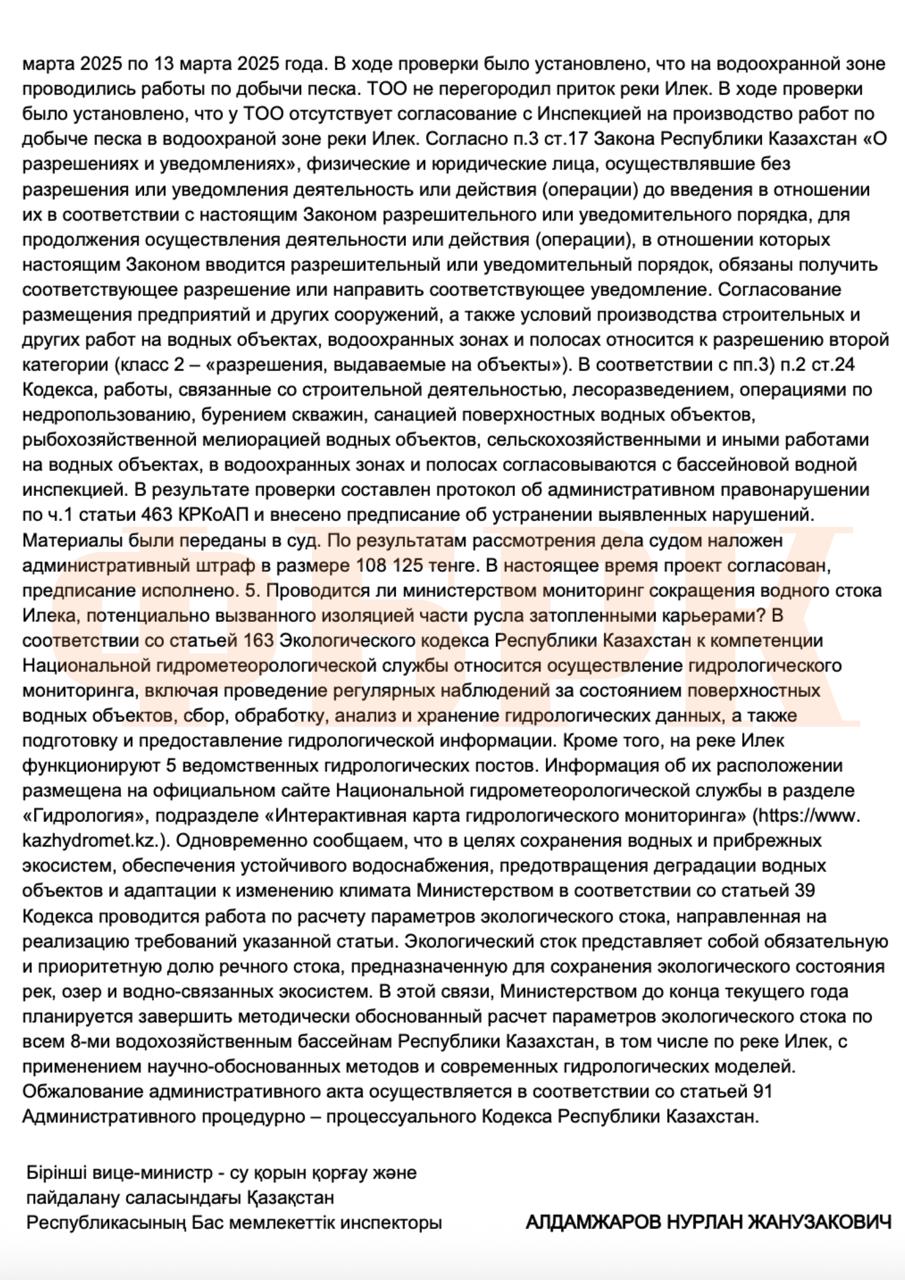
Regarding the quarry of Aktobe Taza-Kum LLP at the Zhinishke-1 deposit in the area of the Orleu residential district - the very one which, according to residents, caused spring flooding of houses - the ministry clarified an important detail that differed from initial reports. According to the results of an inspection from 10 to 13 March 2025, the inspectorate established that the company had not blocked the Ilek tributary, but had carried out sand extraction in the water protection zone without approval from the inspectorate. The court imposed a fine of 108 thousand tenge.
WHY THERE IS STILL NO COMPREHENSIVE ASSESSMENT
To the question about plans to initiate a separate comprehensive assessment of the impact of sand extraction on the hydrological regime and water balance of the Ilek, the ministry gave a detailed but essentially negative answer. According to Articles 64–67 of the Environmental Code of the Republic of Kazakhstan, an environmental impact assessment, including the impact on surface waters and channel processes, is carried out within the framework of the project documentation of each specific subsoil user, and not as a separate independent study of the river as a whole. These materials are then reviewed during the state environmental expert review. Furthermore, under Article 86 of the Water Code of the Republic of Kazakhstan, any work within the boundaries of water bodies and water protection zones requires approval from the basin inspectorate.
Thus, the ministry confirmed the position previously voiced by the regional departments. A separate comprehensive impact assessment is not envisaged, since, according to the ministry's logic, the necessary research is already built into the system of targeted approvals for each project. The question remains whether the sum of dozens of disparate project assessments can replace a single picture of the cumulative impact on the river.
Separately, the ministry reported that the hydrological monitoring of the Ilek is carried out by the National Hydrometeorological Service through 5 departmental posts on the river, and by the end of 2026, it is planned to complete the calculation of parameters for environmental flow (the mandatory portion of river flow intended for the preservation of river ecosystems) for all 8 water management basins of the country, including the Ilek.
Despite the fact that the ministry has for the first time officially confirmed the facts of violations, the conducting of inspections and the holding of individual subsoil users accountable, this does not remove the key questions about the systemic impact of large-scale sand extraction on the condition of the Ilek. A comprehensive assessment of the cumulative impact of dozens of quarries on the hydrological regime of the river is still absent, and until it is, the identified violations show that the requirements of water legislation are far from always being observed.
The FBKK will continue to monitor the development of the situation.