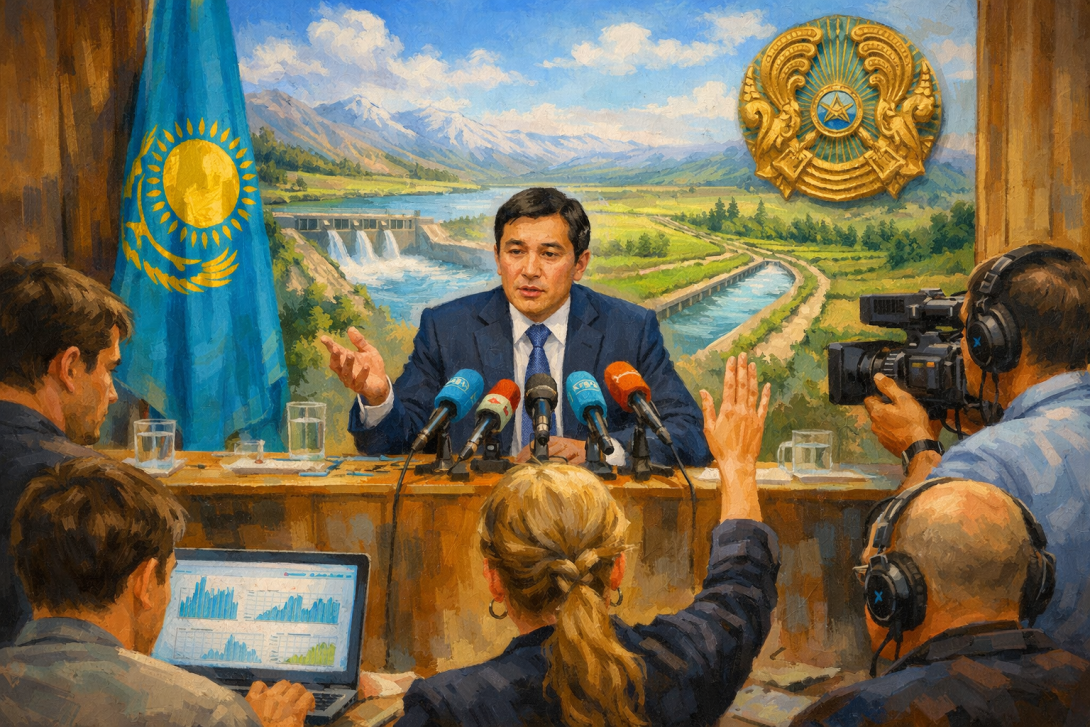
There are questions that are uncomfortable not because they are off-topic, but precisely because they cut to the very heart of the matter. On 10 April 2026, at a press conference held by the Central Communications Service (CCS) dedicated to the implementation of the Head of State’s tasks on fostering a culture of water conservation, the editorial team of FBRK had the opportunity to experience this first-hand.
WHAT HAPPENED
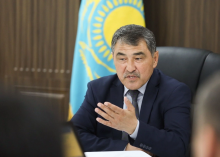
The speaker at the event was Vice-Minister of Water Resources and Irrigation of the Republic of Kazakhstan, Talgat Momyshev. The topic — “Implementation of the Head of State’s Tasks on Fostering a Culture of Water Conservation”, in other words, a culture of water consumption, careful stewardship of the resource, and cultivating responsibility.
The FBRK editorial team asked a question about what specific and measurable results had been achieved by the digital water resource management systems — Tasqyn and Talsim-NG, developed with the participation of the Ministry of Water Resources and Irrigation (MWRI), the Republican State Enterprise “Kazvodkhoz”, and its subordinate Information and Analysis Centre: how much more accurate had forecasts become, had losses been reduced, had an effectiveness assessment been carried out, and where could its results be reviewed.
However, the moderator stated that the question did not correspond to the topic of the press conference. And that was that.
WHY THE QUESTION WAS EXACTLY ON TOPIC
Allow us to explain the obvious — in case it truly isn’t obvious to the department.
When the state talks about a culture of water conservation, it is important to understand whose culture exactly is being discussed. Total water consumption for personal needs — showers, laundry, cooking, car washes, bathhouses and saunas — accounts for no more than 6% of the country’s overall water balance. The rest goes to industry, energy, and above all irrigation, which makes up more than 65% of all water consumption.
It is in this sector that the greatest losses are concentrated: outdated canal infrastructure, a lack of accurate metering, and uncontrolled water abstraction. Explaining to citizens how often to do their laundry and how to brush their teeth frugally against this backdrop is not resource management policy — it is a simulation of it.
Talsim-NG was created precisely to address the real problem. The system is capable of forecasting river flow in real time, modelling snow cover dynamics, managing reservoir operations, and providing early warning of flood and drought risks.
If Talsim-NG accurately models snowmelt, then it is possible to regulate discharges in advance and avoid flood losses. If Tasqyn provides digital metering of water abstraction, it creates a basis for fair distribution of limits and identifying systemic violations. This is the infrastructure of conservation. The question of whether these systems actually work in practice is precisely the question of real, not merely declarative, water conservation.
SILENCE AS A STANCE
Dismissing the question through the moderator looks like a technically flawless manoeuvre. But substantively, it conveys exactly what was probably not intended to be conveyed: the department is not prepared to publicly report on the results of its own digital policy. Whether this is deliberate or not is an open question. But both options are equally worrying: either Momyshev does not have the data on the work of his subordinate structures, or he does — and prefers not to disclose it.
The culture of water conservation, which Momyshev speaks so loudly about, is indeed important. But it begins not only with citizens. It begins with whether the state is capable of counting its own resources and whether it is willing to speak about it openly.
At present, the FBRK editorial team continues to await an official response from the department. However, it is hard not to admit: the Vice-Minister’s silence has already spoken far more loudly than any possible comment.