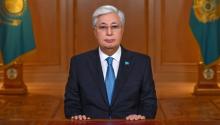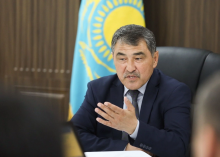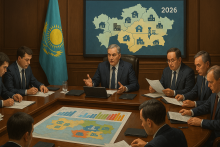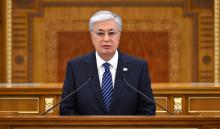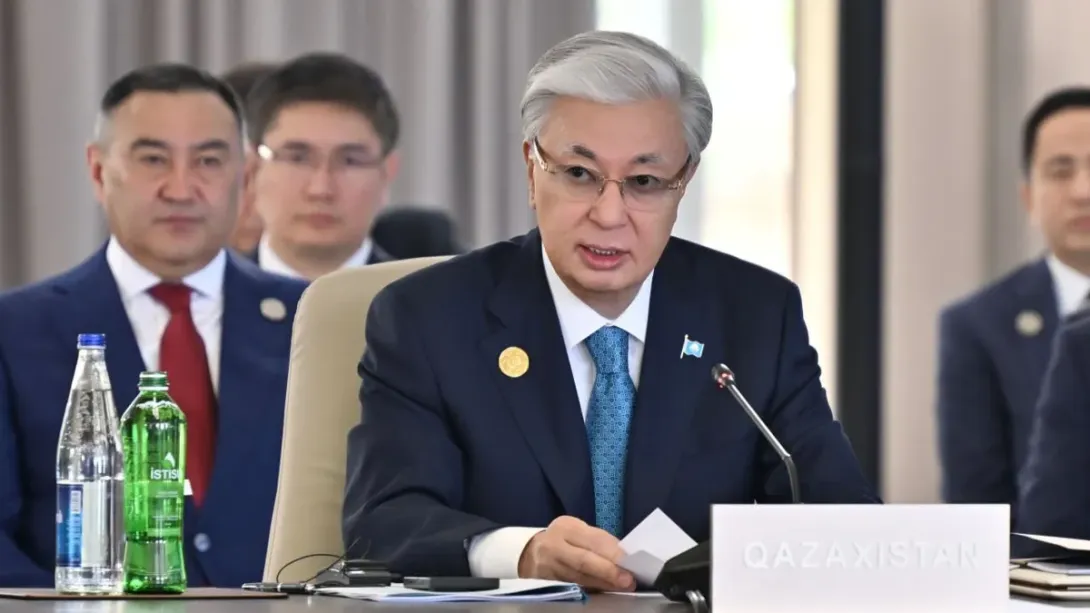
A month ago, in his annual address, President Kassym-Jomart Tokayev elaborated on issues concerning housing and communal services and the country's water security. The Head of State outlined the need for comprehensive reforms in these areas and instructed the creation of a single digital platform for water resources. Currently, the Ministry of Water Resources and Irrigation is working on implementing this task — the system's launch is scheduled for the end of 2026.
The President noted that over the decades, the housing and communal services system in Kazakhstan has accumulated serious structural problems. The wear and tear of networks has reached a level that threatens the reliability of heat, water, and energy supplies. The state must build a new management model that ensures transparency and improves service quality. The liberalisation of tariffs should be accompanied by increased efficiency of utility companies, so that every tenge invested in infrastructure delivers a tangible result.
Kassym-Jomart Tokayev emphasised the need to involve the private sector in modernising the utilities sector. Authorities should focus on regulation and control, while equipment upgrades and technology implementation should fall under the responsibility of businesses. This mechanism will accelerate modernisation without increasing the burden on the budget. The introduction of digital tools will ensure transparency in utility projects and allow citizens to see how funds are spent.
The Head of State also noted that energy efficiency should become a key principle of the entire utility system. He instructed the introduction of new environmental and sanitary standards aimed at the rational consumption of resources. Fostering a culture of careful use of water and energy, especially among young people, requires ongoing information efforts.
Regarding water security, over the past two years, Kazakhstan has created a legal and institutional framework for reforms in this area. However, according to the President's assessment, tangible results are still far from expectations. Water losses in canals in some places exceed half of the total volume, accounting is carried out using outdated methods, and data on reserves remain incomplete.
To change the situation, the Ministry of Water Resources and Irrigation is developing the National Water Resources Information System. The system will include data on surface and groundwater, hydraulic structures, and other water management facilities. In the future, it is planned to use artificial intelligence and space monitoring data, which will make it possible to determine the country's water balance, the real water needs of the economy and citizens, and to analyse and monitor the use of water resources.
The creation of a unified digital platform will eliminate data duplication through integration with state systems, increase transparency and efficiency of water use through more accurate forecasting and analysis, and also make it possible to combat water shortages and emergency situations more effectively.
The platform's development is funded by grant resources from the Eurasian Development Bank (EDB). The project's completion is scheduled for the end of 2026. It is noted that currently, the Information and Analytical Centre for Water Resources under the ministry is conducting training seminars on working with the system for specialists of basin inspections and the RSE "Kazvodkhoz". It is reported that after launch, every citizen will be able to access up-to-date information on the state of the country's water resources.
Kassym-Jomart Tokayev noted that the issues of preserving water reserves cannot be solved without international cooperation. He proposed creating a Centre for the Study of Water Problems within the framework of the Shanghai Cooperation Organisation (SCO) and developing an interstate programme for the conservation of the Caspian Sea.