A state body responsible for the information sphere has sent a letter to the Ministry of Foreign Affairs (MFA) of the Republic of Kazakhstan asking it to comply with the law when considering journalists' requests. The reason was three requests from FBRK about the fate of a lorry driver from Shchuchinsk, Ivan Chekulaev, who was convicted in Georgia. The MFA responded to them with general phrases, referred journalists to the convict's wife, and then demanded a power of attorney from him himself.
WHAT IS KNOWN ABOUT IVAN CHEKULAEV'S CASE
On 8 October, the Poti City Court sentenced the lorry driver from Shchuchinsk to 16 years in prison. At the customs office of the port of Poti, 56 tilidine tablets were seized from him. This is a strong painkiller which is dispensed by prescription in Germany, while in Georgia it is on the list of narcotic substances. Ivan was not charged with distribution. According to the family, the verdict was appealed on 30 October.
FBRK covered this story in more detail in a special episode on YouTube and in an article on the website.
WHAT THE EDITORIAL TEAM ASKED THE MFA
Since October, FBRK has sent three journalists' requests to the Ministry of Foreign Affairs. In the first, on 12 October, the editorial team asked about the ministry's position on the verdict and about the embassy's specific actions in Georgia.
The second, on 15 October, the editorial team sent on the advice of the embassy itself: the consulate in Tbilisi replied that it does not communicate with journalists and referred us to the MFA press service. In it, we asked whether Ivan had an interpreter and a defence lawyer at all hearings and whether the verdict had been served on him.
The third, on 2 November, concerned the appeal stage: when Ivan received the verdict translated into Russian, whether embassy staff visited him after 29 July and how they helped with the appeal.
HOW THE MFA RESPONDED
The first response consisted of general phrases: the case is under control, the embassy helped find a lawyer, "a visit took place", appealing the verdict falls within the defence's remit. There was not a single date in it.
The second response came with the reference details of the first. It did not answer the questions about the interpreter and the verdict, and ended with advice: "For additional information on the said case, we recommend that you contact I. Chekulaev's wife".
In the third request, the editorial team warned in advance that it did not consider such advice to be an answer. The MFA then refused with reference to the law on personal data and demanded a document confirming authority to represent Ivan Chekulaev's interests. At the same time, in the first response the ministry provided information about the visit and court hearings without any power of attorney at all.
The editorial team filed complaints about all three responses, and on 6 November it turned to the Ministry of Culture and Information (MCI), which is responsible for state policy in the field of information and access to it.
WHAT THE MINISTRY OF CULTURE AND INFORMATION RESPONDED
The MCI's response came on 13 November and was signed by First Vice-Minister Kanat Iskakov. The ministry reported that it had sent a letter to the MFA asking it "to ensure compliance with the requirements of the legislation of the Republic of Kazakhstan when considering journalists' requests".
In the letter, the MCI recalled two provisions. Under Article 36 of the Law "On Mass Media", a request from a media outlet must be answered within five working days. And subparagraph 6) of Article 9 of the Law "On Personal Data and Its Protection" permits the collection and processing of personal data without a person's consent in the lawful professional activity of a journalist. It was precisely this provision that the editorial team cited when disputing the matter with the MFA.
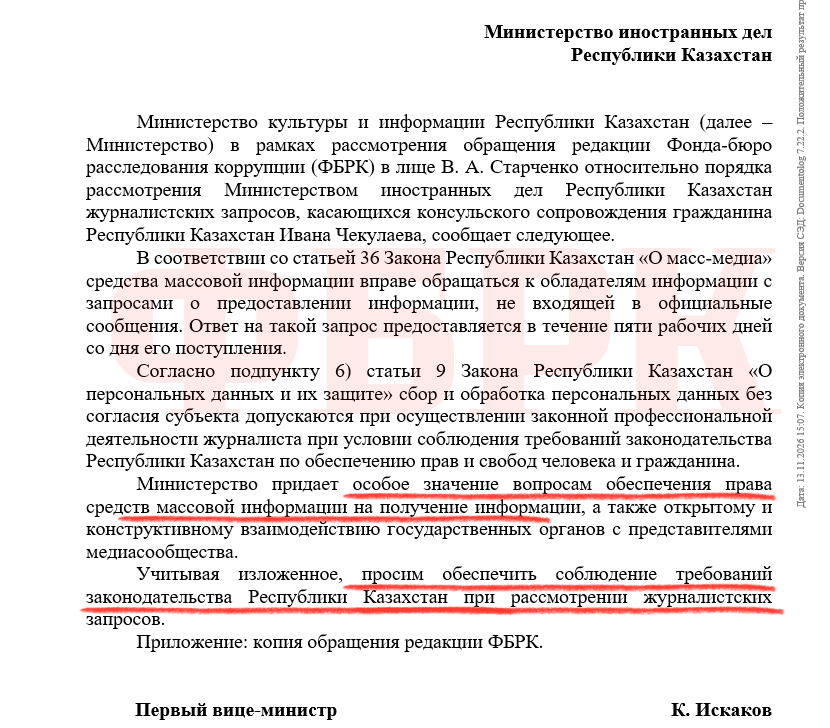
In its response to the editorial team, the MCI also clarified that it has no authority to check other central state bodies. It recalled that the law permits refusal to provide information with restricted access. But it was precisely to the MFA that it sent a reminder about journalists' right to information. The letter stressed that the ministry "attaches particular importance" to open and constructive interaction between state bodies and the media community.
WHAT NEXT
The editorial team is awaiting responses to its complaints to the MFA. Following the MCI's letter, we expect that the ministry will finally answer on the merits the questions about what the embassy did for the Kazakhstani in a Georgian prison. FBRK continues to monitor the situation.