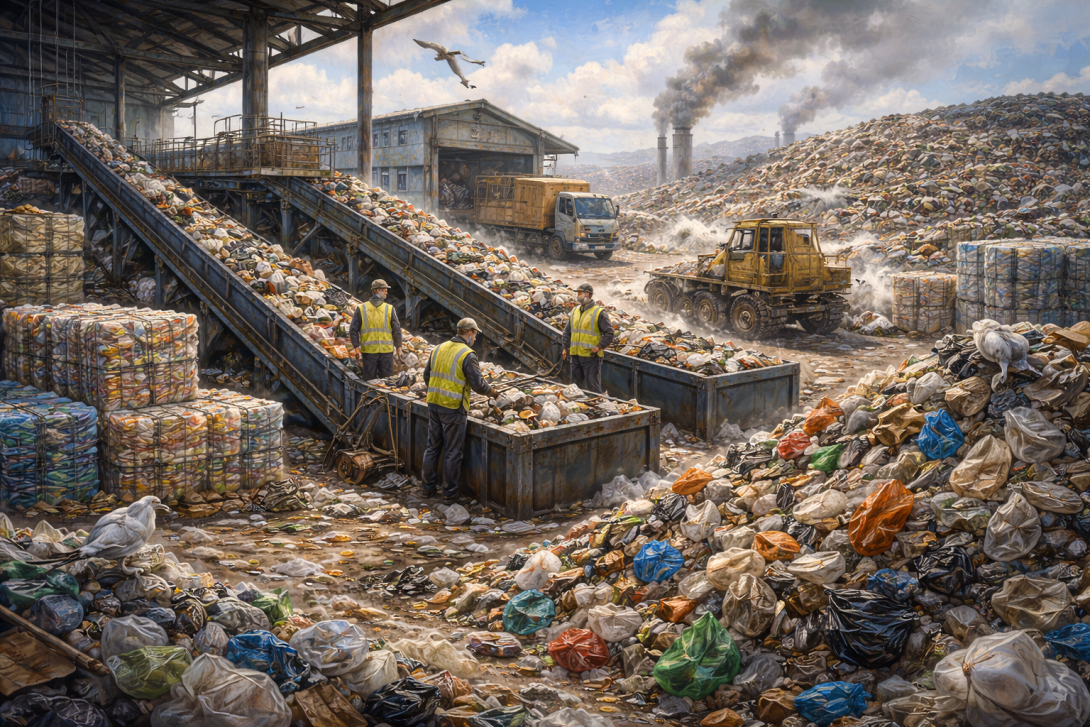
Despite an increase in official recycling figures for municipal solid waste (MSW), waste management in Kazakhstan continues to yield modest results. The majority of rubbish, even after sorting, is ultimately landfilled, and the volumes of secondary raw materials actually obtained remain minimal.
According to Energyprom.kz, the recycling and reuse rate is rising annually: in 2024 the figure stood at around 26%, and by December of the current year it had increased to 29%.
However, behind these rising figures lies a systemic problem. Existing waste collection, sorting, and recycling technologies yield only negligible volumes of secondary raw materials.
According to the Bureau of National Statistics, between 4.2 and 4.8 million tonnes of municipal solid waste are generated annually in Kazakhstan. Since 2022, this figure has been growing, reaching a peak in 2024 of 4.8 million tonnes.
Of this volume, around 1.3 million tonnes — just over a quarter of total MSW — were recycled or reused last year. The Ministry of Ecology and Natural Resources reportedly plans to increase this figure to 40% by 2040.
At the same time, more than 4.5 million tonnes of the total waste in 2024 was municipal waste. Only 1.3 million tonnes of that passed through sorting lines. The remainder was sent to MSW landfills. In percentage terms, the share of sorted waste stood at around 29%.
It is noted that even after sorting, a significant portion of the rubbish does not undergo further recycling. Of the 1.3 million tonnes of sorted municipal waste, 490,400 tonnes were landfilled, and 588,000 tonnes were sent for recycling.
Yet the actual volume of waste from which secondary raw materials were obtained amounted to just 49,000 tonnes. This is little more than 8% of the recycled volume and around 1% of all municipal waste generated in the country.
Thus, despite the growth in recycling figures reported, the real effectiveness of the MSW management system in terms of obtaining secondary raw materials remains extremely low.
As previously reported, President Kassym-Jomart Tokayev stated the need for the accelerated development of a modern waste recycling system and issued a number of specific instructions to the government in the field of ecology.
Meanwhile, Minister of Ecology and Natural Resources Yerlan Nysanbayev stated that 91% of unauthorised landfills had been eliminated and that waste recycling had increased to 28.6%. Plans are in place to build three waste incineration plants in Astana, Almaty, and Shymkent at a cost of 293 billion tenge.