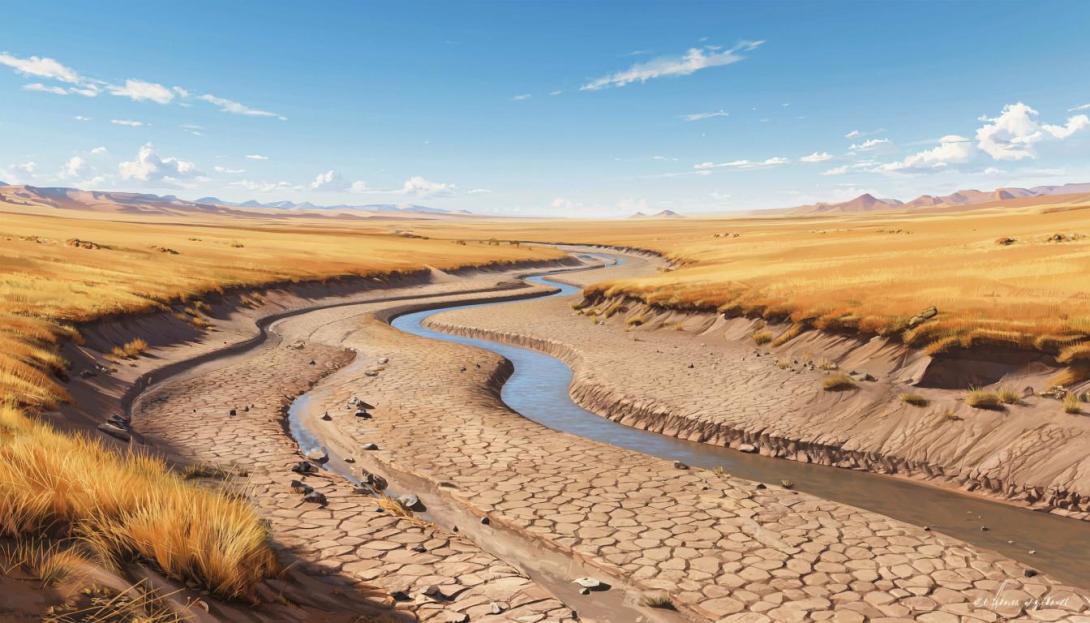
The editorial board of FBRK has received a long-awaited response from the Zhaiyk-Caspian Basin Inspectorate regarding the situation with the Bukharka channel in the Atyrau region. The document proved to be quite telling – not so much for its content as for the fact that no one can (or will not) take responsibility for the disappearance of this three-hundred-year-old waterway.
The inspectorate's response states that on 30 May 2025, during a site visit, the fact of construction of a building in the riverbed of the channel was indeed recorded. However, from there begins a curious tale of searching for the responsible party. It turns out that during the inspection, "the owner was not on site", so the inspectorate sent a letter to the local executive body requesting information about the owner. Only after receiving this data does it plan to conduct an unscheduled inspection.
But the most interesting detail lies in the administrative arithmetic revealed by the inspectorate. Of the more than a dozen channels in the Ural River delta – Bagyrlay, Kuraily Sai, Aksai, Sboryny, Narynka, Peretaska, and others – almost all are on the balance sheets of the specialised enterprises 'Tabigat' and 'Kazvodkhoz'. Only three channels remain ownerless: Bukharka, Zolotenok, and Zarosly. An astonishing coincidence – it is precisely with the 'no-man's-land' Bukharka that this entire story has unfolded.
The water inspectorate openly admits that the channel has not functioned for 40 to 50 years due to silting. Restoration requires a whole range of costly measures: channel rehabilitation, dredging, construction of water-regulating structures, and installation of pumps. And most interestingly, according to the Water Code, the organisation of all these works falls to the local executive bodies. The very same bodies that, twelve years ago, issued permission for construction in the riverbed of the dried-up channel.
The result is a paradoxical administrative structure: city authorities issue construction permits in places where nature created waterways, while formally adhering to all procedures. The water inspectorate records violations but finds itself unable to stop them promptly due to bureaucratic red tape.
The situation is made particularly interesting by the fact that water protection zones and strips on the Bukharka were never established. It is hard to imagine a more telling indication of how water resources are 'cared for' in the region.
The inspectorate tries to soften the overall picture by mentioning that the Peretaska channel flows nearby, from which the Atyrau Thermal Power Plant provides water to the population for agricultural needs. However, the residents of the 'Spektr' gardening society, left without water due to the disappearance of the Bukharka, would surely view this 'care' more sceptically.
Now we must wait for the results of the promised unscheduled inspection. Although, given that construction has been ongoing for several years and "the owner could not be found", there is little reason to hold out much hope for the promptness of water oversight.
The case of the Bukharka channel highlights fundamental flaws in Kazakhstan's water resource management system. We are witnessing a classic example of administrative irresponsibility, where all agencies are fully aware of the problem but each considers it outside its remit.
The chronology of the inter-agency correspondence itself is telling: the city authorities refer the matter to the water agencies, 'Kazvodkhoz' declares the issue outside its jurisdiction, the rural district directly disclaims competence, and the Zhaiyk-Caspian Inspectorate, having finally received the request, acknowledges the problem but seeks the 'owner' of the facility, for which the documents were issued twelve years ago. This closed circle of bureaucratic brush-offs creates a legal vacuum in which entire waterways disappear.
In the context of climate change and growing water scarcity, the state displays astonishing negligence towards existing water arteries. A channel that for three centuries served as a natural flood regulator and a source of water for the population has been sacrificed to dubious commercial gain precisely because, formally, no one is responsible for it.
Particularly alarming is the fact that the Bukharka is not the only 'ownerless' channel. Zolotenok and Zarosly are in a similar legal vacuum, creating the preconditions for such situations to recur. While agencies continue their game of 'hot potato', shifting responsibility onto one another, commercial interests prevail over environmental and social needs.
The Bukharka case also exposes a deeper problem – the absence of a single coordinating body in the sphere of water use. Each agency operates within the limits of its narrow authority, but no one takes responsibility for the integrity of the region's water system. As a result, strategically important decisions are made on a residual basis or not at all.
The forecasts are bleak: if the current practice of passing the buck continues, within a decade the Ural River delta could lose a significant portion of its natural channels, which will inevitably affect the region's ability to manage floods, supply water to the population, and preserve the unique ecosystem of the Caspian basin.
The paradox of the situation is that all participants in the process – from the city authorities to the water inspectorate – acknowledge the importance of the problem, yet each seems to be waiting for someone else to solve it. In this atmosphere of collective irresponsibility, it is ordinary citizens, who have lost access to water, who suffer first and foremost.
The editorial board of FBRK will continue to follow developments.