(5 March 2026 | Source: draft of the new Constitution of the Republic of Kazakhstan)
Against the backdrop of escalating geopolitical tensions, the issue of protecting political sovereignty is taking centre stage. In the draft of the new Constitution of Kazakhstan, the key mechanisms for this protection are enshrined in Article 6.
The provision establishes direct restrictions on foreign influence in the party system and introduces transparency requirements for organisations receiving foreign funding. Discussion of these provisions is taking place ahead of the referendum on 15 March 2026.
WHAT RESTRICTIONS DOES ARTICLE 6 INTRODUCE?
The draft Constitution enshrines the principle of ideological and political diversity. At the same time, it establishes rules defining the boundaries of public associations' participation in the political system.
Specifically, Article 6 prohibits:
- the activity of political parties and trade unions of other states on the territory of Kazakhstan;
- the creation of political parties on a religious basis;
- the financing of political parties and trade unions by foreign states, international organisations, foreign companies, foreign citizens, and legal entities with foreign participation.
Thus, Article 6 enshrines the principle of forming the party system exclusively within the framework of national legislation.
TRANSPARENCY OF FOREIGN FUNDING FOR NGOS
A separate provision of the article concerns non-governmental organisations (NGOs).
The draft Constitution does not prohibit their activity when receiving funds from abroad, but it introduces a mandatory requirement:
information on the movement of funds and assets received from foreign states and organisations must be open and accessible in accordance with the legislation of Kazakhstan.
In effect, this refers to a mechanism of public transparency, which is intended to ensure societal access to information about such financial flows.
POLITICAL CONTEXT OF THE DISCUSSION
The issue of foreign funding of public organisations in Kazakhstan has been raised for some time.
At the end of 2025, the head of the People's Party of Kazakhstan (PPK) faction, Magerram Magerramov, sent a parliamentary inquiry to the Minister of Culture and Information, Aida Balayeva, demanding disclosure of the sources and volumes of foreign funds received by public organisations and media.
According to the State Revenue Committee (SRC), in the first half of 2025, 186 individuals and legal entities received foreign funding. At the same time, information on specific amounts, donors, and the purposes of the funds is not publicly available.
THE PROBLEM OF SECONDARY GRANTS
The parliamentary inquiry also describes the mechanism of so-called secondary grants.
According to Magerramov, funds first arrive at branches of foreign organisations and are then redistributed among various recipients within the country. At the level of the end beneficiaries, the origin of the money can disappear from the sphere of public oversight.
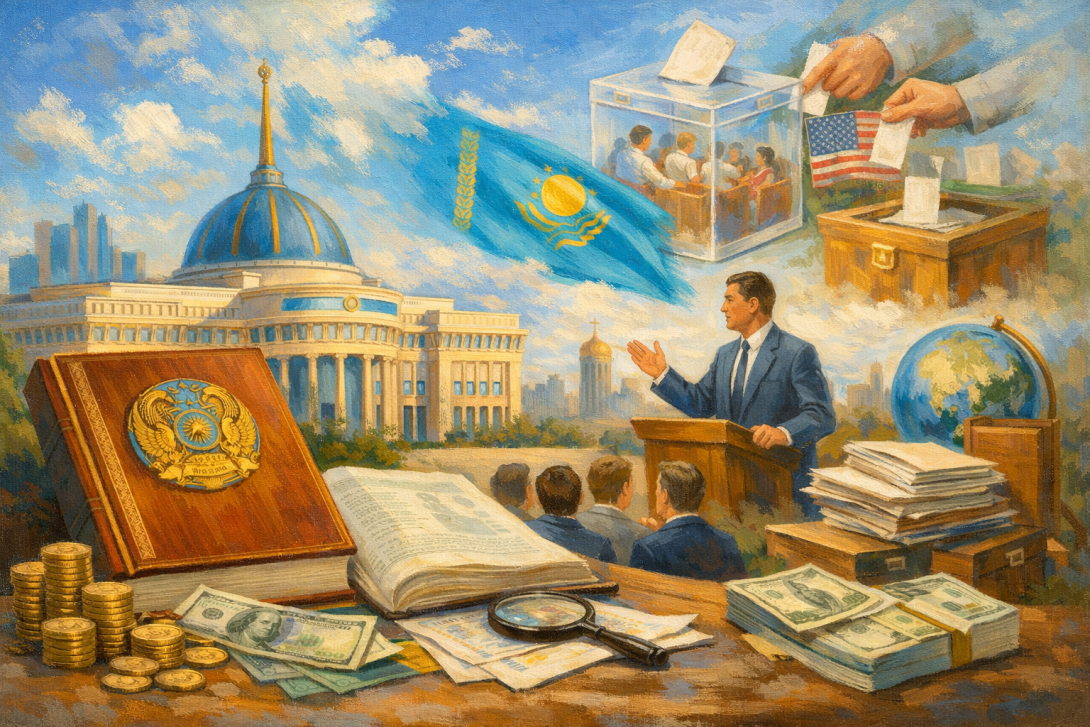
According to estimates from a number of media outlets, the total volume of foreign receipts into Kazakhstan's public and media sphere could reach around $60 million per year. It is also noted separately that the United States Agency for International Development (USAID) has directed more than $150 million in grants to Kazakhstan over the last ten years.
WHY ARTICLE 6 HAS BECOME A KEY PROVISION
Against the backdrop of these discussions, the provisions of Article 6 form the legal framework for regulating foreign participation in the country's public and political life.
The provision simultaneously enshrines three principles:
- political pluralism and equality of public associations before the law;
- a ban on external interference in the party system;
- mandatory transparency of foreign funding for the non-profit sector.
The decision on adopting the new Constitution is to be made by the citizens of Kazakhstan at the referendum on 15 March 2026. Work on the draft of the fundamental law lasted about six months, after which the document was published on the official website of the Constitutional Court.