
Following a complaint from the editorial team of FBRK, the Committee on Legal Statistics and Special Records of the General Prosecutor's Office of the Republic of Kazakhstan reconsidered its position and provided additional statistical data. However, key information on the outcomes of deferring the execution of a sentence is still lacking.
WHAT HAS CHANGED AFTER THE COMPLAINT
The FBRK editorial team had previously received contradictory responses from the Committee on Legal Statistics of the General Prosecutor's Office and the Committee of the Criminal Executive System (CCES) of the Ministry of Internal Affairs of the Republic of Kazakhstan, which effectively passed the editorial team back and forth, without providing information on how many convicted individuals are ultimately sent to serve their sentences after a deferral.
Consequently, we submitted complaints to both committees regarding the contradictory responses. Additionally, the FBRK editorial team further contacted the General Prosecutor's Office requesting a legal assessment of the actions of both bodies and clarification on which authority is obliged to maintain and provide the requested information.
After the complaint was filed, the Committee on Legal Statistics and Special Records sent us a preliminary decision, along with statistical tables in Excel format.
The department provided data on the number of convicted individuals who were granted a deferral of the execution of their sentence, broken down by articles of the Criminal Code of the Republic of Kazakhstan, as well as information on the courts' consideration of materials concerning the deferral of sentence execution and its revocation.
WHAT DATA IS STILL NOT BEING COLLECTED
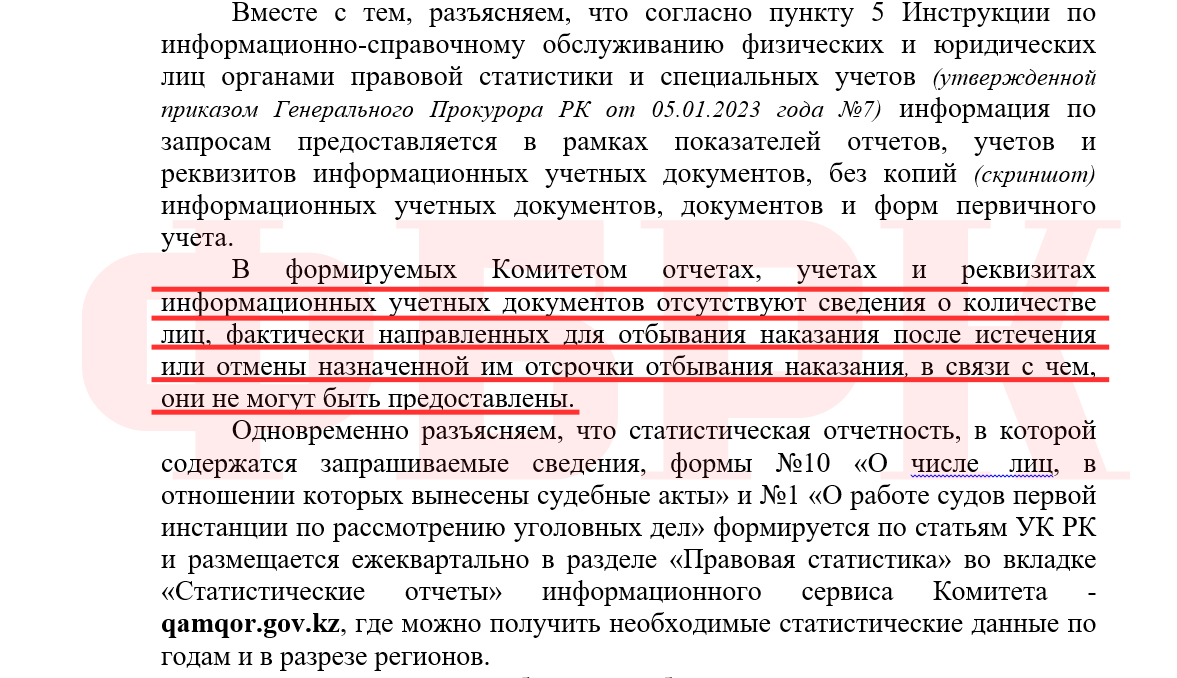
At the same time, the committee confirmed that it does not have information on how many individuals, after being granted a deferral, were ultimately sent to serve their sentences.
As per the response, such data is not generated in statistical reports and, consequently, cannot be provided.
THE EDITORIAL TEAM SUBMITTED OBJECTIONS TO THE DECISION
Despite the provision of partial information, the situation regarding the distribution of powers between the authorities remains unresolved. In the new response, the Committee on Legal Statistics did not clarify how such data is recorded and which body is responsible for generating it.
The FBRK editorial team submitted objections to the preliminary decision, stating that:
- the lack of data generation does not ensure access to information relevant to the substance of the request;
- the mechanism for recording individuals after the revocation or expiry of a deferral has not been explained;
- the contradiction between the positions of the state bodies has not been resolved.
We also requested that they either provide the available data, or explain how access to this data can be ensured.
CONTEXT AND SIGNIFICANCE
The situation shows that, despite the existence of general statistics on court decisions, state authorities do not keep records of the actual outcomes of deferring the execution of a sentence.
In particular, the available materials contain no data on how many convicted individuals are ultimately sent to serve their sentences after a deferral. This makes it impossible to objectively assess how this mechanism is applied in practice.
The committee's response also does not specify how the effectiveness of deferring the execution of a sentence is analysed in such circumstances.