
A large-scale scheme to inflate social maternity payments has gained new momentum in Kazakhstan, despite the measures being taken.
In 2024, over 950 billion tenge was paid out from the State Social Insurance Fund, while the volume of payments significantly exceeded the inflow of insurance contributions. The state suffered losses of 158 million tenge from identified cases of fraud alone, and criminal cases have been opened against 113 recipients of illegal benefits.
According to the Minister of Labour and Social Protection of the Population, Svetlana Zhakupova, in February 2025, criminal cases were opened against 113 recipients of social benefits. The total damage from these fraudulent schemes amounted to 158 million tenge.
The scheme actively used by fraudsters is not new. As early as 2013, identified cases of fraud led to changes in the procedure for determining the amount of benefits and increased control over social contributions. However, in recent years, the problem has taken on a new scale.
THE FRAUD SCHEME
A pregnant woman simultaneously takes a job at several organisations or registers as an employee with several individual entrepreneurs. At the same time, a fictitious high salary of around 400-500 thousand tenge per month is arranged for her. Employers make social contributions for a short period or as a one-off payment, creating the appearance of official income.
After this, the woman takes maternity leave, and the state system calculates the benefit based on her 'official' income, without verifying its authenticity. As a result, the payout significantly exceeds the actual contributions made to the social insurance system.
ILLUSTRATIVE EXAMPLES:
'Participant A' received an 'official' income of 14.97 million tenge over 10 months, which led to a benefit payout of 5.2 million tenge. 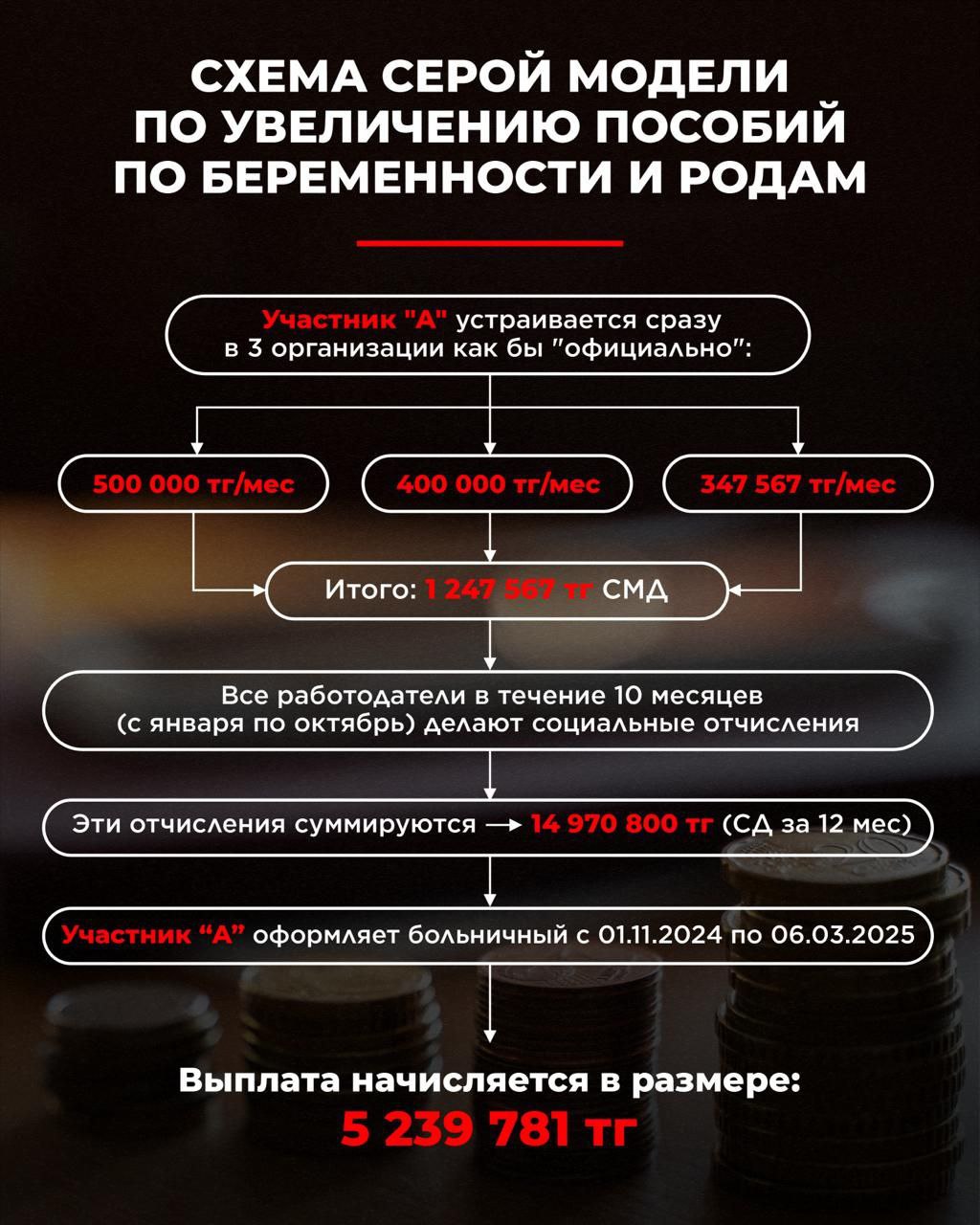
'Participant B' received a fictitious income of 21.77 million tenge over several months of 'work', on the basis of which he was awarded a benefit of 7.6 million tenge. 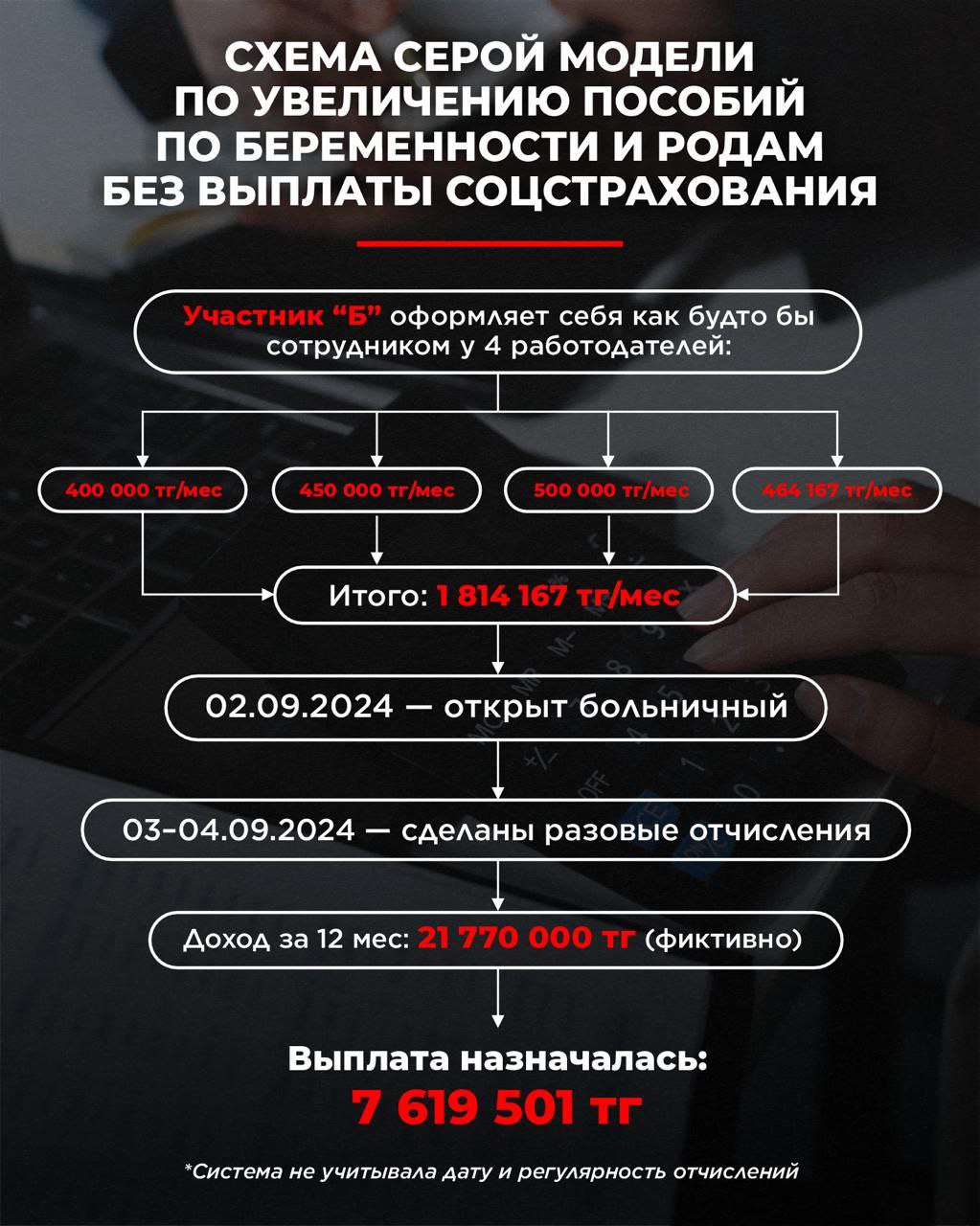
In October 2024, particularly flagrant cases were recorded in Shymkent, where pregnant women were registered with up to 20 individual entrepreneurs in different cities of Kazakhstan, employing them 'retroactively' to obtain maximum payouts.
GEOGRAPHY OF ABUSE
The Minister of Labour and Social Protection, Svetlana Zhakupova, noted that the biggest gap between payouts and insurance contribution receipts is observed in the Turkestan Region, where payouts exceeded contributions by 3.6 times. Significant excesses were also recorded in the Zhambyl Region (2.7 times), in Shymkent, the Kyzylorda and Almaty Regions (2.5 times), as well as in the Mangystau Region and the Abai Region (more than 2 times).
SYSTEMIC VULNERABILITY AND COUNTERMEASURES
The main vulnerability of the system is the lack of a maximum cap on maternity benefit payments and a lack of control over the date and regularity of contributions. Since September 2024, around one and a half thousand people have voluntarily admitted to inflating their income, which allowed the fund to preserve assets worth 3.4 billion tenge.
In 2023-2024, Kazakhstan began tightening control over such schemes. Mechanisms for analysing the continuity of employment and the regularity of social contributions are being introduced. The introduction of restrictions on sharp income increases just before maternity leave is being considered.
The State Social Insurance Fund pays social benefits to working citizens of Kazakhstan in cases of loss of ability to work, loss of job, loss of a breadwinner, as well as during pregnancy and after childbirth. The fund is replenished through mandatory contributions from employers and self-employed citizens. In 2024, the State Fund's support covered almost one and a half million Kazakhstani citizens.
The situation demonstrates a problem common to many countries: balancing support for expectant mothers with the prevention of abuse of the social security system. Kazakh authorities are striving to ensure the fair distribution of social benefits, while simultaneously closing loopholes for dishonest citizens.