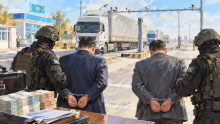
In the Mangystau region, an employee of the transport prosecutor's office was sentenced; he had been detained on 9 November on suspicion of attempting to bribe, promising to influence the imposition of a suspended sentence in a criminal case.
According to the Telegram channel «HALYQSTAN», the man demanded 2.5 million tenge, assuring the victim that he had the means to "sort out the matter." The arrest was carried out by officers of the Internal Security Department of the General Prosecutor's Office together with the National Security Committee department.
Not only the prosecutor's office employee was involved in the case: the investigation revealed that another man, who carried out instructions as part of the scheme, also took part in the negotiations. He later appeared in court as well.
During the proceedings, both pleaded guilty. The second defendant was released from criminal liability due to reconciliation with the victim.
The main defendant was found guilty under Article 24 of the Criminal Code of the Republic of Kazakhstan ("Attempt to commit a crime") and Article 190 of the Criminal Code of the Republic of Kazakhstan ("Fraud") and was sentenced to 2 years and 7 months in prison. He was also permanently banned from working in government bodies.
It will be recalled that earlier the FBRK published a series of articles on corruption in the transport sector: about bribery schemes in capital and regional transport inspection structures. Following the publications, the editorial board faced an organised campaign of pressure — mass, identical comments in defence of the defendants and attempts to discredit the complainants.
Also in Kostanay, former prosecutor of Arkalyk and Rudny, Murat Uspanov, was sentenced. He was found guilty of attempting to bribe.
Initially, Uspanov was charged with attempting to bribe on a large scale. However, of the 20.1 million tenge seized from him upon arrest, 8.1 million tenge turned out to be counterfeit banknotes, which led to the charge being reduced to a lesser one — "attempt to bribe."