
Ecologist and ornithologist Ruslan Urazaliev has reported that from 14 to 18 July 2025, public discussions on amendments to the master plan for the development of Astana up to 2035 are scheduled to take place in the building of the Astana General Plan Research and Design Institute. As Urazaliev emphasises, this discussion directly concerns the future of the Maly Taldykol lake group.
"It can be said that during this week, to some extent, the fate of the Maly Taldykol lake group will be decided. The fact is that in the current version of the master plan, the lake territory is designated for development. However, the real fact of the existence of these lakes on this territory is being ignored. And we are fighting to ensure the lakes are returned to the capital's master plan, as was the case in its previous versions," — writes the ecologist on his Facebook page.
The author's spelling and punctuation have been preserved — ed. note FBRK
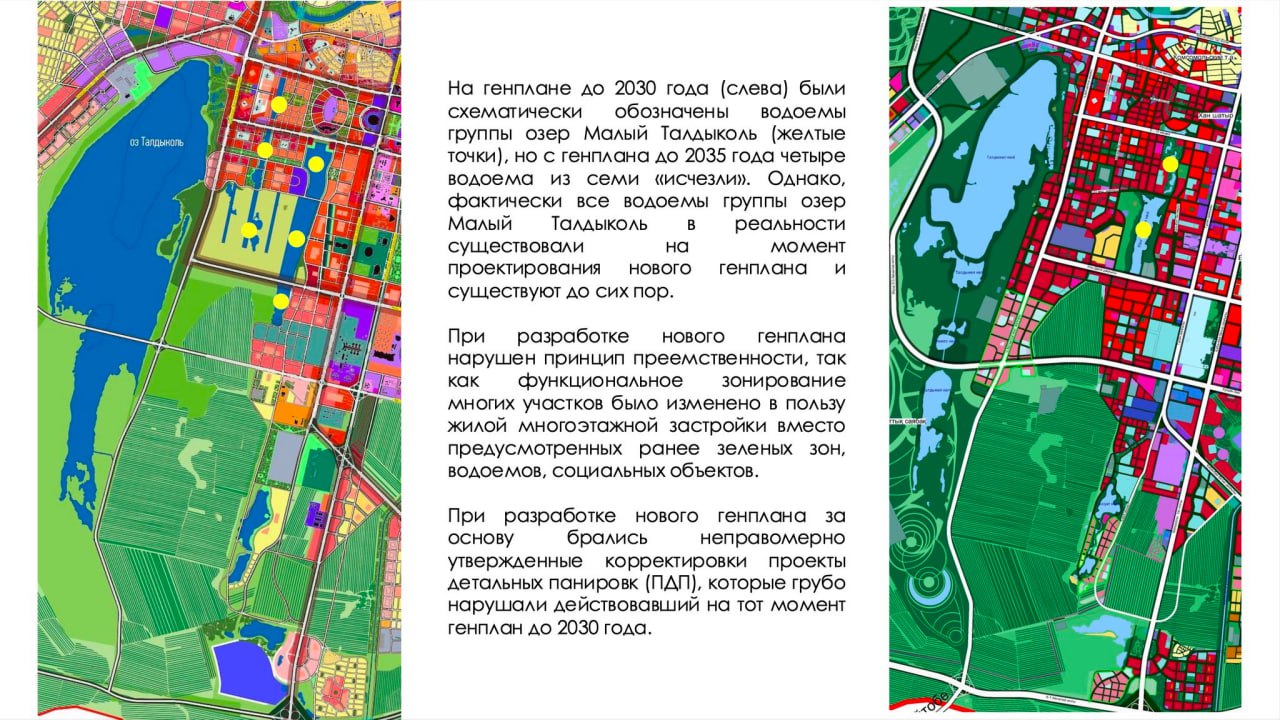
According to Urazaliev, the Maly Taldykol lakes were marked on the master plan that was in effect until 2030, and the surrounding areas were designated as recreational zones. However, in December 2020, a meeting of the capital's Land Commission decided to reclassify the lands of the lake group from the water fund category to settlement lands.
The ecologist believes that this step was a legal instrument used by the akimat, headed by the former mayor Altay Kulginov, to attempt to formally bypass legislative restrictions and prepare the site for development. However, according to Urazaliev, transferring the lakes from one land category to another did not deprive them of their status as water bodies.
"Thus, according to Article 107 of the Land Code of the Republic of Kazakhstan, the settlement land category is divided into four functional zones: residential, social, commercial, and other. The other zone includes lands of 'reservoirs and water areas, occupied by rivers, natural and artificial reservoirs and water areas, water protection zones, hydraulic engineering and other water management facilities.' That is, even within the settlement land category, water bodies do not lose their essence and remain water bodies," insists Urazaliev.
He emphasises that from 2021 onwards, a wave of amendments to detailed planning projects (DPPs) began, contradicting the current master plan. These DPPs provided for multi-storey development on the site of actual lakes, ignoring the ecological and legal justification for their preservation.
Urazaliev claims that this violates paragraph 1 of Article 47-1 of the Law of the Republic of Kazakhstan "On Architectural, Urban Planning and Construction Activities", which prohibits the approval of DPPs that do not conform to the approved master plan.
According to the ecologist, the main public discussions on the new master plan took place in August 2023, but even in this version, the physical existence of five of the seven lakes is completely ignored. Only two water bodies (lakes No. 5 and No. 7) remained on the map; the rest were replaced by multi-storey development.
"I did not use the verb 'drawn' by chance. In my opinion, the new master plan was not designed as it should be according to science and the law, but was, for the most part, simply drawn," notes the ecologist.
As Ruslan Urazaliev reports, in November 2023 he had a personal meeting with the mayor of the capital, Zhenis Kassymbek, at which the return of Lake No. 9 to the map was discussed. The mayor then gave an instruction to include it in the new master plan, and in December of the same year, the lake indeed appeared in the project documentation on the Open NPA website.
However, the ecologist emphasises that in the version of the master plan approved by the government in January 2024, Lake No. 9 had disappeared again.
"The fact that the new master plan passed all approvals and received positive conclusions is outrageous. I conclude that the specialists of the authorised bodies did not even read the explanatory note to this project, nor did they familiarise themselves with the attached drawings. And they should have looked at them carefully," he noted.
Furthermore, Urazaliev draws attention to the internal materials of Astana General Plan itself, attached to the project. In particular, on the drawings:
- GP-4 "Comprehensive Urban Planning Assessment of the Territory" — the lake area is marked as "unfavourable for construction" (purple zone).
- GP-11 "Natural-Ecological Framework" — the same territory is identified as a zone of seasonal flooding during high floods.
"Even the internal analysis and assessment of the territory, carried out by Astana General Plan, indicate that construction on the lake territory is unfavourable! How could such facts be ignored?" the ecologist asks.
He also refers to recommendations from the Administration of the President of the Republic of Kazakhstan, which were attached to the master plan project and contained a direct instruction to preserve the water area.
"Proof of this was a letter attached to the master plan project. The Presidential Administration recommended leaving the lake territory. But we see that this recommendation was ultimately ignored as well," writes Urazaliev.
The ecologist emphasises that the current discussions on amendments to the master plan are the last chance to return the lakes to the legal and urban planning framework.
"This publication is also motivated by the announced public discussions on amendments to the new master plan, which will take place from 14 to 18 July 2025 in the Astana General Plan building (Mambetov St., 22, from 10:00 to 18:00, with a lunch break), with the final discussions taking place on 22 July 2025 at the same location at 10:00. Therefore, I ask all concerned residents of the capital to show their civic responsibility and come to these public discussions to speak out in favour of preserving the lakes," urges the ecologist.
Recall that in 2023, the FBRK editorial team conducted a large-scale journalistic investigation into the issue of the drying up of the Maly Taldykol lakes, analysing more than 100 plots and over 360 hectares of land, and compiling a list of the largest landowners in the area. Read the details of the investigation at this link.