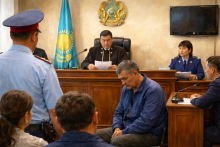
(25 February 2026 | Source: Hronika.kz)
The case of Ksenia Sedova from the Aktobe region concluded with a verdict of murder committed in a state of physiological affect. The prosecution had previously supported the charge under Article 99 of the Criminal Code of the Republic of Kazakhstan as premeditated murder, despite expert conclusions regarding a state of intense emotional disturbance.
HOW EVENTS UNFOLDED ON THE DAY OF THE TRAGEDY
According to case materials, on 29 April 2025, Sedova's husband subjected her to physical violence throughout the day. Later, during a confrontation, the woman inflicted a knife wound on him. During questioning and in court, she stated that she did not remember the moment of the strike and came to her senses only after the man had already fallen, reports Hronika.kz.
Following the incident, Sedova called an ambulance. By the time medics arrived, her husband was still showing signs of life, but they were unable to save him.
The initial forensic examination established that the woman was in a state of physiological affect caused by prolonged violence. The criminal case was reclassified under Article 101 of the Criminal Code of the Republic of Kazakhstan ("Murder committed in a state of passion"), and was dismissed under an amnesty.
WHY THE CASE WAS REOPENED
Several months later, prosecutors overturned the decision to terminate the case and ordered a new psychological and psychiatric examination. The court later deemed this order unlawful.
Before the examination results were obtained, Sedova was placed in a pre-trial detention centre. A review by private expert Molchanov appeared in the case files, expressing doubts about the presence of a state of affect. He noted "pronounced emotional tension" at the time of the incident.
Lawyer Adlet Izbasar secured a court order for a panel examination, citing procedural violations. According to his arguments, the review had been conducted by a single specialist, whereas the law required a panel examination to be ordered through the Centre for Forensic Examinations of the Ministry of Justice of the Republic of Kazakhstan.
The panel examination once again confirmed Sedova's state of physiological affect.
POSITIONS OF THE PROSECUTION AND DEFENCE
Despite the experts' conclusions and witness testimony regarding systematic violence by the husband, the prosecution insisted on premeditated murder. According to the state prosecution's version, the conflict was verbal, and the defendant's actions were deliberate.
The investigation also claimed that the woman had beaten her husband and broken his ribs before the knife attack. However, an ambulance paramedic stated in court that no rib fractures were found during resuscitation efforts and that they could have occurred precisely during chest compressions. This testimony aligned with the findings of the forensic medical examination.
At the end of the trial, prosecutors dropped the charge of premeditated murder and reclassified the case as murder committed in a state of passion.
COURT DECISION AND FURTHER ACTION
The court found that Sedova had committed murder in a state of affect and sentenced her to 1.5 years' imprisonment. In accordance with the Law "On Amnesty in connection with the Thirtieth Anniversary of the Constitution of the Republic of Kazakhstan", she was released from punishment, and the case was dismissed.
She was also ordered to pay 5 million KZT in moral damages to the relatives of the deceased. The verdict has not yet entered into legal force.
Lawyer Adlet Izbasar stated his intention to seek accountability for the law enforcement officers involved in the investigation. According to him, all examinations consistently confirmed the state of affect, and signs of direct intent to murder had not been established.
The case materials do not specify what specific measures may be initiated against the law enforcement officers or within what timeframe.