The story surrounding the A.I. Barayev Research and Production Centre for Grain Farming (RPCGF) has continued at the level of state agencies. Following the FBRK publication about the complaints of chief accountant Gulnar Kabdina, our editorial team sent official requests to the Ministry of Agriculture and the Ministry of Labour and Social Protection of the Population. Both departments confirmed that appeals regarding the situation at the Centre are within their purview, although they are at different stages of review.
WHAT PROMPTED THE APPEALS
Not long ago, the FBRK reported on a letter from chief accountant Gulnar Kabdina, in which she described the situation that had arisen after the change of management at the Barayev Centre. The appeal contained arguments about violations of financial discipline, staffing pressure, and what the author herself calls a reversion to the "era of chaos" in one of northern Kazakhstan's main agricultural scientific institutions.
WHAT THE MINISTRY OF AGRICULTURE RESPONDED
In the response from the Ministry of Agriculture (MoA), it is stated that Gulnar Kabdina's complaint is indeed registered in the E-Otinish system. 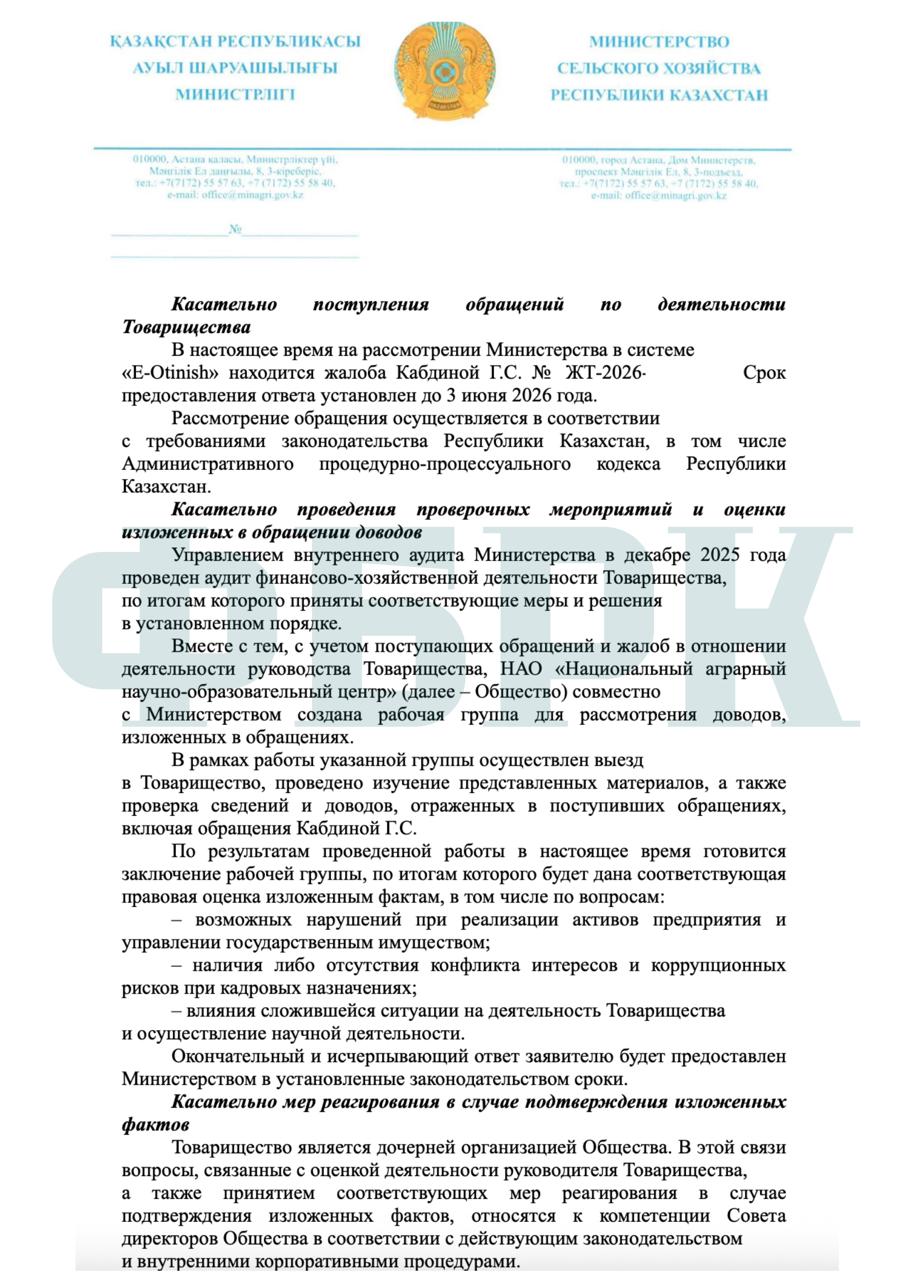
The department reminded that in December 2025, the MoA's Internal Audit Department had already conducted an audit of the enterprise's financial and economic activities. Following the inspection, "appropriate measures and decisions were taken in accordance with the established procedure", although the Ministry does not specify exactly what these were.
In parallel, due to incoming appeals and complaints regarding the activities of the Centre's management, NAC "National Agrarian Scientific and Educational Centre" (NASEC), jointly with the MoA, established a working group. Its members visited the organisation, studied the materials presented, and verified the arguments set out in the appeals.
As per the Ministry's response, the final conclusion of the working group is currently being prepared. The department stated that a legal assessment will be given, including on issues of possible violations in the disposal of the enterprise's assets, the presence or absence of conflicts of interest and corruption risks in personnel appointments, as well as the impact of the current situation on the Centre's activities and the fulfilment of scientific tasks.
However, the Ministry has not disclosed the composition of the working group. Therefore, as our readers rightly noted, it remains unknown who exactly will assess the stated facts: independent experts and public representatives, or exclusively representatives of the structures that made the personnel decisions regarding the management of the Barayev Centre.
WHY THE MINISTRY OF LABOUR IS NOT CONDUCTING AN INSPECTION
The Department of the State Labour Inspectorate Committee of the Ministry of Labour and Social Protection of the Population for Akmola Region reported that Gulnar Kabdina's appeal was received through state agencies on 8 May 2026. According to the inspectorate, the document lacked specific demands for the elimination of violations and the adoption of measures, and part of the arguments presented concerned other employees.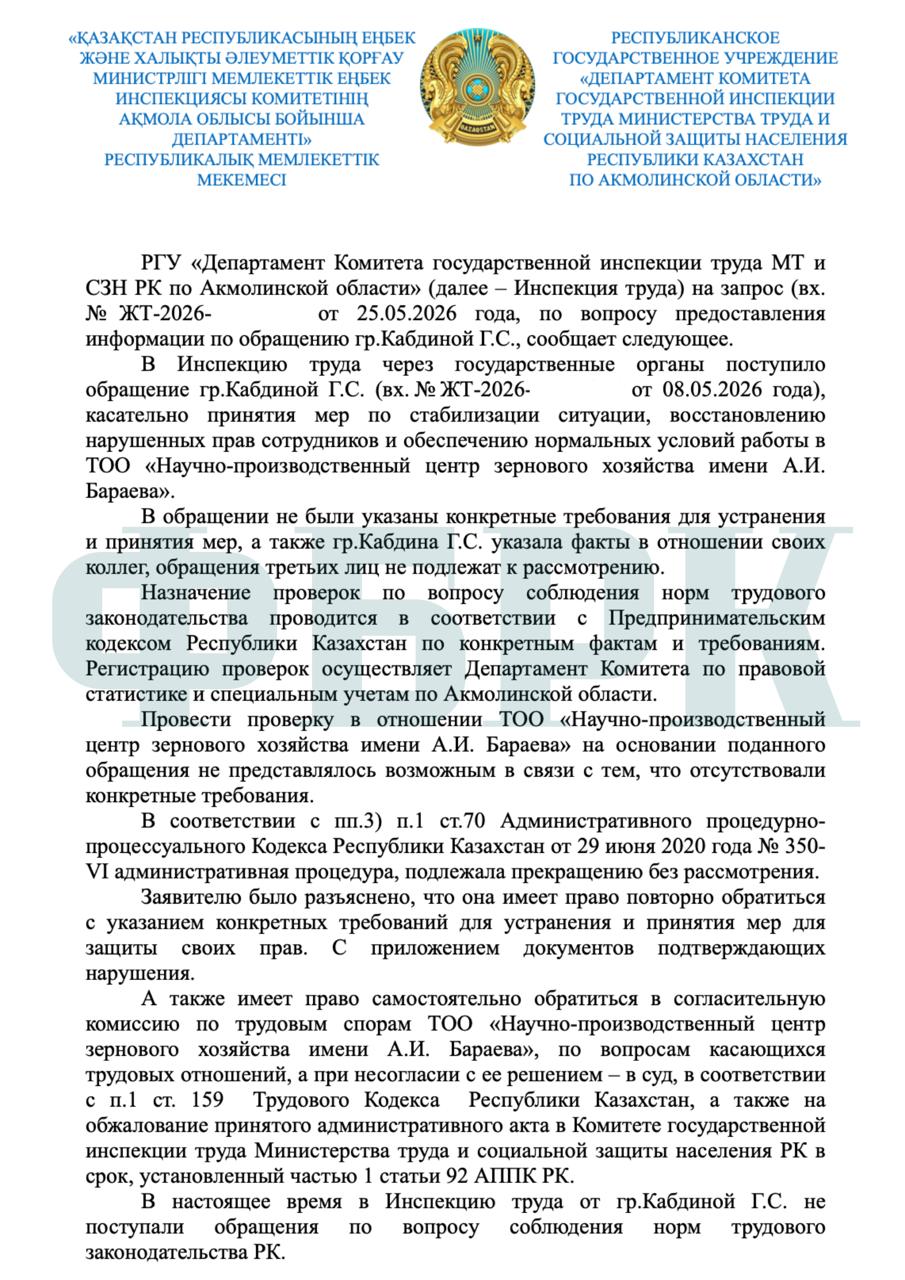
It is for this reason that conducting an inspection regarding the Barayev Centre was not deemed possible. The administrative procedure was terminated without consideration.
At the same time, the inspectorate specifically noted that, as of the time the response was prepared, no appeals from Gulnar Kabdina directly concerning compliance with labour legislation norms had been received by the department.
WHAT HAPPENS NEXT
The Barayev Centre is not just another subsidiary of NASEC. It is one of the country's few agricultural institutes that has defined the development of Kazakhstan's grain farming for decades. Therefore, the issue today is not just whether the facts stated in the appeals will be confirmed. The issue is why a situation arose around one of the country's key scientific centres that required the intervention of ministries and the creation of a special working group.
The editorial team of FBRK will continue to follow developments.