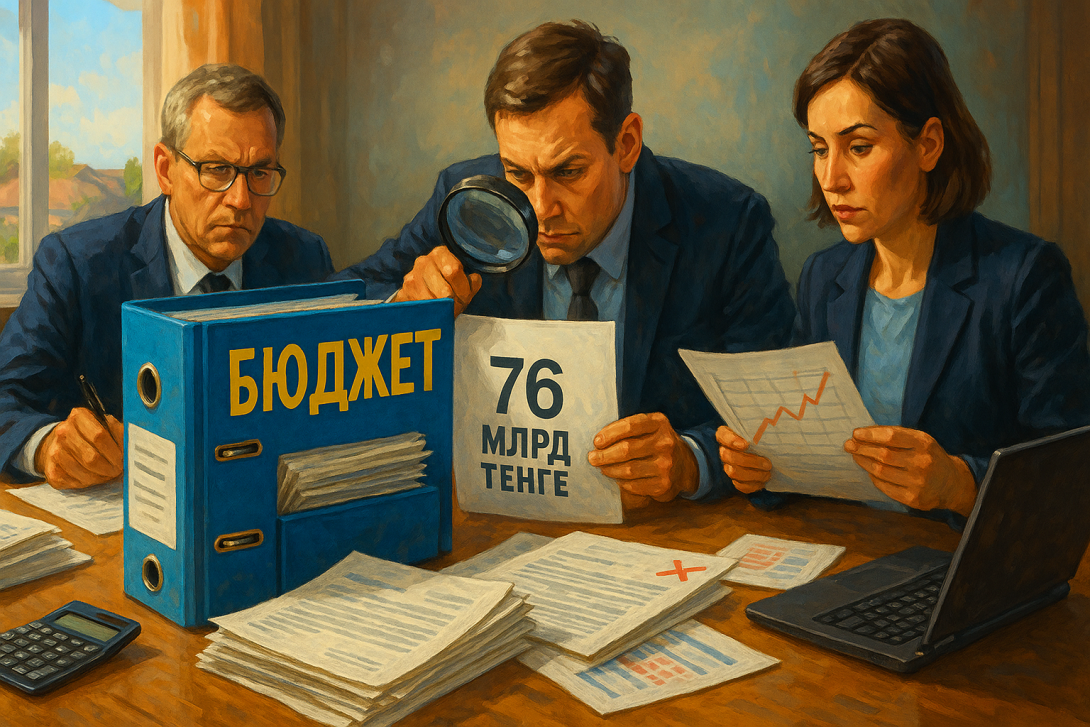
The Audit Commission of the West Kazakhstan Region published the results of a budget review for Uralsk for 2024. According to the commission, violations and distortions in financial reporting were identified totalling more than 76 billion tenge, which is comparable to nearly the entire annual expenditure side of the budget (83.1 billion tenge). According to auditors, the city administration is effectively operating without an effective financial control system.
According to Uralskweek.kz, only five accountants from the akimat were punished — each was fined 100 MCI (393 thousand tenge). All department heads, as well as the deputy akims of the city, retained their positions.
The review covered key departments of the akimat — the departments of construction, land relations, housing and communal services (HCS), culture, sports, internal policy, entrepreneurship, as well as the akim's office.
According to the audit commission's report, distortions in financial reporting amounted to 48 billion tenge, financial violations — 23.7 billion tenge, and procedural violations — 4 billion tenge.
One of the most serious violations is related to the failure to record gratuitously received property — flats, buildings and land plots. From 2021 to 2024, such assets accumulated to 22.9 billion tenge, but they were not entered into the accounting books.
The largest number of violations was identified in the HCS department — totalling 34 billion tenge. Auditors note that the materiality threshold for violations was exceeded by 37%. The department's reporting did not reflect income from housing rentals amounting to 112.2 million tenge, nor over a thousand flats gratuitously transferred by sponsors to flood victims.
Furthermore, the land relations department did not account for income from the sale of land plots totalling 910.1 million tenge.
It also emerged that the city akimat rented 21 flats for 31 million tenge, but the rental rate was not set, meaning the corresponding payments did not reach the city budget.
In second place for the volume of violations was the construction department — 10.6 billion tenge. Long-demolished properties were still listed there, while those accepted into service were not registered. Funds totalling 1.7 billion tenge were not recovered from debtor accounts.
According to the auditors, in one instance the construction department unjustifiably wrote off an advance payment of 3.6 million tenge in favour of AsiaTechStroy LLP. Contractors were also paid invoices exceeding the price stated in the public procurement tender documentation.
In particular, the akimat purchased 188 flats from Bolashak LLP and private individuals for 3.5 billion tenge, while, it is noted, paying more than the tender terms stipulated.
The commission concluded that the Uralsk akimat lacks internal control, assets are not accounted for, income is not recognised, and accounting is conducted formally. In several cases, auditors could not determine the extent of reporting distortion due to incomplete data.
"The same HCS departments may receive less money for repairs and heating because assets and funds are not accounted for. And simultaneously, there may be overpayment for objects already listed as owned but not reflected in the accounts," explains audit commission member Batyrzhan Khamidullin.
He also gave an example: the HCS department did not reflect 3.4 billion tenge in the 'subsidies' line out of the 8.6 billion tenge allocated for passenger carriers. As a result, the total subsidy amount was understated by nearly half.
"And since this amount is not reflected in income, the HCS department had no funds to pay subsidies. In January, the akimat needs to pay this money — but it isn't there according to the reports. A critical situation is possible," added Khamidullin.
According to the audit commission member, the leading role in forming the consolidated reporting belongs to the akimat's finance department.
"That is where they receive reports from departments, check them and compile summary data. This department is obliged to provide reliable information to the management, deputies and residents of the city," noted Khamidullin.
However, as established in the audit report, the finance department did not review the reports but merely mechanically consolidated them into a single document. The department's management told auditors that responsibility for the accuracy of the data lies with the heads of departments.
As a result, the akimat's annual reporting does not reflect the real financial situation of the city. Auditors pointed out to management that internal control is absent, and key decisions are made without sufficient legal and economic justification.
In the near future, the Uralsk akimat and maslikhat are to consider the draft city budget for 2026. However, as experts note, planning based on distorted data could lead to a repetition of previous mistakes.
Journalists have sent questions to maslikhat deputies asking whether they are familiar with the audit results and whether they intend to pursue an investigation.
According to available information, most deputies have not received the audit commission's report. The chairman of the maslikhat, Ginayat Kaliyev, did not answer journalists' calls. The head of the budget and HCS committee, Aslanbek Aminov, stated that he intends to study the report and raise the issue at the next meeting of the department.