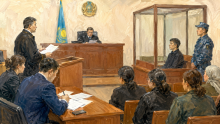
While the trial concerning the death of Assem Shabelskaya in Shchuchinsk has not yet begun, the victim's family has come under pressure from several sides simultaneously: relatives of the suspect are writing insults and threats, the prosecutor's office has demonstrated documented negligence in transmitting instructions to the investigators, and the editorial board of FBRK received an official document for the first time revealing the confirmed cause of death. Attempts to contact the suspect's father for comment went unanswered.
Previously, FBRK published material following its own investigation in Shchuchinsk. This text contains new information received after that publication. In accordance with Article 19 of the Criminal Procedure Code of the Republic of Kazakhstan, the suspect is presumed innocent until a guilty verdict is handed down by the court and enters into legal force.
OFFICIAL DIAGNOSIS: LIVER RUPTURE AND INTERNAL BLEEDING
Until now, the nature of Assem Shabelskaya's injuries was known only from the accounts of relatives who saw the body at the morgue. Now there is an official document. The editorial board has obtained a ruling on the partial satisfaction of the complaint, signed by the prosecutor of the Burabay district of the Akmola region and dated 10 July 2026, which confirms that on 9 June 2026, Assem Shabelskaya was admitted to the emergency department of the Avicenna-Burabay hospital in Shchuchinsk, where she died.
The criminal case is registered under Part 3 of Article 106 of the Criminal Code of the Republic of Kazakhstan ("Intentional infliction of grievous bodily harm resulting in death"). This is the first official confirmation of the case classification.
The same document indicates that the family is contesting the diagnosis made by the medics. According to the victim's side, the medics incorrectly established the cause of death, citing traumatic brain injury and concussion, whereas death resulted from liver rupture and internal bleeding. The family is also raising questions about the adequacy of the emergency medical care provided.
Liver rupture as the cause of death is an injury incompatible with the explanation "she fell and hit the radiator", which, according to relatives, the suspect gave to medics when calling the ambulance.
DOCUMENTED NEGLIGENCE BY THE PROSECUTOR'S OFFICE
The same ruling reveals a timeline that the family described in their interview with FBRK, and which is now officially confirmed.
On 25 June, the victims' side filed a petition with the investigator requesting an additional forensic medical examination and the questioning of medical personnel. On 28 June, the investigator refused the request outright.
On 3 July, the family filed a complaint with the prosecutor's office of the Burabay district. On 10 July, the prosecutor issued a ruling on the partial satisfaction of the complaint.
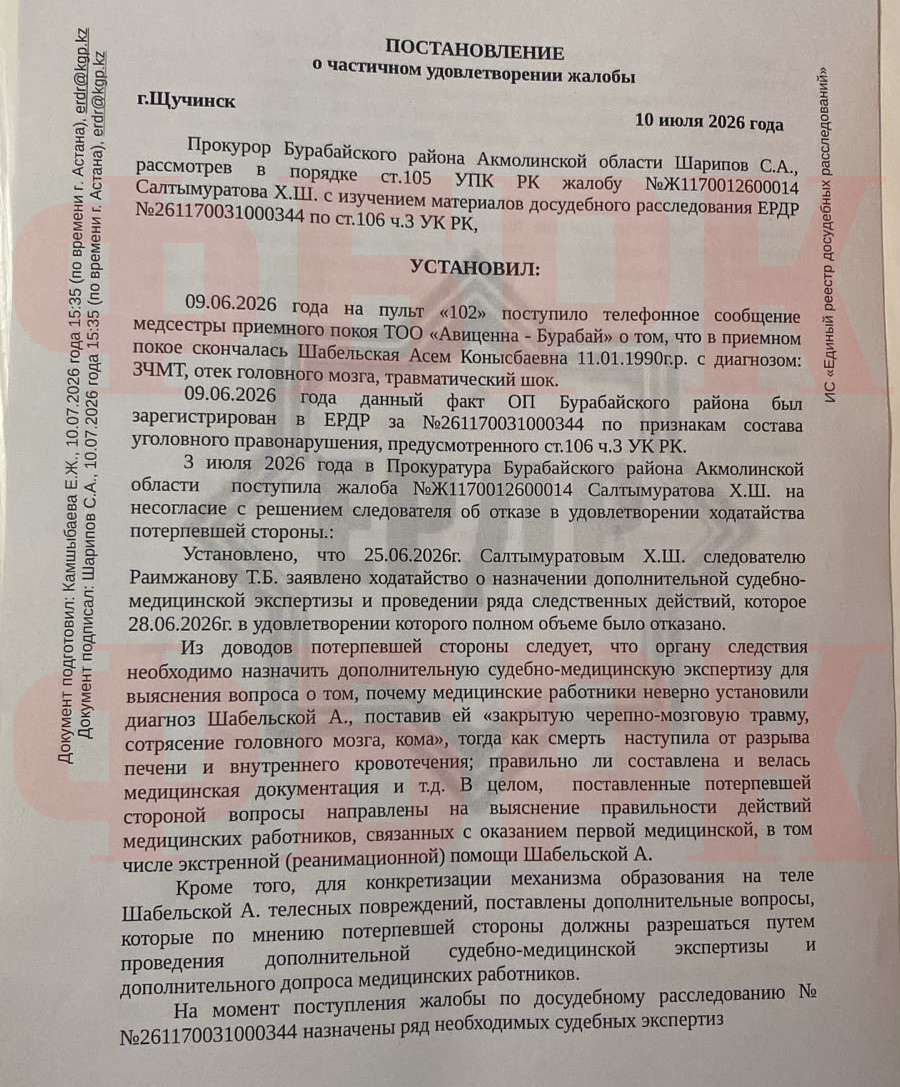
However, as the victim's sister Bakhyt told the FBRK editorial board in an interview, neither she nor her lawyer received this response by post or by any other means. Bakhyt only learned of the ruling by chance on 20 July, when she went to the prosecutor's office in person and requested a copy. The investigator, according to her, also received no instructions and saw the document for the first time from the family itself.
"This is simply negligent behaviour on the part of the prosecutor's office," says Bakhyt. Notably, according to her, the investigator himself agreed with this assessment.
After the family pointed out the omission, the questioning of medical personnel was carried out within two days. According to Bakhyt, the picture became clearer after these interviews, but no official comments on the results of the investigative actions have been received.
On 30 July, Bakhyt published a video address on social media describing what had happened. The Akmola Regional Police Department responded in the comments that the medical personnel had been questioned and everything was under control. Bakhyt objected, providing dates and details that refuted the official version.
PRESSURE ON THE FAMILY: INSULTS, THREATS AND ATTEMPTED HACKING
In parallel with the investigative issues, the family has faced what it describes as organised pressure.
On 2 August, according to Bakhyt, messages began arriving from the Instagram account samat_madiev_ addressed to the victim's mother-in-law. Initially, there was an attempt to negotiate: to come over, "have a talk", and secure a softening of the family's position at trial, citing the difficult conditions of detention her son was enduring in pre-trial custody. When the mother-in-law refused to engage, the tone changed.
In the correspondence, published by the relatives, the suspect's father wrote a number of things that the family interpreted as an attempt to shift blame for what happened onto the victim herself. When the mother-in-law described the nature of Assem's injuries to him - multiple internal organ damage and broken ribs - the father replied: "She just has thin skin. And weak health."
In the same correspondence, he wrote that his son "was brought up to always be everyone's priority", that "he doesn't like Russian people" and that he "would never have accepted" Assem's children. Separately, that Assem "always, for some reason, put her children ahead of him" and "he didn't like that".
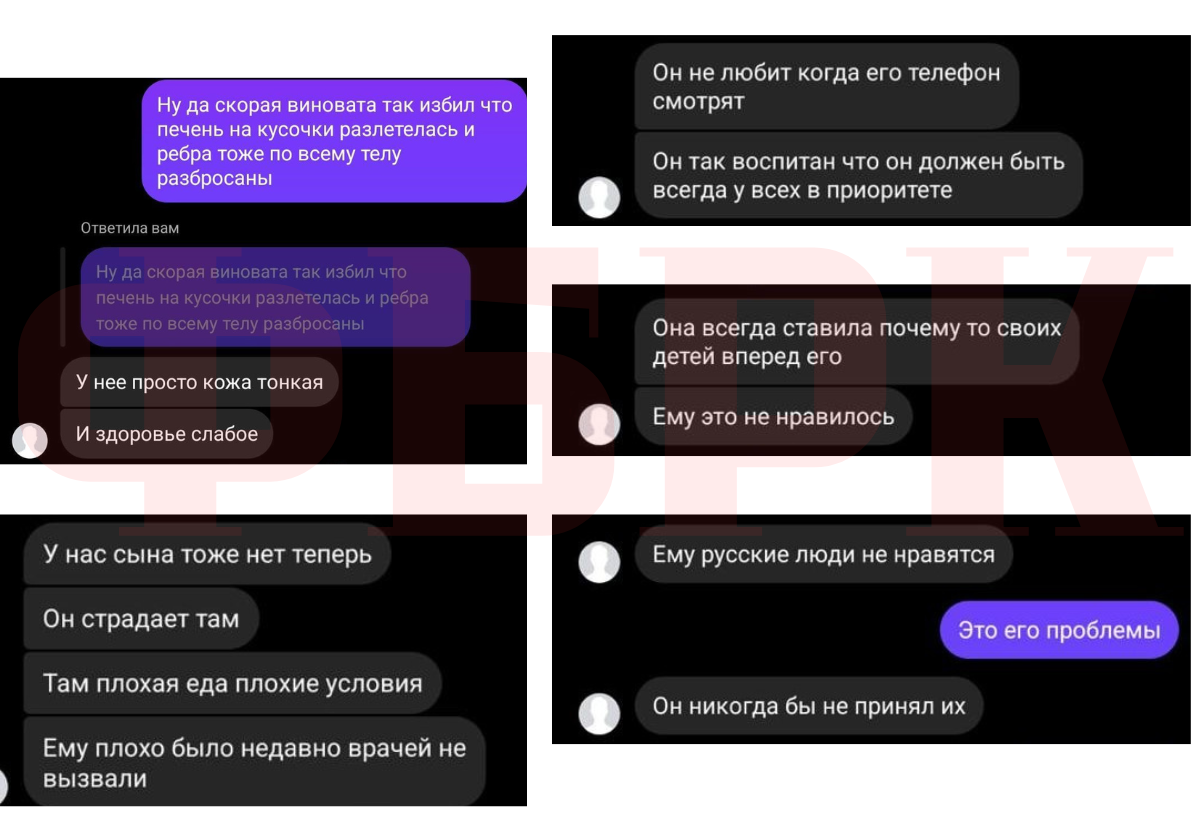
From the Instagram account nurgul_shokaeva, insults were directed at the mother-in-law along with threats of making reports. In one of the messages recorded by the family, it said: "What, scared of us now? Sweet revenge is still coming for you. You have no idea what I'm talking about."
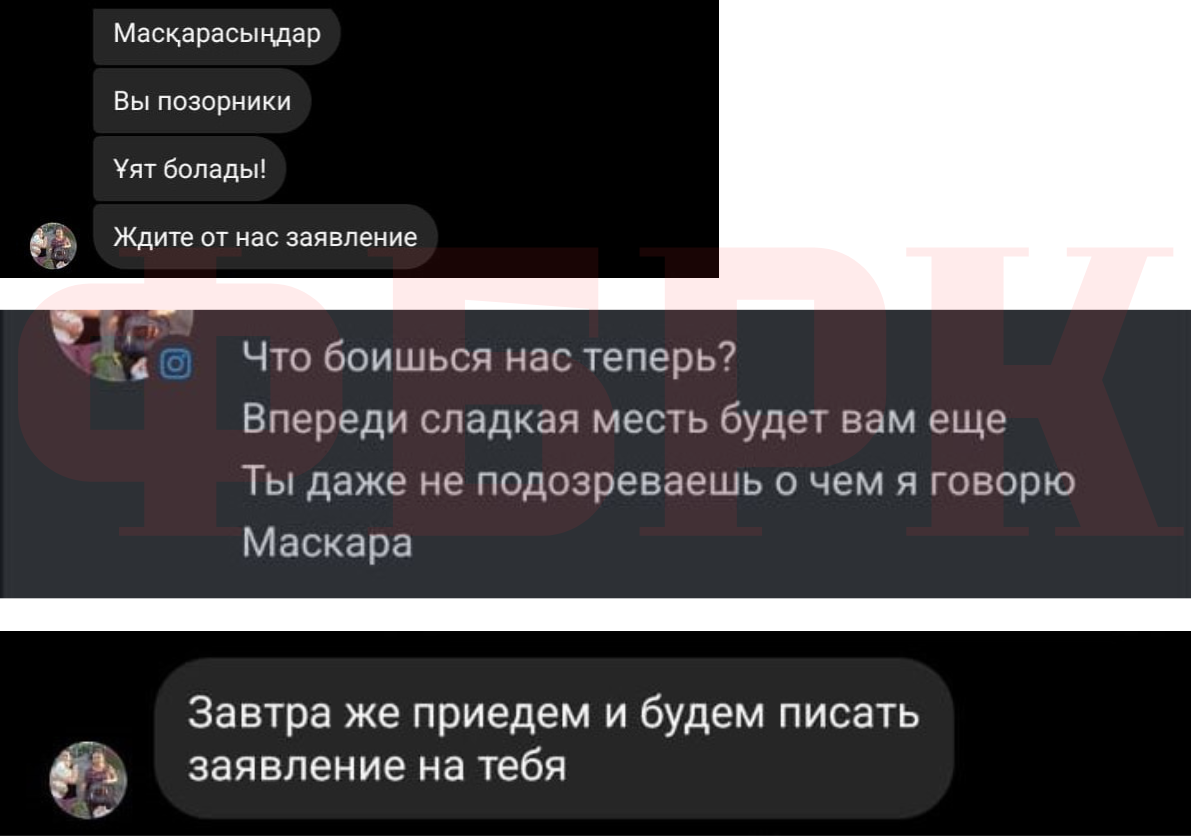
As of the time of publication, the FBRK editorial board could not find either the samat_madiev_ account or the nurgul_shokaeva account on Instagram - both appear to have been deleted.
The family filed reports with the police on 2 and 3 August. According to Bakhyt, the local police officer said that no offence was found and that the senders could be held neither administratively nor criminally liable.
"So it turns out that we, citizens of our country, are protected by nothing," says Bakhyt. According to her, the family no longer has faith in either justice or the ability of the authorities to protect them.
Another sister of the victim - Dina - told the FBRK editorial board in an interview that threats are also being issued on behalf of the suspect's ex-girlfriend and contain specific language: "I know where you live, be afraid, this is only the beginning."
The family is recording suspicious activity on Instagram accounts: logins from unknown devices during the night. Dina links this to the fact that the suspect is an IT specialist, and she suspects that among his circle there are people with the relevant skills.
THE OTHER SIDE'S POSITION: SILENCE
The FBRK editorial board repeatedly attempted to contact the suspect's father to give him the opportunity to state his position. The calls went unanswered.
ANALYSIS: THREE OPEN QUESTIONS
The situation surrounding this case extends beyond the criminal proceedings themselves.
The first question concerns the nature of the injuries. The official diagnosis upon admission to hospital recorded a traumatic brain injury. The family insists that the cause of death was liver rupture and internal bleeding. It was precisely to resolve this contradiction that they sought an additional expert examination. The prosecutor's office partially satisfied the complaint, but the instruction to the investigation was sent with delay and a breakdown in communication, as recorded in the same official document. The answer to the question of the cause of death directly affects the assessment of intent.
The second question concerns pressure on the victim's side. The police, according to the family, see no offence in the insults and threats. Meanwhile, the threat of "sweet revenge" in the context of an ongoing criminal case is not merely rudeness. If the family's statements are accurate, this amounts to pressure on victims during the pre-trial investigation.
The third question is systemic. The case is being investigated in a district town. The prosecutor's instruction never reached the investigator. The family only learns of responses to their complaints when they go there in person. This is not a unique situation in Kazakhstani law enforcement practice, but that is precisely why it is telling.
EDITORIAL OPINION
The prosecutor's ruling of 10 July is the first official document in this case to come into our hands. It confirms the classification, records the diagnosis, and at the same time documents negligence in the execution of its own decision. This is a rare combination: an official body has effectively documented a failure in its own work itself. What exactly the additional expert examinations will establish remains to be seen in court. But it is already clear: the victim's family is forced not only to seek justice, but also to track the progress of their own case independently - without which, judging by the described timeline, some investigative actions might not have taken place at all.
CONCLUSION
The case of Assem Shabelskaya is moving towards trial. Exactly when the hearings will begin is not yet known. The FBRK editorial board continues to monitor the course of the investigation and will report on the start date of the trial and its outcome.