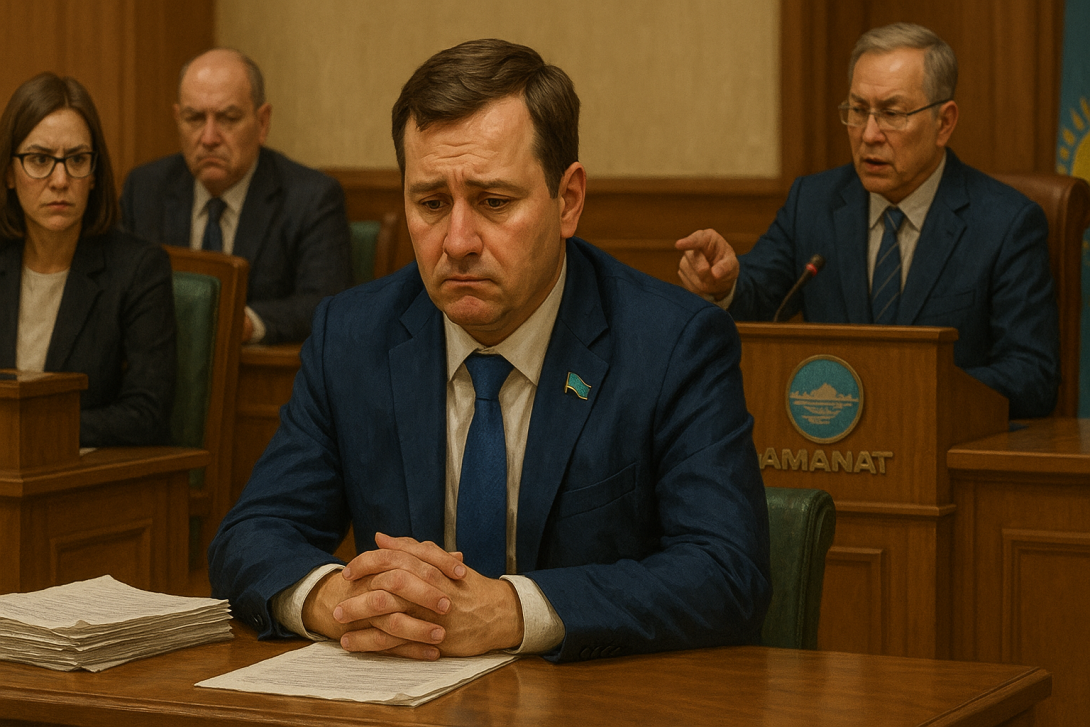
The AMANAT Party conducted an internal review regarding a district maslikhat deputy, Dauren Kalibekov, who was at the centre of a scandal involving a debt of more than 127 million tenge, and limited its action to a reprimand for violating the Code of Ethics, stating it was impossible to intervene in civil law relations.
For context, recently the FB RK editorial team investigated the situation regarding the multi-million tenge debt of the elected official, which became the subject of a collective letter from residents of the Katonkaragay District. It concerned a debt of more than 127 million tenge owed to businessman Marlen Kudaibergenov, as well as land disputes over plots linked to the deputy's family.
Our editorial team has established that Kalibekov's total debt exceeds 250 million tenge, including arrears to Eurasian Bank. A travel ban has been imposed on the elected official, and his property has been seized.
Simultaneously, a land case was developing in which the legality of transactions concerning plots measuring 10 hectares was contested. The court of first instance declared the contracts invalid; however, an appeal in January 2025 overturned this decision, agreeing with the arguments of the Kalibekov family that all transactions were concluded based on decisions of the akimat.
Now the AMANAT party has officially commented on the situation. In response to an official enquiry from the FB RK editorial team, it is stated that, as a result of the internal review, Dauren Kalibekov has been subjected to party disciplinary action in the form of a reprimand for violating the Code of Ethics of a party member. Such a measure appears relatively lenient given the scale of the scandal and the size of the debt. However, the party's response contains an important legal caveat.
Citing Article 4, Paragraph 2 of the Law of the Republic of Kazakhstan "On Political Parties," AMANAT emphasises the principle of state non-interference in the affairs of political parties and vice versa. Furthermore, the law prohibits assigning state body functions to political parties. Effectively, the party states that it cannot and must not resolve issues falling under the jurisdiction of the judicial system and executive bodies.
Additionally, it is reported that Marlen Kudaibergenov has been "advised to contact the relevant state authorities in a civil law manner for the execution of the court decision." In other words, AMANAT acknowledges the existence of a problem but redirects its resolution to the legal framework, distancing itself from the debt obligations of its party member.
On the one hand, the party is formally correct in citing legislation on the separation of powers. A political organisation is indeed not a judicial or executive body and cannot forcibly recover debts.
On the other hand, this concerns an elected official, a public figure, whose conduct affects the reputation of the entire party. A reprimand for violating the code of ethics in a situation involving a multi-million tenge debt, a travel ban, and asset seizure may seem an insufficient measure for restoring voter trust.
Be that as it may, the final word will rest with the voters when, at the next elections, they judge elected officials not by their promises, but by their actual reputation.