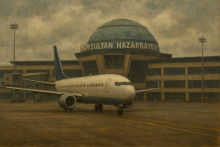
Almaty International Airport JSC is the sole operator of international flights in the Almaty region, classified as a strategic facility of Kazakhstan and subject to regulation under the Law "On Natural Monopolies". For three consecutive years, its reporting has shown revenue growth, but a line-by-line comparison of the 2023, 2024 and 2025 reports reveals not just growth, but a set of details that migrate from document to document unchanged, including the wording about an expired licence and the amount of the liability for the construction of the new terminal, which remained frozen at a single value even after the terminal itself had already been built and opened.
WHAT IS KNOWN ABOUT THE COMPANY
The company's most recent licence for airport operations was issued on 19 April 2023, valid until 27 June 2025. This wording is repeated verbatim in all three reports – for 2023, 2024 and 2025. In the first report, the wording was current; in the second, it was already questionable; and in the third, it formally describes a licence that had expired almost nine months earlier, without a single word about renewal or a new licence number.
The auditor's opinion on the reporting is a so-called "qualified opinion". This means the auditor broadly confirms the reliability of the financial statements but expressly states that there is one specific issue whose impact he was unable to assess, and therefore cannot provide a fully unqualified opinion. A similar qualification was recorded in the reporting of Astana Airport, which we have already covered in detail.
In this case, the reason has been the same since at least the 2022 report: the last independent revaluation of fixed assets (buildings, equipment, land) was carried out in 2019, and since then their carrying amount has not been reviewed, although there are indications that it has diverged from market value. This same wording is repeated word-for-word in the 2024 and 2025 reports.
CONSTRUCTION OF THE NEW PASSENGER TERMINAL
The so-called EPC contract requires separate explanation – this is a type of construction agreement (from the English Engineering, Procurement, Construction – "design, procurement, construction") under which a single contractor takes on the entire cycle of delivering a major facility "turnkey": from design to handover of the completed building. Such contracts typically involve a fixed, pre-agreed total scope of the customer's obligations to the contractor, which gradually decreases as work is completed and invoices are paid. In the case of Almaty airport, this concerns an EPC contract for the construction of the new passenger terminal. According to the 2023 report, the outstanding balance of obligations under this contract was 9.34 billion tenge at the end of 2022 and almost 34 billion tenge at the end of 2023 – growth of nearly 3.6 times in one year.
And in the 2024 report, the same amount (33.9 billion tenge) is again presented as the outstanding liability as at 31 December 2024, while the comparative figure for 2023 is given not in tenge but in dollars – the same value as the year before. The figure did not change by a single tenge, even though the terminal itself, according to the note on fixed assets, was commissioned in May 2024, after which the outstanding liability under the contract should logically have fallen sharply, not remained unchanged.
WHAT ELSE THE REPORTING REVEALS
The third fact concerns the so-called return of dividends. Dividends are the portion of net profit that a company pays out to its shareholder rather than retaining in the business. A "return of dividends" means that previously paid amounts to the shareholder are retrospectively recognised as having been paid improperly, and the shareholder is obliged to return them to the company. In this case, the Internal State Audit Committee of the Ministry of Finance of the Republic of Kazakhstan ordered in 2023 that 6.78 billion tenge paid in 2021–2022 from profits of 2015 and 2017 be returned. The company contested this decision in the courts, including the appellate instance, lost, and on 25 December 2025 the money was returned.
The ultimate controlling shareholder is the French group Airports de Paris, which owns Turkish operator TAV Havalimanlari Holding A.Ş., which in turn owns TAV Kazakhstan LLP – the direct owner of Almaty airport. In 2021, the company together with TAV Kazakhstan LLP and Vines Trading LLP raised a loan of $450 million from four international development institutions – the International Finance Corporation (IFC), the European Bank for Reconstruction and Development (EBRD), the Eurasian Development Bank (EDB) and the German Deutsche Investitions- und Entwicklungsgesellschaft (DEG). Part of the amount went towards refinancing the purchase of the airport itself, and part ($235 million) went specifically towards the construction of the new terminal. As security for this loan, not only land, buildings and vehicles were pledged, but also all funds in the company's accounts, shares and insurance proceeds.
Such large loans are almost always accompanied by banking covenants – these are contractual conditions that the borrower must comply with throughout the life of the loan, typically in the form of specific financial metrics. If a metric is breached, the lender formally gains the right to demand early repayment of the entire loan amount at once, so a covenant breach is considered a serious signal, even if loan payments themselves continue to be made on time.
In this case, the metric used is the Debt Service Coverage Ratio (DSCR) – it shows how many times the company's operating cash flow exceeds the amount due on the loan (interest plus the principal portion) for the period. If the ratio is, for example, 1.10, funds cover the amount with a 10% margin; if it falls below the threshold specified in the agreement, that constitutes a covenant breach. Under the terms of the agreement, testing of this metric began on 31 December 2024, which is why it does not yet appear in the 2023 report. This is an important detail for the chronology: this is not a metric that was quietly breached for years and went unnoticed, but a completely new requirement that the company failed in its very first year of application, and this was not a one-off slip but the start of a deteriorating trend that in the second year of testing led to a breach of both ratios simultaneously.
The backstory of the land plot under the terminal is also telling. In the note to the 2023 report, advances paid for this plot are explicitly described as having been paid "for the new frozen passenger terminal", meaning that at the time of drafting that report in April 2024, construction was officially characterised as suspended. Just a month later, in May 2024, the terminal, according to the subsequent reporting, was opened. The rapid transition from "frozen" to "operational" is not in itself a violation, but it contrasts markedly with the fact that the amount of liabilities under the construction contract remained unchanged another year later.
WHAT THIS MEANS
If the three reports are viewed not separately but as a single chronology, it becomes clear that revenue, for example, grew from 200.9 billion tenge in 2023 to 245 billion in 2024 and 285.6 billion in 2025 – nearly 42% over two years – while dependence on aviation fuel reselling simultaneously declined: from roughly 69% of revenue in 2023 to around 58% in 2025 – driven by faster growth in income from airport services themselves. This is a structurally healthy trend – the airport is gradually becoming less dependent on fuel trading.
But net profit moved less linearly: 27.4 billion tenge (2022) – 36.2 billion (2023) – 26.9 billion (2024) – 35.5 billion (2025). The final 2025 result barely exceeds the 2023 level, despite revenue growth of 42% over two years. At the same time, the group's net foreign currency position (the difference between assets and liabilities denominated in foreign currency – essentially an indicator of how dependent the company is on the dollar-to-tenge exchange rate) steadily deteriorated: 36.2 billion tenge at the end of 2022, 50.1 billion at the end of 2023, 60 billion at the end of 2024 and 74.6 billion at the end of 2025 – almost linear deterioration for four consecutive years.
Another useful indicator is the net debt ratio. This is the ratio of the company's net debt (all loans and supplier liabilities less cash on hand) to its equity (what actually belongs to shareholders after deducting all liabilities). The higher the ratio, the more dependent the company is on borrowed funds and the more sensitive it is to problems with debt servicing. At Almaty airport, this behaved unevenly: 0.86 (2022) – 0.93 (2023, peak) – 0.81 (2024) – 0.76 (2025). The formal improvement after 2023 came from growth in retained earnings, not from a reduction in the debt itself: net debt rose from 78.4 billion tenge in 2022 to 111 billion in 2023 (+41.6% in one year) and then virtually plateaued at around 129 billion tenge in 2024–2025.
It was precisely on this "plateau", rather than at the moment of the sharpest debt growth, that the company first breached its DSCR covenants – meaning the narrow metric of debt-servicing capacity from cash flow deteriorated even when the overall debt burden had formally stabilised. In 2024, only the forward-looking DSCR metric was not met, while the historical one was satisfied. The lenders granted a waiver (an official document by which the bank voluntarily waives its right to demand early loan repayment due to a covenant breach, effectively "forgiving" it under certain conditions) on 3 October 2024. A year later, as at 31 December 2025, both metrics were breached, and the waiver was only obtained on 4 December 2025.
There is also a less obvious but telling contrast: remuneration to key management personnel fell from 1.53 billion tenge in 2022 to 1 billion in 2023 (–29% with the same headcount – 6 people), remained at 1 billion in 2024 but for 7 people, and dropped to 0.8 billion in 2025 for 5 people – a cumulative fall of almost 45% over three years against the backdrop of the company's net profit growing by 30% over the same period. The reporting does not disclose the reasons for this trend.
Finally, the recurring liability amount for the terminal is a case where comparing all three reports yields more than each individually. The figure of 33.9 billion tenge, "frozen" between the 2023 and 2024 reports, disappears entirely from the 2025 report. In its place appears a different contract (reconstruction of the runway, taxiway and aprons) worth $144 million, with a note that as at 31 December 2024, this new contract was "fully performed". What happened to the previous obligation for the terminal between 2024 and 2025 is not explained by any of the three documents.
In the final analysis, if the wording about the expired licence is an uncorrected technical error recurring for the third cycle in a row, this is a question for the quality control system within the company itself and its auditor. If, however, it reflects the real fact of an absent renewal of the licence, the consequences concern the lawfulness of the operational activity of a strategic facility; the current data available in the documents studied is insufficient to make this determination. The same applies to the frozen liability amount for the terminal – the coincidence of figures across two different years suggests unverified data carryover, but there is no conclusive confirmation of this in the reports themselves.
The escalation of DSCR covenant breaches within the first two years of their application increases the likelihood that the lender syndicate – IFC, EBRD, EDB and DEG – will, at the next review of terms, demand additional security, restrict dividend payments or tighten monitoring, which is typical for project finance agreements of this kind.
Or, in other words, behind the outwardly healthy revenue growth lies a steadily deteriorating currency position, escalating bank covenant breaches and at least one figure that, according to the documents, did not change year-on-year contrary to the logic of completed construction. Against this backdrop, the outdated wording about the licence and the court-confirmed return of dividends are not isolated details but part of a broader picture raising the question: will these facts receive regulators' attention before the next annual report does it for them.