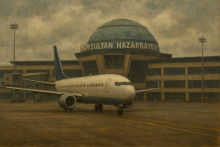
In May of last year, Nursultan Nazarbayev International Airport JSC published its financial statements for 2024. Usually, this is an unremarkable document of a few dozen pages, read mainly by investors and tax authorities. But as it turns out, it is far from boring. It features a lost legal dispute with the state, an auditor who refused to vouch for 80% of the company's assets, and even a halving of the fuel business.
HOW THE AIRPORT FELL INTO DEBT WITH THE BUDGET
Let's start with the most telling episode.
On 13 November 2023, the Internal State Audit Committee completed an inspection of Astana Airport and issued the company an order to remedy violations, namely to return 395.4 million tenge to the republican budget.
The company disagreed and in 2024 challenged the order in court. However, the court sided with the state. Following this, according to the audit information, the airport's management began negotiations for a deferral. In April 2025, the committee relented and allowed the debt to be paid off in three equal instalments (approximately 131.8 million tenge each), with a final deadline of 31 March 2027.
At the same time, the financial statements nowhere explain what the violations actually consisted of. It merely mentions the "remedying of identified violations and the accountability of those responsible". The words "accountability of those responsible" usually mean that it was not just about money, but also about specific employees whose decisions led to budget losses. Who these people are and what exactly they did or failed to do is not disclosed in the document. Nor is it stated who formally acted as the defendant in court - whether it was the Internal State Audit Committee itself or another state body that, on the basis of its order, demanded recovery.
HOW A LOST COURT CASE BECAME AN ACCOUNTING GAIN
There is also a subtler point here that is easy to miss if you don't scrutinise the figures. The instalment agreement was signed in April 2025, that is, after the close of the 2024 reporting year. Nevertheless, the company included it in the 2024 financial statements, calling it a "correcting event after the reporting date" - international standards allow events that merely clarify what already existed at the end of the year to be recognised in this way. Formally, this is permissible, since the debt itself and the court decision arose before 31 December 2024; the instalment plan simply set out the schedule for its repayment.
But an instalment plan stretched over years has a side effect - so-called discounting. Put simply, money the airport will pay in three years' time is worth less today: over that period, both inflation and the lost opportunity to use those funds differently will have taken their toll.
Therefore, the balance sheet did not show the full amount of the debt, but its present value. The difference, around 64.9 million tenge, was recognised as income and reflected in the profit and loss statement.
And here a notable financial paradox arises: the airport lost a court case against the state and took on a multi-million-dollar liability, but thanks to the instalment plan, this loss ultimately contributed to an improvement in the annual financial result. Formally, the debt increased, but in the financial statements part of that debt was converted into income.
AUDITOR REFUSED TO VOUCH FOR 80% OF THE BALANCE SHEET
While the debt story unfolds in the notes, a far more direct warning appears at the very beginning of the document - in the auditor's report. The private auditor, Finex-Standart, issued Astana Airport a qualified opinion, meaning the auditors are not prepared to vouch for the financial statements in full. It is noted that the auditors were appointed after 31 December 2024, that is, after the reporting year had ended. This means they physically could not observe the stocktake - the procedure during which a company's actual assets are counted and reconciled with what is recorded in the books.
As a result, two major balance sheet items were immediately called into question: inventories (2.68 billion tenge) and property, plant and equipment - the airport's buildings, equipment and machinery (86.7 billion tenge). Together, this amounts to around 80% of all the company's assets.
There is another curious detail here: the state licence of the audit firm itself was issued on 5 December 2024 - less than a month before the end of the year under review. In other words, the auditor appeared in this story almost as it began, which directly explains why they did not have time to check anything in person.
The staffing picture only reinforces this impression. The financial statements were signed by two acting managers: the acting Deputy Chairman of the Management Board for Finance - in post since 25 November 2024, and the acting Chief Accountant - since 2 November 2024. Both people responsible for the figures in this document took up their positions just one or two months before the end of the year they were reporting on. Then, on 22 January 2025, immediately after the period closed, the entire shareholding of the airport was transferred into trust management for a period of six months to Terminals Astana Airport Management - without the right of subsequent buyback. These three events - the change of financial leadership, the belated appointment of the auditor, and the transfer of management to a new company - happened almost simultaneously.
HOW THE FUEL BUSINESS HALVED
The report also contains a purely operational anomaly, completely unrelated to court cases and auditors. Revenue from fuel and refuelling complex (FRC) services, that is, refuelling aircraft, fell from 39.2 billion tenge in 2023 to 22 billion tenge in 2024. That is a decline of 44%, almost half. Even sharper was the drop in fuel inventories in storage: from 3.6 billion tenge to 530 million tenge - a reduction of almost sevenfold. It was the fuel segment that dragged down the airport's total revenue - 52.2 billion tenge compared with 63.9 billion the previous year. Yet no reason for this collapse is given anywhere in the financial statements.
DEBT OF FORMER EMPLOYEES AND MONEY IN A SINGLE BANK
There is another telling line in the balance sheet: 1.23 billion tenge in receivables - this is debt owed by former airport employees whom the court ordered to compensate the company for losses incurred. Against this debt, together with other receivables, the company has created a provision of almost 1.8 billion tenge. Judging by this, the company itself does not particularly believe that this money will ever be recovered.
The way the airport holds its spare cash is also concerning. Of the 17 billion tenge held in bank accounts and deposits, 16.2 billion - that is, the overwhelming majority - sits in a single bank, Forte Bank JSC, with a BB rating. This is not a top-tier reliability bank, and holding almost all liquidity in one such bank represents a notable concentration of risk. Incidentally, Forte Bank JSC is listed among the assets of Bulat Utemuratov, whom the media often call "Nazarbayev's wallet". It is also telling that the provision for potential losses specifically on cash and cash equivalents grew over the year from 270 to 340 million tenge - a rather unusual precaution if these are merely account balances.
Of course, none of the above facts individually proves any wrongdoing. State companies often litigate against regulatory bodies and lose, auditors are sometimes changed, and revenue from individual business segments can fall for perfectly market-driven reasons. But when several such episodes coincide in a single reporting year, it is no longer coincidence, but a picture of a year lived in a state of managerial stress.
The editorial team of FBRK has sent official requests to the relevant departments to clarify the circumstances of this story.
To be continued...