
The Committee of the Penal Enforcement System of the Ministry of Internal Affairs of the Republic of Kazakhstan intends to lease control and measuring equipment to register the location of convicted individuals. The editorial team of the FBRC decided to investigate the details of the tender.
In April 2024, the state institution ‘Committee of the Penal Enforcement System’ (CPES) published an open tender for the provision of services for the lease of tracking bracelets worth over 1.4 billion tenge.
According to the technical specification, the location of convicts will be monitored using bracelets with the application of a monitoring platform. Data transmission channels must be built on the basis of a cellular network standard 2G/3G/4G.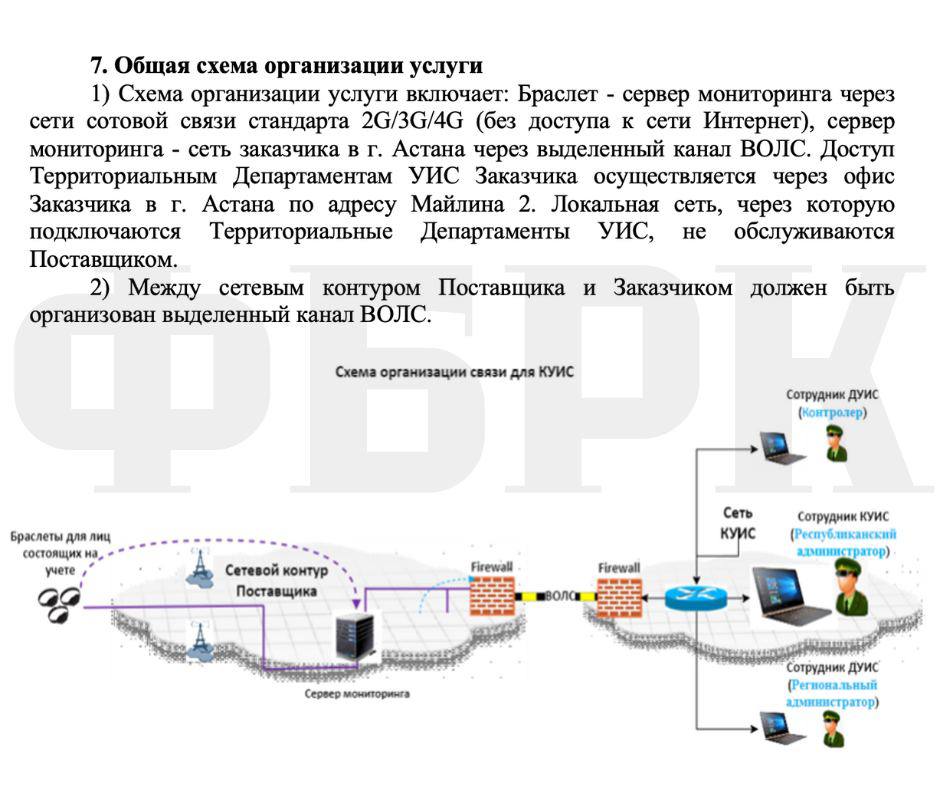
Included with the bracelet must be a charger with a cable, a Power Bank, and a key to remove the bracelet. The monitoring platform must be multi-user software, involving the determination of the required geofence, and with an alarm activation function.
In total, the supplier undertakes to lease 2,562 bracelets within five months from the date of signing the contract.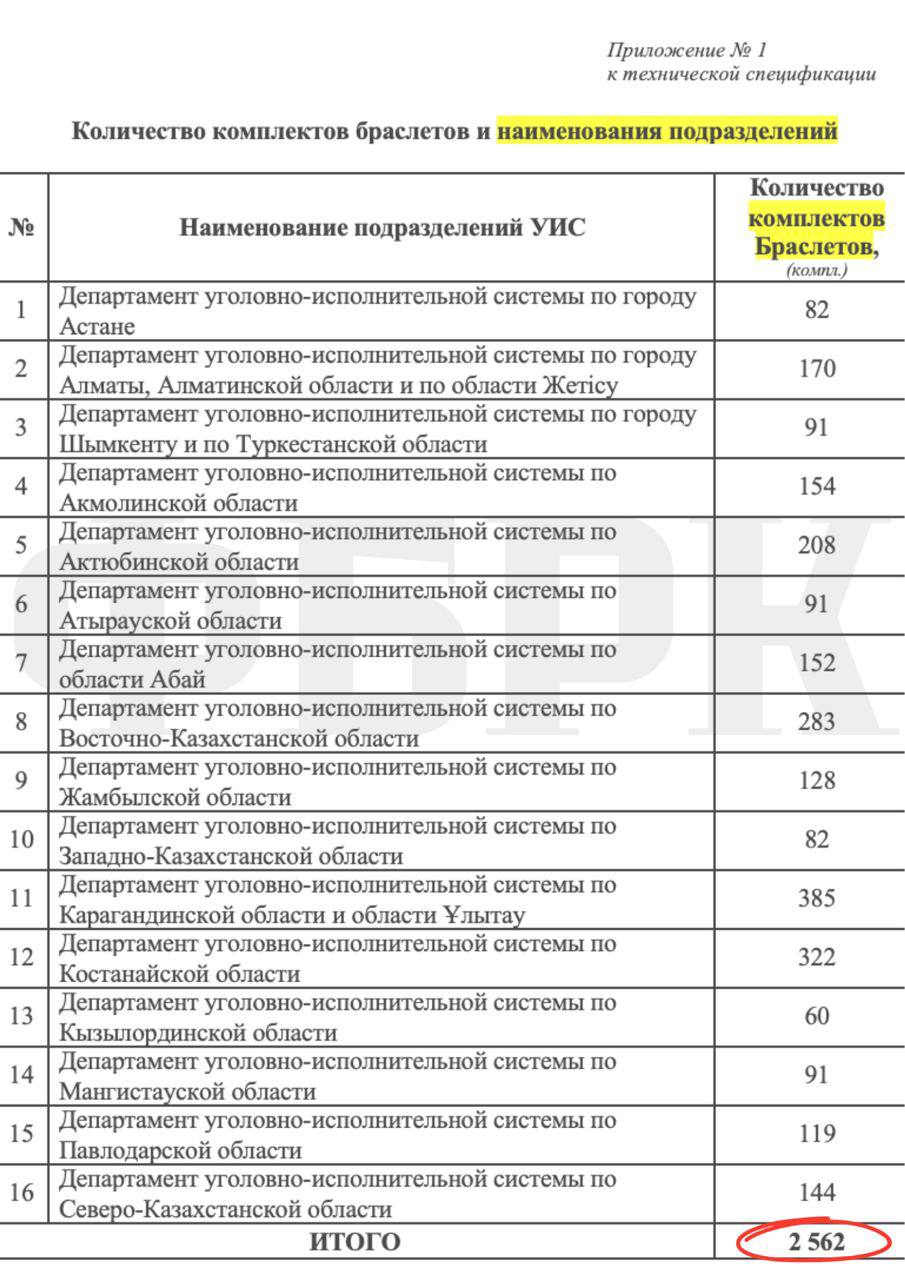
The agreement is valid until 31 December 2026.
The CPES held the open tender for the provision of services for the lease of electronic tracking devices three times. The first tender in February of this year was declared invalid due to a lack of submitted bids.
On 20 February, a potential supplier sent an official request to adjust the tender documentation. However, the customer decided to reject the request.
Only on the third attempt was a tender winner identified - the mobile operator Kar-Tel LLP.
The sole founder of the Partnership is VIP Kazakhstan Holding AG JSC, which previously belonged to a subsidiary of Vympelcom (‘Beeline’). At the same time, 25% of Kar-Tel is under the control of businessman Bulat Utemuratov.
Incidentally, in December 2023, the Agency for the Protection and Development of Competition (APDC) conducted an investigation into Kar-Tel LLP.
It is worth noting that the Committee of the Penal Enforcement System has been cooperating with Kar-Tel LLP for several years already.
In 2022, the CPES already concluded a contract with Kar-Tel for the provision of services for the lease of those very tracking bracelets. However, the contract amount was significantly lower then – 329,574,696 tenge.
Later, the CPES concluded another four additional agreements adjusting the amount of the main contract. Ultimately, the lease of equipment in 2022 cost the Committee 165 million tenge.
It should be noted that an attempt to conclude a similar contract was made back in 2021 via an open tender for approximately 25 million tenge.
Interestingly, in 2022, the equipment lease contract was concluded from a single source due to failed procurement.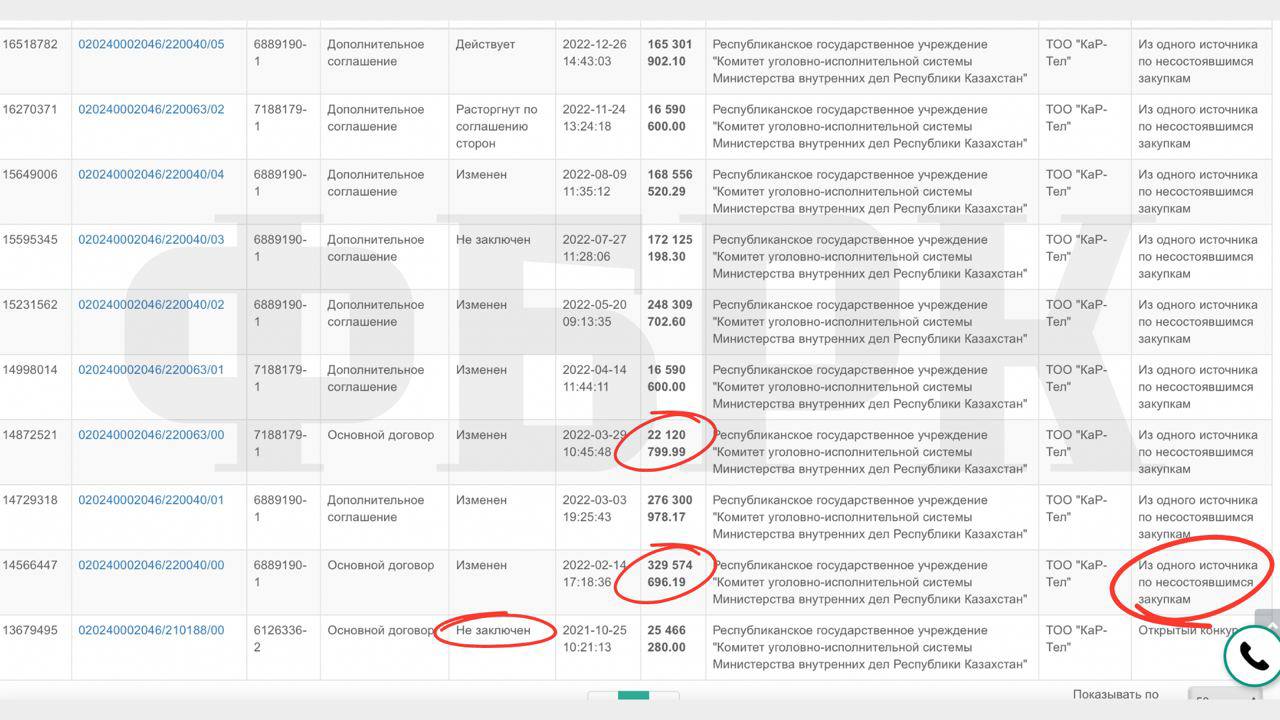
Furthermore, in 2022, the CPES purchased from the Partnership services for the provision of a tariff plan package (VPN channel) for the operation of those very electronic bracelets.
The contract amount was initially around 22 million tenge, and later changed to 16.5 million tenge. In November 2022, one month before the end of the term, the contract was terminated due to ‘the inexpediency of its further execution’.
If you calculate the equipment itself and the tariff plan package, it turns out that the CPES spent around 180 million tenge in 2022. Now, two years later, the contract amount will be over 1.4 billion tenge.
Moreover, this concerns not the purchase, but the lease of equipment, which allows such agreements to be concluded every few years.
Of course, one might assume that the electronic bracelets have soared in price over two years. However, there is a feeling that the problem lies not in this at all, but rather in the absence (often artificially created) of a competitive environment, which provides ample opportunities for dubious manipulations.