Following the recent FBK publication about water discharges in southern Kazakhstan amid a predicted drought, the Committee for Regulation, Protection and Use of Water Resources of the Ministry of Water Resources of the Republic of Kazakhstan presented data on the Tasotkel Reservoir, confirming its filling above last year's level. However, the question regarding the logic behind the discharges across the entire region remains unanswered.
WHAT WAS SAID AT THE BRIEFING
At a briefing at the Central Communications Service (CCS) on 24 June, dedicated to the digitalisation of water resource management, FBK founder and journalist Kirill Pavlov recalled the problem of low filling of the Tasotkel Reservoir in the Zhambyl region and the impending shortage of irrigation water there. The journalist asked whether this aligned with the ministry's forecasts.
In response, Vice-Minister of Water Resources and Irrigation Aslan Abdraimov explained that digital tools had provided a forecast for drought in the south and had even proven "somewhat" accurate.
Following the briefing, the FBK published an article, stating that despite the existence of a forecast for a shortage, which the Vice-Minister confirmed, the Ministry of Water Resources conducted water discharges of approximately 1 billion m³ in the south of the country in April.
Our editorial team questioned how the April water discharges fit into the ministry's logic. If digital systems had predicted in advance drought and the risk of shortages in several regions simultaneously, then emptying reservoirs before the flood season, without a comparable scale of flood threat, appears to be a decision that would only exacerbate the very shortage the department had been warned about by its own calculations.
WHAT THE COMMITTEE RESPONDED
The Committee for Regulation, Protection and Use of Water Resources responded to these conclusions with a comment under the publication itself. It states that as of 1 April 2026, reservoirs in the Zhambyl region had accumulated 731.7 million m³ - 67% of permitted capacity, which is 16.7 million m³ more than the figure for 2025. The Tasotkel Reservoir on the same date contained 422.2 million m³ - 22.2 million m³ more than last year, and today it already holds 374.2 million m³, 69.3 million m³ more year-on-year.
The discharges, according to the committee, were carried out according to approved operational schedules, and the releases along the Shu River are justified by calculations from KazNIIVKh LLP for the needs of the Sozak district.
It is worth noting that the committee's comment is centred on Tasotkel, a problem Pavlov did indeed raise at the briefing, but the conclusions of the FBK article concerned the logic of water resource management in southern Kazakhstan as a whole.
WHAT THE STATISTICS ON OTHER RESERVOIRS SHOW
This overall picture is supplemented by statistics from a briefing at the CCS from 21 May 2026, where the Committee Chairman, Seilbek Nurymbetov, presented data on reservoirs across the entire southern basin. According to this data, the Toktogul Reservoir (Kyrgyzstan), the largest flow regulator in the Syr Darya basin, was only filled to 41%, while the Andijan Reservoir (on the Kyrgyzstan-Uzbekistan border) was at 74%, Bakhri-Tochik (Tajikistan) at 103%, and the Shardara Reservoir (Kazakhstan) at 96%. 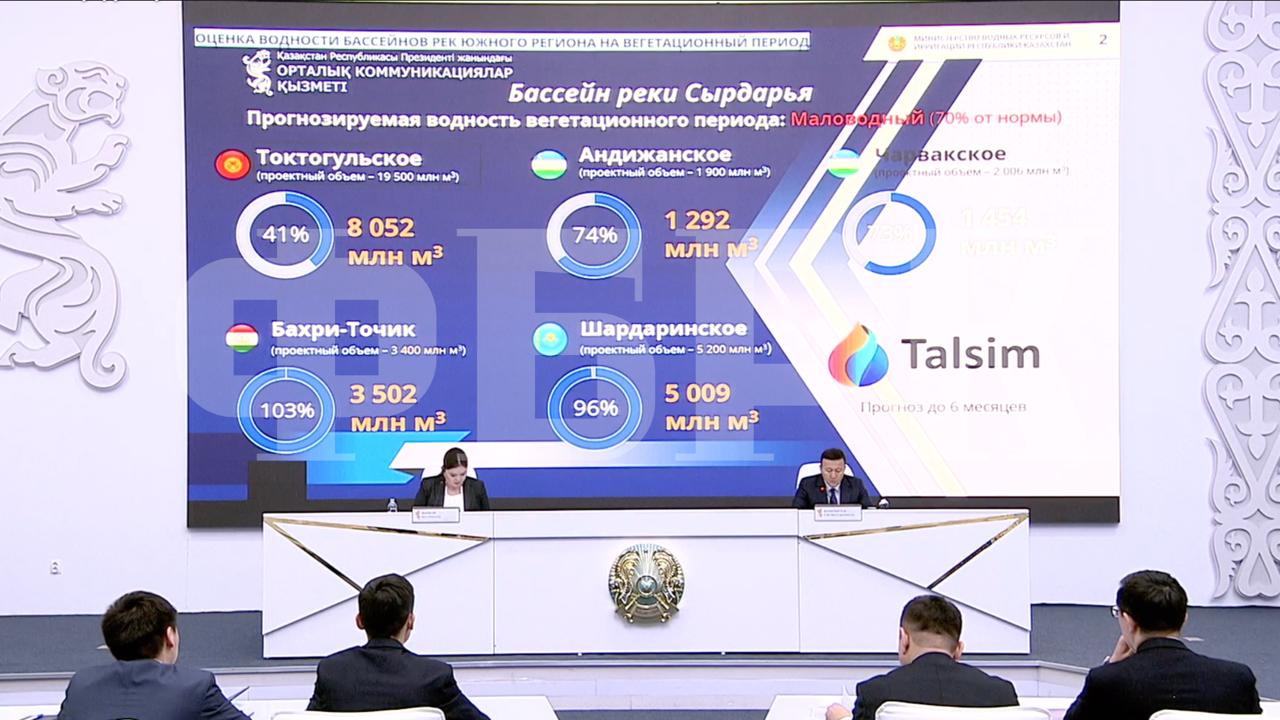
Confirmation that Tasotkel is filled with a surplus does not, however, answer the question of why, with a predicted water shortage and uneven filling of southern reservoirs (including the critically low level of Toktogul), massive water discharges were carried out in April. The committee's comment actually confirms a specific fact about one body of water but avoids the very managerial logic that was initially being questioned: how the department weighed flood and drought risks, and why the cost of these decisions fell on peasant farms.
For behind these decisions are specific farms. Farmers in the same Zhambyl region, counting on the season, have already invested in seeds, land cultivation, and equipment, only to face a shortage of irrigation water. If these investments were made against the backdrop of a forecast that, according to the Vice-Minister, the ministry already possessed, then the very chronology of events - first discharges, then shortage - appears to be a management paradox, which the committee's comment does nothing to explain.