The Ministry of Water Resources and Irrigation reported on standard preparations for the irrigation season at a briefing at the SCC. The founder of FBRK, journalist Kirill Pavlov, personally attended the event and found that the reconstruction of the K-30 canal in the Turkestan region has been delayed to 2027–2029. Meanwhile, the department could not even specify the size of the shadow water market - neither in monetary terms nor in cubic metres.
WHAT HAPPENED
On 21 May 2026, at the Central Communications Service (SCC) under the President of the Republic of Kazakhstan, a press conference was held, dedicated to preparations for the irrigation season. The main speaker was the chairman of the Committee for Regulation, Protection and Use of Water Resources of the Ministry of Water Resources and Irrigation (MWRI), Seilbek Nurymbetov. The deputy general director of the RSE "Kazvodkhoz", Yerbol Salikhbayev, also answered journalists' questions.
In his report, Nurymbetov stated that the flood period passed normally, the country's reservoirs are filled to planned levels, and emergency situations at hydraulic structures were not allowed. As of 18 May, the reservoirs in the southern regions had accumulated 26.2 billion cubic metres of water, which is 1 billion cubic metres more than a year earlier. In the current growing season, it is planned to withdraw approximately 11 cubic kilometres of water for irrigating 1.2 million hectares of sown areas.
Large-scale work on cleaning canals was separately noted: during the inter-vegetation period, 1,840 km of irrigation canals were cleaned. For the introduction of water-saving technologies in 2026–2028, 228.1 billion tenge has been allocated - four times more compared to the previous three-year period. Of this amount, 89% goes to five southern regions: 31.5 billion tenge is provided for the Turkestan region, 12 billion tenge for the Kyzylorda region, 11.8 billion tenge for the Zhambyl region, 4.4 billion tenge for the Almaty region, and 320 million tenge for the Zhetysu region.
In parallel, under a loan from the Islamic Development Bank (IsDB), the automation of 103 irrigation canals with a total length of about 1,000 km and an irrigation area of 65,000 hectares has been launched. More than 25,000 electronic contracts for water supply have been concluded with farmers.
K-30 CANAL
One of the key episodes of the briefing was an exchange of questions between the founder of FBRK, journalist Kirill Pavlov, and the deputy general director of "Kazvodkhoz", Yerbol Salikhbayev, regarding the on-farm K-30 canal in the Turkestan region.
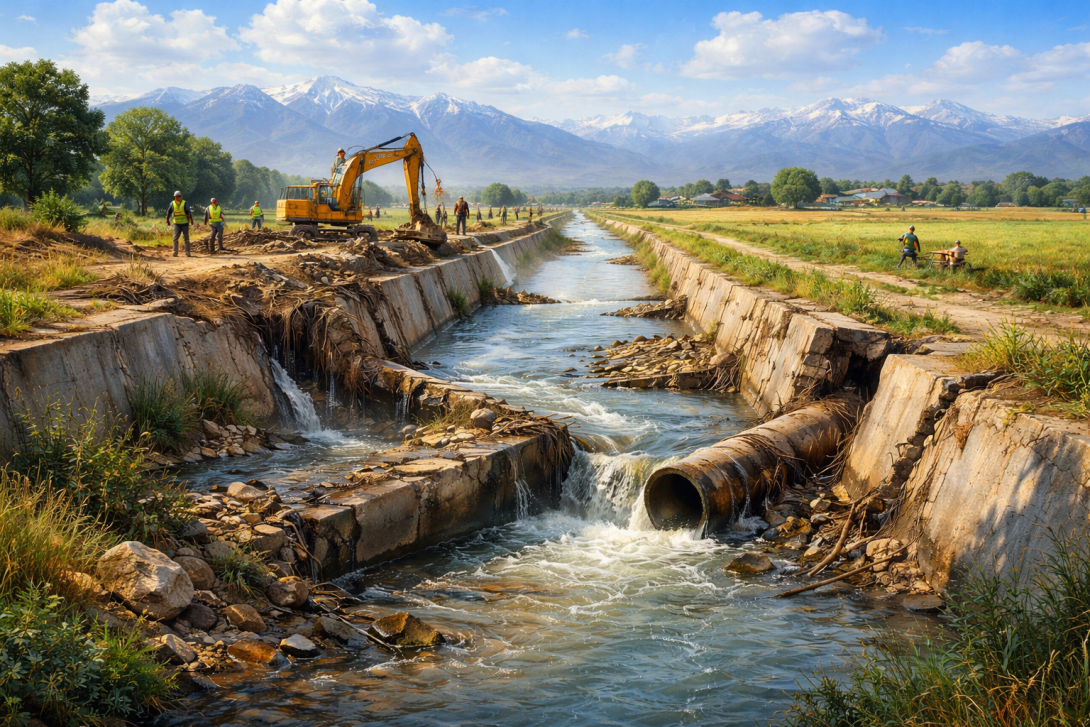
Previously, the FBRK editorial team had already reported in detail that the collapse of the banks and the uncleaned bottom of the structure pose a real risk for irrigating 1,700 hectares of agricultural land and supplying water to the residents of the villages of Zhetykazyna, Zhanadala and Zerdeli. As we managed to find out, based on the results of a technical survey, the canal has been assigned to technical condition category II, "operable structure", which according to regulations means a recommendation for major repairs or reconstruction.
At that time, the MWRI officially responded to FBRK that it planned to begin construction and installation work in 2026. However, at the briefing on 21 May, Salikhbayev stated that the design and estimate documentation (DED), worth approximately 6 billion tenge, was developed in 2025. The canal is in municipal ownership, and for reconstruction to begin, it must first be transferred to republican ownership. The reconstruction itself is planned for 2027–2029.
Yerbol Salikhbayev noted that the structure of the "Machine Water Supply" canal from the Shardara reservoir was built in 2011 using Chinese equipment, which has reached the end of its service life after 15 years. Annual mechanical cleaning only addresses the problem over a section of about 2 km, while the complete reconstruction of 15 km with replacement of pumping stations requires a separate project. This project, according to him, has only just "entered state expertise" - meaning there are still several stages before a budget application and construction.
90% OF CANALS IN THE SECOND CATEGORY: WHAT THIS MEANS IN PRACTICE
Journalist Kirill Pavlov also asked: how many canals in the overall network are assigned to that same "operable" second category and what are the actual water losses? Salikhbayev's answer was quite noteworthy. It turned out that of the 3,550 irrigation networks on the balance sheet of "Kazvodkhoz", 90% belong to the second category. Only strategic main lines like the Kyzylkum canal and the Big Almaty Canal (BAC) belong to the first.
Does this mean that 90% of the country's irrigation infrastructure officially requires major repairs or reconstruction? According to the logic of the regulatory documents - yes, that is precisely what follows from the classification. At the same time, the infrastructure itself continues to be operated, and its technical condition in most cases remains the same - with collapsing banks, an uncleaned bottom, and filtration losses.
When asked about water losses, Salikhbayev confirmed that on main canals, losses amount to more than 20%. At the on-farm and intra-farm level, where canals are in municipal or private ownership, losses, according to him, are significantly higher. Summing up, he stated that out of approximately 11 cubic kilometres of annual water withdrawal, losses amount to "plus or minus 3 cubic kilometres". That is, about 27% of the water does not reach the fields.
Remarkably, 20% is only the lower threshold, and only for main canals. Salikhbayev did not specify the upper limit of losses. Meanwhile, back in September 2025, President Kassym-Jomart Tokayev in his annual address to the nation directly stated that water losses in some canals reach 50–60%. At that time, the head of state also noted that the relevant bodies have no accurate information about the available volume of water resources, and that accounting technologies are hopelessly outdated. At the briefing in May 2026, the picture had not fundamentally changed.
It is precisely to reduce these losses that the ministry plans to gradually reconstruct 4,500 km of canals in on-farm and intra-farm networks, starting with the Zhambyl region and converting earthen canals to flumes and concrete structures.
SHADOW WATER MARKET
At the beginning of 2026, the volume of illegal water consumption in Kazakhstan was estimated at between 5 and 10% of the total volume of water used in agriculture. According to FBRK estimates, five years ago, the black market for water in Kazakhstan exceeded 20 billion tenge. At the briefing, Kirill Pavlov asked directly: what is the current dynamics of the shadow market?
However, the committee chairman, Seilbek Nurymbetov, could not specify either the monetary equivalent or the specific volume of illegal water abstraction nationwide. As an example, he cited data for individual basins: monitoring results revealed 197 hectares and about 790,000 cubic metres of water abstraction without contracts. According to him, systematic accounting is now carried out through a billing system and data from the European space monitoring programme Copernicus, and all "Kazvodkhoz" contracts have been converted to electronic format since the beginning of 2026. However, no overall figure for the shadow market, either in tonnes or tenge, was provided.
The official's reaction to the journalist's clarification that the issue was not about losses, but specifically about illegal instances of extraction and sale, was also noteworthy. Nurymbetov effectively conflated two concepts - technological losses and illegal water abstraction, which in itself is quite telling. The distinction between these categories is fundamental: the former is an engineering problem, the latter is a legal one.
During the 2026 growing season, the FBRK editorial team intends to monitor the situation with water supply and undertake its own assessment of the scale of the shadow water market.
WHAT THIS MEANS
We believe that for farmers in the southern regions, primarily the Turkestan region, the key risk this season is not a lack of water in the reservoirs, but water not reaching the fields due to dilapidated infrastructure. With losses of 27% and 90% of canals in the second category, the question of which farmers receive water on time and in the required volume largely depends on who owns the specific canal and how well it is maintained.
For the industry as a whole, the unresolved issue of the shadow water market means the preservation of a system where part of the water abstraction remains outside accounting and taxation. The transition to electronic contracts and billing potentially creates tools for identifying such cases, but only on condition that the data is analysed and used for law enforcement, and not just for reporting purposes.