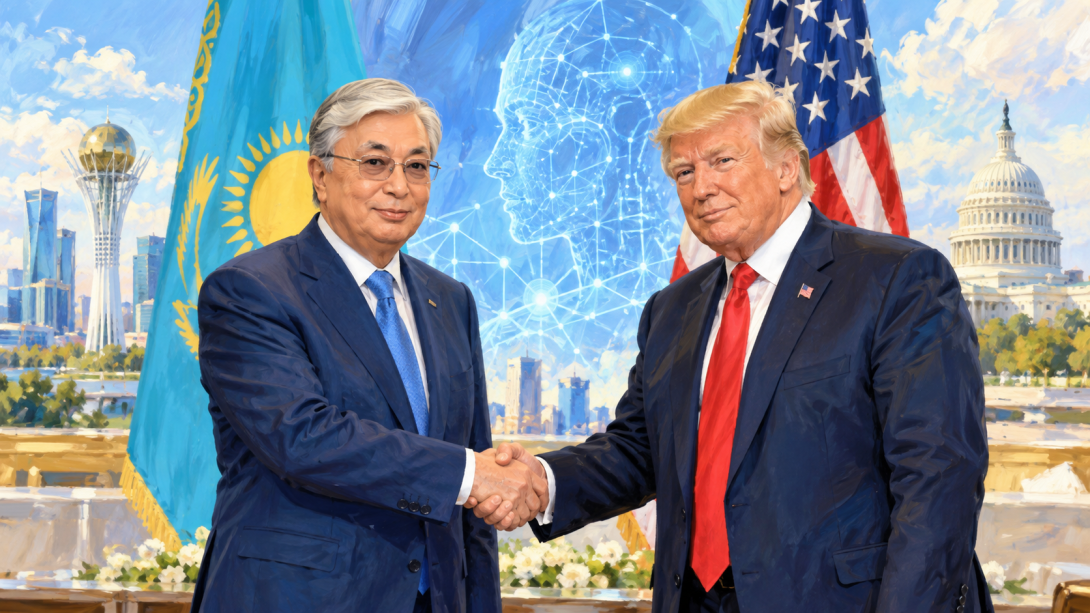
President of Kazakhstan Kassym-Jomart Tokayev supported US President Donald Trump's approach to regulating superintelligence and suggested the possibility of extending this model to the international level. The Head of State said this at the international forum AI & Digital Bridge — 2026.
WHAT TOKAYEV PROPOSED
The President of Kazakhstan stressed that the development of artificial intelligence (AI) requires a high degree of responsibility and integrity. He noted Donald Trump's initiative, which was supported by leading American technology companies.
Tokayev suggested that the agreement could become the basis for an international regulatory model, but stressed the need for prior discussion with interested states.
The Head of State also set out a principle that, in his words, should guide AI regulation: requirements must be strict on matters of security and the protection of citizens' rights, but not excessive. He warned that excessive regulation could lead to promising developments, teams and capital moving to other jurisdictions.
WHAT TRUMP'S INITIATIVE PROVIDES FOR
On 29 September 2026, Donald Trump announced an agreement with representatives of the American technology industry aimed at controlling the development of advanced AI systems. On 30 September, at a meeting at the White House, he presented a framework model based primarily on self-regulation by companies.
The agreement provides for four levels of safety control for advanced AI models:
- internal monitoring of the technologies' capabilities;
- the work of specialised internal oversight teams;
- external audit;
- independent oversight by special committees.
At the same time, the measures envisaged are voluntary in nature and do not replace mandatory state regulation. According to The Guardian, companies choose auditors and supervisory bodies themselves, and public disclosure of audit results is not mandatory.
WHAT POSITION KAZAKHSTAN SET OUT
Tokayev's speech at AI & Digital Bridge — 2026 was not limited to support for the American initiative. The President also touched on issues of Kazakhstan's technological development, the protection of citizens' rights and attracting investment into the industry.
According to him, last year the export of Kazakh IT services exceeded $1 billion, and the country's digital solutions are used in more than 100 states. The President linked the industry's further development to support for innovative startups and the implementation of cutting-edge projects.
Separately, Tokayev stressed the need for balanced regulation: the state must ensure security and the protection of citizens without creating excessive restrictions for technology businesses.
CONTEXT
Against the backdrop of discussions about AI regulation, technology companies and research organisations are proposing their own approaches to ensuring its safety.
For example, the head of Anthropic, Dario Amodei, called on companies and governments to slow the development of advanced AI models and strengthen control over their safety. The company estimated the probability that AI could destroy humanity within the next decade at more than 10%.
Microsoft presented a new AI Code of Conduct, which sets mandatory rules of behaviour for its AI models. The document provides for a ban on cyberattacks, nuclear weapons and the creation of deepfakes, and also requires that the possibility of human control over systems be preserved.
Alongside the initiatives of technology companies, the scientific community is working on systematising the risks associated with the development of AI. The Alan Turing Institute presented an analysis of the threats posed by the most advanced artificial intelligence systems. The researchers identified five areas requiring particular attention: cybersecurity, democratic stability, AI behaviour diverging from human intent, the loss of effective human control, and chemical and biological threats.