
The editorial board of FBRK has repeatedly written about the unsuccessful attempts of the Ministry of Digital Development, Innovations and Aerospace Industry of the Republic of Kazakhstan (MDDIAI RK) in the field of satellite monitoring, particularly in connection with JSC «NC «Qazaqstan Gharysh Sapary».
As is known, «Qazaqstan Gharysh Sapary» is the national operator of the Earth remote sensing space system and the high-precision satellite navigation system.
We previously reported that JSC «NC «Qazaqstan Gharysh Sapary» provided the Committee for Land Resources Management with satellite images, purchased earlier from the Chinese company China HEAD Aerospace Technology Co, which is under US sanctions.
At the same time, the Aerospace Committee of the MDDIAI RK denied the supply of Chinese images, which JSC «NC «Qazaqstan Gharysh Sapary» sold to the Committee for Land Resources Management under a government procurement contract. Meanwhile, QGS itself does not deny purchasing images from a foreign supplier.
Furthermore, according to data from the government procurement website, NC «QGS» has entered into a number of single-source contracts with regional emergency departments for the provision of space monitoring services. QGS has a similar contract with the Ministry of Defence of the Republic of Kazakhstan, as well as a contract with the State Institution «Republican Methodological Centre for Phytosanitary Diagnostics and Forecasts».
According to official data from the government procurement website, we know that this year JSC NC «QGS» spent over 1.7 billion tenge on access to spatial data and the purchase of satellite images from foreign suppliers, which were later resold to state institutions of Kazakhstan for a total of over 1.4 billion tenge.
In particular, JSC NC «QGS» paid approximately $611,415 to the American company Maxar Intelligence Inc. for services providing satellite images and $940,000 to another American company Planet Labs for a subscription service for access to data from the Data Access satellite constellation.
However, it must be taken into account that not all contracts with foreign companies are reflected on the government procurement website. For example, the contract with Ti-Tech Development Limited (a subsidiary of China HEAD Aerospace Technology Co), which we learned about from insiders. It is also worth noting that, according to information from our sources, «Qazaqstan Gharysh Sapary» has still not settled its accounts with this supplier.
It is also worth recalling that the revenue of «Qazaqstan Gharysh Sapary» from contracts for Earth remote sensing space system services and research services for 2022 amounted to approximately 3.6 billion tenge.
The editorial board of FBRK has repeatedly asked the question: why does NC «QGS», having its own satellites at its full disposal, buy satellite images from foreign companies?
The answer to this question is clearly visible in the new information system «Unified State Real Estate Cadastre» (USREC), introduced in 2022, which includes a function for viewing a map of Kazakhstan from «QGS» satellites.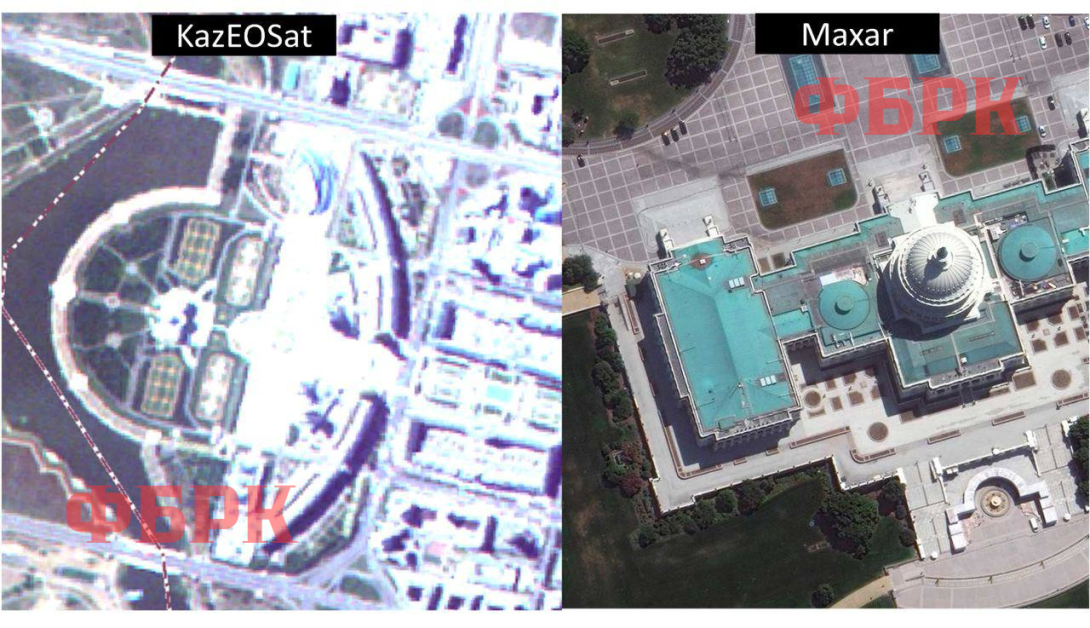
Indeed, comparing images from KazEOSat and Maxar, it is impossible not to notice that the domestic product is significantly inferior in quality, precisely when the technical characteristics of the images are critically important for solving specialised tasks.
The conclusion is obvious. The images that «QGS» provides to our state bodies are hardly made by them. Although, even with the availability of foreign images, which required considerable financial resources, it is not possible to prevent various emergencies in a timely manner.
For example, the fire in the Kostanay region, the fire on the territory of the «Semey Ormany» State Nature Reserve, or the repeated floods in Kazakhstan, when the Ministry of Emergency Situations of the Republic of Kazakhstan received incorrect satellite data. There was no timely and prompt information provision from «QGS», which led to the well-known tragic events, while even private companies predicted these emergencies.
In this regard, it remains a mystery why QGS and the Aerospace Committee plan to launch another three satellites of the same quality for 18 billion tenge, hiding behind the claim that they will solve the tasks for which high-resolution images are currently being purchased anyway.
It is also unclear why the MDDIAI RK decided to launch the clearly unprepared project «Unified State Real Estate Cadastre» (USREC), which has already received numerous complaints.
The editorial board of FBRK intends to find out who developed the new USREC information system and at what cost. Meanwhile, another question remains unanswered: How did the Agency for the Protection and Development of Competition of the Republic of Kazakhstan allow a monopoly on the resale of satellite images?
To be continued...