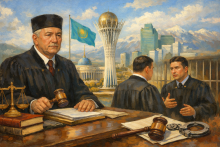
In Kazakhstan, judicial immunity is seen as a guarantee of the independence of judges, not a personal privilege. At the same time, the legislation provides for mechanisms of accountability, but with a more complex procedure to prevent pressure on the judicial system.
JUDICIAL IMMUNITY AND ACCOUNTABILITY
A member of the Supreme Judicial Council (SJC), Saltanat Zhunuspekova, explained that judicial immunity is not a personal privilege. According to her, it is a constitutional guarantee of a judge's independence in the administration of justice. However, the existence of immunity does not imply impunity.
She noted that current legislation provides for mechanisms to hold judges accountable, including disciplinary and criminal proceedings. However, these procedures are more complex than those for other individuals, as they are designed to prevent pressure on the courts and the judicial system.
HOW JUDGES ARE HELD ACCOUNTABLE
According to her, these procedures follow an established process. In particular, when considering the issue of holding a judge administratively liable, internal affairs bodies first contact the Prosecutor General. After that, he submits a representation to the Supreme Judicial Council.
The Council reviews the matter and makes a recommendation, after which the materials are sent to the Presidential Administration.
WHEN POLICE CAN ACT AT THE SCENE
The discussion also touched on the issue of police actions when a judge is suspected of driving under the influence of alcohol.
Saltanat Zhunuspekova explained that in situations requiring the immediate suppression of an offence, police officers have the right to take measures at the scene — including stopping the vehicle and carrying out necessary procedures.
At the same time, the issue of holding the judge accountable is considered separately and requires compliance with the established mechanism.
PERSONNEL RESULTS AND SYSTEM CHANGES
The Supreme Judicial Council has summarised the personnel results for 2025. Since July, three cassation courts have started operating in Astana, completing the renewal of the judicial system's structure.
Over the year, 151 judges were appointed and 64 vacancies were filled. The replenishment rate was 131.3%.
In 2026, a further 128 judges have already been appointed, 230 vacancies remain, and 41 candidates are undergoing verification.
Selection procedures have been accelerated: exams now take around 3 months instead of 1.5 years. There are 149 judges in reserve, of whom 47 have already taken up higher positions. A digital selection system is planned to launch in July.
The Council also noted that there is a public demand for fairness and transparency in such matters.