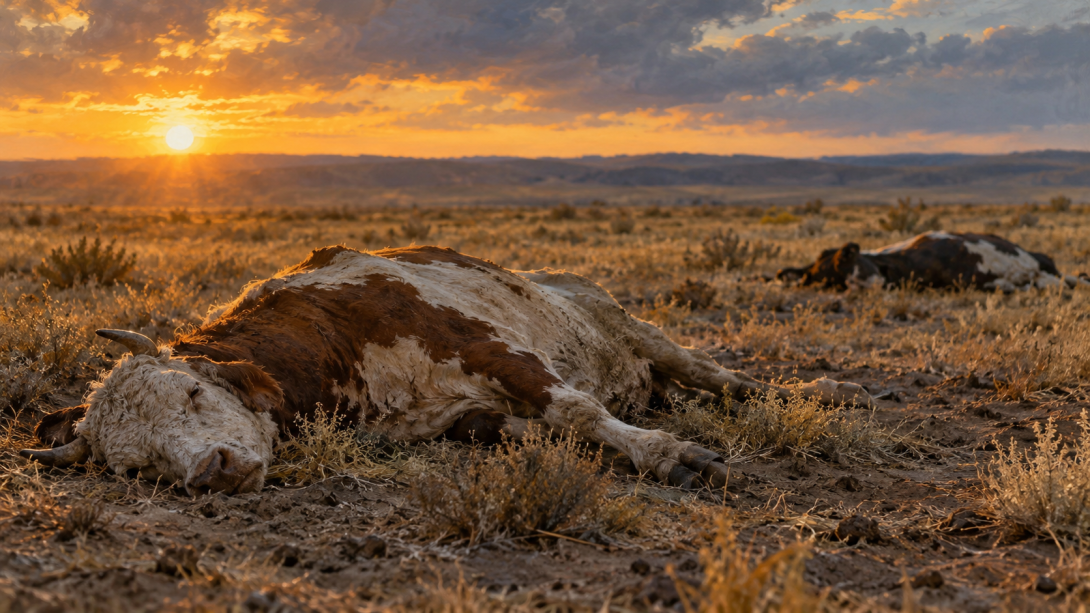
In Atyrau Region, near Makat, cattle are dying. A local livestock farmer reports ten dead animals, but the regional agriculture department officially confirms only two cases.
WHAT THE LIVESTOCK FARMER SAID
According to the Instagram page "Aq Zhaiyq", private livestock farmer Nazbek Tastemirov, who tends local residents' livestock for a fee, spoke about the deaths of animals on the "Bileuli ata" plot.
According to him, the cattle began to fall ill and die one after another. The animals stop eating, weaken and cannot rise on their hind legs.
"The cattle lie down and cannot rise on their hind legs. The animals stop eating hay and feed, gradually weaken and die," Tastemirov said.
WHAT CAUSE THE LIVESTOCK FARMER SUSPECTS
Tastemirov suspects that the cause of the cattle deaths may be emcar (emphysematous carbuncle).
According to him, vaccination against this disease is usually carried out in spring, but this year the animals were not vaccinated.
Because of the cattle deaths, the livestock farmer is forced to return the animals to their owners.
WHAT THE AGRICULTURE DEPARTMENT REPORTED
The head of the department, Amangeldy Salamat, reported that only two head of cattle have been officially registered as dead.
According to him, specialists took samples and sent them for laboratory testing to establish the cause of the animals' death.
WHAT MEASURES ARE BEING TAKEN
According to the regional agriculture department, vaccination against emcar is currently being carried out.
However, the results of laboratory tests have not yet been provided. Thus, the suspected link between the animals' deaths and emcar has not been officially confirmed.
CONTEXT
Previously, FBRK reported the deaths of about 25 head of cattle in two villages of Raiymbek District, Almaty Region. Among the dead animals were cows and horses. The cause of death remained unknown.
Similar cases have occurred in other regions. In Atyrau Region, in the village of Kenuzek, farmer Raya Mukhanbetova lost 13 head of cattle, and another livestock farmer reported the deaths of 20–30 animals a year earlier. In Mangystau Region in September, 126 sheep died. Veterinarians suspected poisoning, but the exact cause was not established.
In Aktobe Region, 51 dead animals were found to have theileriosis, piroplasmosis, and in some cases — leptospirosis.
In spring in West Kazakhstan Region (WKR), livestock diseases raised suspicions of foot-and-mouth disease. Doctor of Veterinary Sciences Gaisa Absatirov doubted the official diagnoses, but the Ministry of Agriculture reported that testing in 477 settlements did not confirm foot-and-mouth disease.
In Kostanay Region, brucellosis was also recorded. In the village of Kazanbasy, the disease was detected in 23 of 323 animals. Later, a court ordered one of the farms to send the infected livestock for sanitary slaughter.
Separate questions arose regarding anthrax. In Kosshy, residential houses ended up in the sanitary zone of an anthrax burial site. In Akmola Region, 250 foci are listed, but the location is known for only 67.
In Balkhash, a man was hospitalised with suspected anthrax after contact with meat carcasses. However, laboratory tests did not confirm the diagnosis, and meat samples and swabs returned negative results.