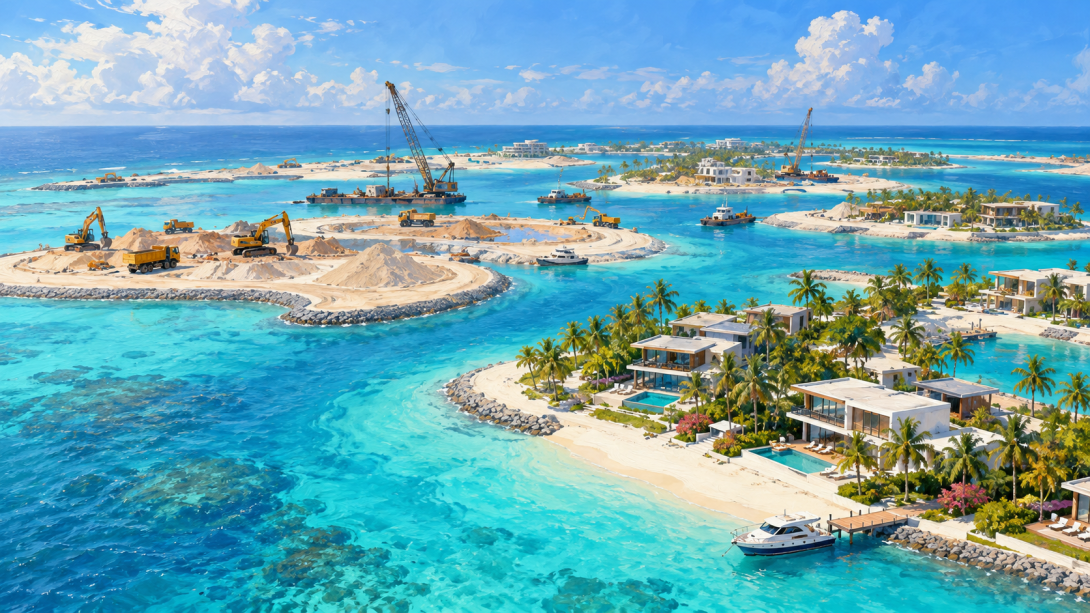
The Maldives is developing a $790 million artificial island project and preparing a residency-by-investment programme. The authorities hope to attract foreign capital amid high government debt, but the initiative has raised questions about the transparency of financial transactions, investor due diligence and protection of the marine environment.
WHAT IS KNOWN ABOUT THE PROJECT
According to OCCRP, Project Ayla is being implemented in Noonu Atoll. Artificial islands and land plots for luxury real estate are being built there. More than 6 million cubic metres of sand have been dredged from the seabed to create the new territories. The project provides for more than 70 luxury residences.
The development is being carried out by local company Crystal Holdings Private Limited and Dubai-registered BluRock Group. Information about their ultimate investors and beneficial owners is not publicly available. Neither company responded to journalists' enquiries.
WHY THE MALDIVES NEEDS FOREIGN INVESTORS
The government is seeking to attract additional funds into an economy under serious debt pressure. According to International Monetary Fund forecasts, in 2026 the Maldives' government debt will reach approximately 130% of GDP.
Minister of Economic Development and Trade Mohamed Saeed has said that the investment residency programme could provide the country with more than $1 billion in direct and indirect revenue.
The Maldives Pearl Residence programme envisages granting foreigners residency in exchange for investment. The minimum investment amount has not yet been announced, and the programme's legislative and regulatory framework is still being developed.
WHAT QUESTIONS HAVE ARISEN ABOUT FINANCIAL TRANSPARENCY
The Maldivian constitution prohibits foreigners from owning land, but in special economic zones (SEZs) long-term leases of property for up to 99 years are possible. Tax incentives are also provided for such territories, including for certain capital gains taxes and import duties.
Under SEZ legislation, offshore banks serving trusts may operate in such zones. Disclosure of information about the ultimate beneficial owners of bank clients and of the banks themselves is restricted: without the owner's consent or a court order, it is unlawful.
Former Information Commissioner of the Maldives Ahmed Ahid Rasheed pointed to a lack of transparency due to the absence of public ownership registers. APG also noted gaps in the regulation of trusts and high money-laundering risks in the real estate sector.
The Ministry of Economic Development of the Maldives said that the residency programme provides for multi-tiered vetting of investors. The ministry also stressed that Project Ayla falls under anti-money laundering and counter-terrorist financing legislation.
WHO IS RESPONSIBLE FOR THE RESIDENCY PROGRAMME
The government is developing and implementing Maldives Pearl Residence jointly with Henley & Partners, a company specialising in investment residency and citizenship programmes.
The company's activities have previously been criticised over its involvement in similar programmes in other countries. Henley & Partners itself rejected the conclusion that past controversial cases indicate insufficient vetting under the Maldivian initiative.
The company said it would help with processing applications and preparing recommendations, while final decisions on granting residency would remain with the Maldivian government.
WHY THE PROJECT RAISES ENVIRONMENTAL CONCERNS
The expansion of territory through land reclamation to create artificial islands is taking place against the backdrop of the Maldives' vulnerability to rising sea levels. Around 80% of the country's nearly 1,200 islands are located less than one metre above sea level.
Environmental activists warn that dredging sand from the seabed may damage coral reefs, marine life and water currents. President Mohamed Muizzu, for his part, has said he intends to combine construction with conservation measures, including coral restoration.