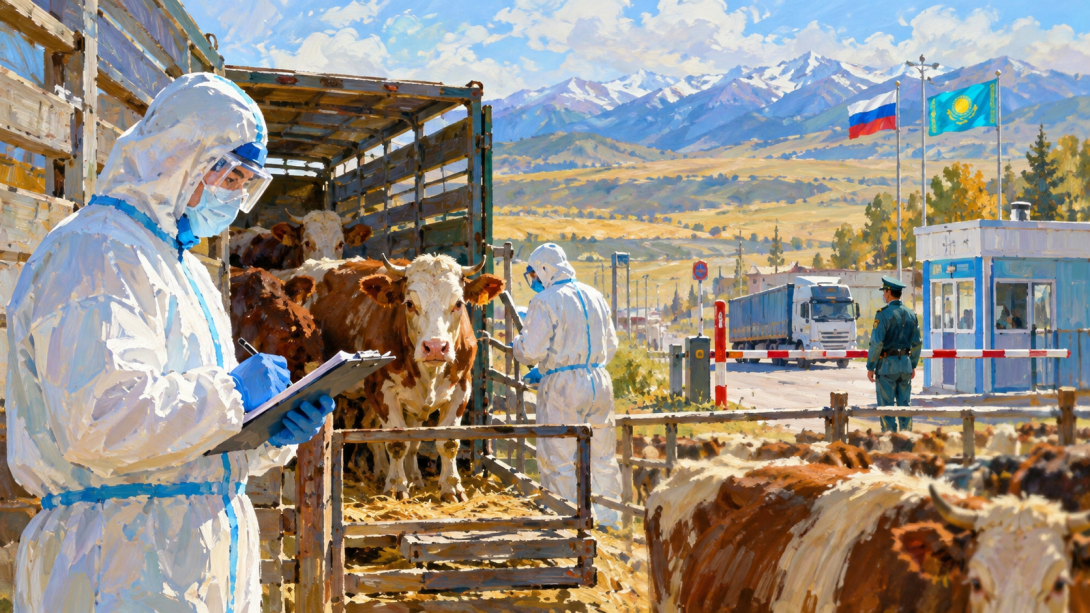
In Russia’s Zabaykalsky Krai, a state of heightened readiness has been in force since 8 October 2026 because of the threat of foot-and-mouth disease being introduced. The authorities ordered vaccination of livestock in 12 border districts, restrictions on grazing animals near the state border and the allocation of funds to purchase vaccines. At the same time, there is no official confirmation of an outbreak of the disease in the region.
WHAT MEASURES WERE INTRODUCED IN ZABAIKALYE
Governor of Zabaykalsky Krai Aleksandr Osipov explained the introduction of the regime by the need to protect the region from foot-and-mouth disease amid reports of outbreaks of the disease in China and Mongolia, which were reported by the World Organisation for Animal Health (WOAH).
Veterinary services were instructed to carry out mass booster vaccination of livestock in 12 border districts. The region’s Ministry of Finance was ordered to urgently allocate funds from the reserve fund to purchase vaccines.
The authorities also ordered restrictions on grazing livestock within a radius of 10 kilometres of the state border. In the rest of the region, only controlled grazing is permitted. In addition, information about animals in household registers must be updated.
Livestock owners must present animals to veterinarians for examination and vaccination and immediately report deaths and mass illnesses. The sale of meat and milk is permitted if veterinary documents are available.
HAS FOOT-AND-MOUTH DISEASE BEEN DETECTED IN THE REGION ITSELF
There is no official confirmation in the material presented that foot-and-mouth disease has been detected in Zabaykalsky Krai. At the same time, Mash claimed that the infection had been detected in local settlements, citing a response from the state veterinary service.
The agency denied this information. According to the veterinary service, the state of heightened readiness is linked to outbreaks of the disease in neighbouring states and the forthcoming migration of gazelles, which requires additional measures.
Thus, information about the possible detection of the infection within the region remains contradictory.
WHAT RESTRICTIONS APPLY TO PRODUCTS FROM ETHIOPIA
Russia introduced separate veterinary control measures in respect of products from Ethiopia. Rosselkhoznadzor restricted the import of goods amid the worsening epizootic situation in the African country.
The restrictions cover susceptible animals, including cattle, small ruminants and pigs, genetic material, milk and dairy products, meat and raw meat materials.
The ban also covered certain types of feed, hides, wool, fur and other raw materials of animal origin, as well as certain substrates and materials used for breeding earthworms.
CONTEXT
In February–March 2026, a large-scale campaign to destroy farm animals took place in Novosibirsk Oblast. The authorities explained it as pasteurellosis, but some experts said there could have been an outbreak of foot-and-mouth disease.
In August and September, mass slaughter of pigs was carried out in several districts of Tyumen Oblast. The authorities cited an outbreak of a particularly dangerous disease, while representatives of the local branch of the Communist Party of the Russian Federation, residents and rural specialists reported African swine fever (ASF). In early September, this information was confirmed by the regional emergency management department.
Kazakhstan began introducing veterinary restrictions amid the epizootic situation in Russian regions as early as January 2026. From 13 January, the Committee for Veterinary Control and Supervision of the Ministry of Agriculture gradually restricted the import and transit of live farm animals, livestock products and untreated feed.
The risks for Kazakhstan are not linked only to the Russian direction. In April 2026, the Chinese authorities reported outbreaks of foot-and-mouth disease in Gansu province and the Xinjiang Uyghur Autonomous Region, which borders Kazakhstan.
At the same time, border restrictions alone may not be enough to control all possible routes of spread of the infection. In the FBK material, the risks associated with the movement of wild animals, in particular saigas, and the need for veterinary monitoring of domestic livestock were considered separately.