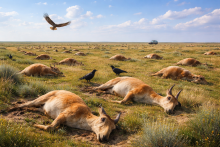
In the Akmola Region, a mass die-off of saiga antelopes occurred during the spring migration. Nearly 2,000 animal carcasses have already been disposed of in the region to prevent a deterioration of the sanitary and epidemiological situation.
WHAT SPECIALISTS SAY ABOUT THE CAUSES OF THE DIE-OFF
According to Nayzakokshe.kz, the mass die-off of saiga was recorded in the Atbasar District during the spring migration and calving period. Veterinary services and the forestry inspection preliminary link the animal deaths to seasonal natural factors.
It is reported that female saiga were exhausted after long migrations and difficult births. Sharp temperature fluctuations, prolonged rains and May frosts had an additional impact. These conditions led to hypothermia and the death of weakened saiga calves.
HOW THE DISPOSAL OF ANIMALS IS BEING CARRIED OUT
Work on the collection and disposal of dead animals is underway in the Shunkyrkol Rural District. Local executive bodies and specialised services are involved.
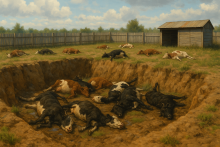
Veterinary specialists have taken the necessary samples. The carcasses are being buried in deep pits in the steppe area.
WHAT THE SPECIALISTS REPORTED
Inspector Yerzhan Saginayev of the Akmola Regional Territorial Inspectorate of Forestry and Wildlife stated that the die-off is preliminarily not linked to infectious diseases and is seasonal in nature.
According to him, similar cases periodically occur during the mass calving period of saiga both in the Akmola Region and in other regions.
He also reported that veterinary services on 30 April 2026 took bacteriological samples from a dead saiga on the territory of the Zhaksyn District. Based on the results of the examinations, tests for particularly dangerous infectious diseases showed a negative result.
WHY THE SITUATION IS UNDER THE CONTROL OF THE SERVICES
Specialists note that it is difficult to intervene in natural processes during animal migration and calving. At the same time, sanitary services continue to collect and dispose of carcasses to prevent a possible deterioration of the ecological and sanitary situation.
CONTEXT
The authorities of Kazakhstan state that the mass die-off of saiga is not linked to an outbreak of foot-and-mouth disease or other particularly dangerous infections. Earlier, the Vice-Minister of Agriculture Ammangali Berdalin reported that over the past month, specialists checked samples from 477 populated localities, and all results for foot-and-mouth disease were negative.
The Vice-Minister of Ecology and Natural Resources Nurken Sharbiyev stated that the recorded saiga deaths correspond to the natural mortality rate. According to his data, a die-off of around 26,000 animals has been recorded across the country, with a total population size of about 4 million individuals before the start of calving.
The editorial team of FBRK continues to monitor the situation with the saiga die-off in the West Kazakhstan, Aktobe, North Kazakhstan, Akmola and Karaganda Regions. The situation remains most tense in the WKR, where saiga deaths and cases of disease in livestock are being recorded simultaneously. Earlier, authorities reported a preliminary diagnosis of pasteurellosis, and a working group of the veterinary control committee visited the region to assess the epizootic situation.
Independent analytical company Geobox Inc. published scenario modelling of the possible spread of foot-and-mouth disease in Kazakhstan. The analysis covered 201 districts of the country and took into account data on 8 confirmed saiga die-off sites, information on 5,484 head of livestock from the official report of the WKR veterinary services, as well as a separate outbreak in the Almaty Region, which is considered in the model as a possible transboundary route for the spread of infection from Xinjiang.