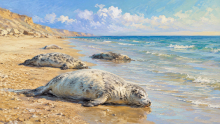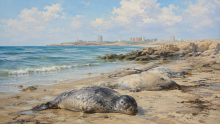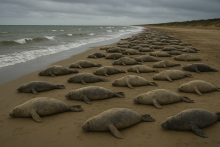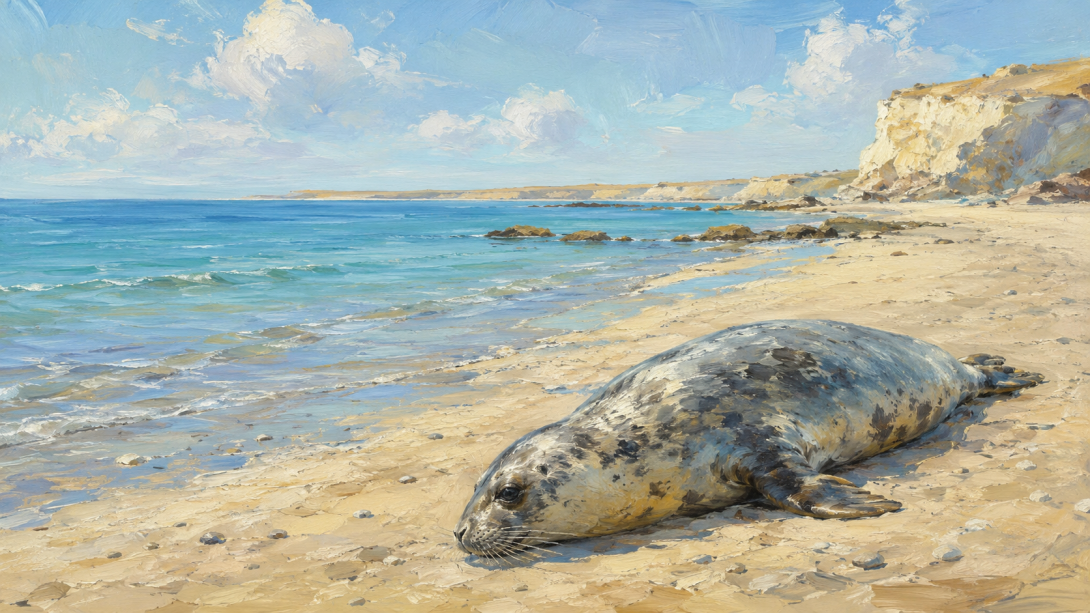
Since the start of 2026, 387 dead Caspian seals have been found on the coast of Mangistau Region. Specialists continue to investigate the causes of their deaths, with the results of studies on this year's finds expected in the autumn.
WHAT DATA HAVE THE SPECIALISTS REVEALED
According to Lada.kz, the head of the regional fisheries department, Arman Moldashev, stated at a press conference in the Public Communications Centre (PCC) of the Mangistau Region that in 2024, 2,212 dead seals were found on the region's coast. Since the start of 2026, 387 dead animals have been recorded.
According to specialists, most of the carcasses had been in the water for a long time and had reached stages 3–4 of decomposition. Therefore, scientists were only able to collect hard tissues for analysis — claws, teeth and bones. These studies will help determine the age and sex of the animals. The results of the examinations regarding this year's finds are expected in September–October.
WHAT THEORIES FOR THE CAUSE OF DEATH ARE BEING CONSIDERED
The director of the state nature reserve "Caspian It Balygy", Samat Yergaziyev, stated that in previous years, scientific studies did not record any cases of seal deaths directly caused by exposure to heavy oil waste.
According to Arman Moldashev, scientists officially attributed the cause of death of the animals in 2024 to the aftermath of underwater seismic earthquakes. He also stated that there is a well-founded assumption that the animals may have been poisoned by gases released from underground as a result of these processes. Furthermore, he added that some of the dead seals may have been carried to the shores of Mangistau Region by storm winds from the direction of Baku.
Specialists are also considering infectious diseases as one possible factor. However, tests conducted in 2024 using PCR methods for pasteurellosis, avian influenza, canine distemper, salmonellosis and listeriosis yielded negative results.
Currently, specialists are studying the combined influence of natural, infectious, epizootic and anthropogenic factors. Monitoring and laboratory research are ongoing.
WHAT WAS REPORTED ABOUT FISHING NETS
During the press conference, representatives from the relevant departments commented on the widespread belief that seals are dying en masse in fishing nets.
According to Arman Moldashev, nets permitted for commercial fishing in the Caspian Sea have a small mesh size, so seals do not get caught in them. However, he noted that isolated incidents of animals being injured by collisions with boats or getting caught in permitted nets are possible.
At the same time, specialists acknowledged that a serious threat is posed by prohibited large-mesh nets used in poaching for sturgeon. According to information from the agencies, no cases of seal deaths in poaching nets have been officially recorded in the Mangistau Region in 2026.
WHAT MEASURES HAVE BEEN PROPOSED TO REDUCE THE STRAIN ON THE ECOSYSTEM
Participants in the press conference also reported on the development of aquaculture as one way to reduce the pressure on the wildlife of the Caspian Sea.
According to their data, 28 sites for cage farms have already been identified in the waters. The materials note that a project by Organic Fish LLP is developing in the region, introducing Norwegian technology for raising salmon in cages. According to industry representatives, this approach could help reduce the impact on the sea's natural ecosystem.