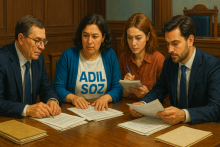
The conflict between ORDA's editor-in-chief Gulnara Bazhkenova and banker Vyacheslav Kim has become the media event of the year. Allegations of commissioned hit pieces against Timur Turlov, suspicions of covert project financing, and a dispute over control of the publication have all woven together into a story where every new comment instantly becomes the subject of public scrutiny.
Recently, Bazhkenova publicly stated that Kim demanded the editorial team write articles against the owner of Freedom Finance, Timur Turlov, and the founder of Kazakhstan Paramount Engineering, Aibek Barysov. According to her, she refused these 'orders', although she admits she criticised Turlov for 'personal reasons'.
Formally, it's impossible to prove these accusations — it all comes down to personal 'belief'. But a simple check of ORDA's articles tagged 'Turlov' creates the impression that the editorial team actively pursued a line coinciding with Kim's interests. This impression becomes particularly stark against the backdrop of the acute phase of the conflict, where the journalist's main weapons are words and credibility.
As for the latter, it's far less clear-cut. The credibility of the 'incorruptible' and 'independent' media outlet crumbled when the country learned who the real beneficiary of ORDA is. Let's be honest: worldwide, the editorial policies of major publications show flexibility when it comes to the interests of a shareholder.
Let's recall that at the beginning of autumn, Maksat Ganiyev stated that he owned 70% of the share in OrdaMediakz LLP. According to his version, he registered the company in 2020, and Bazhkenova acquired her share later. A check of the documents confirmed: Ganiyev is the original founder, Bazhkenova is the director.
Bazhkenova claims the document is forged. However, her request for a forensic examination was denied, and she lost in court. Bazhkenova admitted: she does not have the original founding document that could prove her version.
Bazhkenova's previous position contrasts starkly with Ganiyev's statements about multi-million dollar investments. In the plagiarism lawsuit with Ratel.kz, her representatives argued that ORDA is a 'micro-business' with 7 employees. Now that the founder talks about tens of millions of tenge, this version seems contradictory. If the sums of money were significant, who was determining editorial policy?
A September publication about the alleged detention of Minister Murat Nurtleu deserves particular attention. ORDA fired off a sensational statement: the minister had been detained along with businessman Haji Hajiyev and KNB officers.
The publication cited 'sources'. But government agencies denied the information, and Nurtleu soon appeared in public. The editorial team didn't back down, instead switching to framing his transfer as a 'demotion'. But this version also went unconfirmed.
The story turned out to be sensational but ultimately empty — and the question remains open: was this chance or an element of someone's larger game?
All of ORDA's articles about members of the elite will now be perceived as being on Kim's orders. That's how things work here — the 'follow the money' principle operates flawlessly. Especially when it involves companies in sectors adjacent to Kazakhstan's wealthiest man.
Notably, the oligarchs are staying silent. Turlov is probably in shock at being dragged into this and simply has nothing to say. As for Kim, serious accusations have been levelled at him — but he hasn't made any public statement. The media war is escalating, and the silence is making it even more tense.
One should probably understand: some of Bazhkenova's claims about who 'ordered' the hit on Turlov sound plausible. However, her version of completely refusing Kim's offers raises significant doubts. Especially when you remember that the 'micro-business' turned out to be a generously funded media project, and publications like the Nurtleu story look suspiciously like commissioned pieces.
The conflict promises new revelations and exposes, and ahead, apparently, there are still many twists and turns. Will this story make Kazakh journalism better and more independent? Unlikely.
It's far more likely that we are witnessing yet another round in the struggle of major players, where the public remains a spectator and the media serves as the battlefield.
This scandal merely lays bare an uncomfortable truth: major media projects exist thanks to serious investment, and investors are rarely motivated by altruism.