In 2023, an article was published entitled "The Saiga Conservation Strategy in Kazakhstan", which appeared in the Brazilian Journal of Biology. After analysing the dynamics of the saiga population, as well as the factors affecting their numbers, the authors concluded that under current conditions, the saiga population needs to be controlled. However, as we know, where the scientific approach ends, someone's profit begins.
Among the authors of the aforementioned article is the LLP "Vip Safari Service". LLP "Vip Safari Service" (hunting and trapping, including the provision of services in these areas) has been registered in Almaty since 2006. The company has a tax debt amounting to 637 thousand tenge.
The head of the company is businessman Nurlan Kikimov, who also appears in the Corporate Fund "Central Asian Mountain Sheep Fund", in LLP "Hunting and Fishing Farm 'Tabigat'", which is engaged in tour operator activities, as well as in the PA "Kazakhstan Society of Hunters and Fishermen 'Tabigat'" and LLP "Tastau-S", specialising in hunting and trapping.
According to data from the service Kompra.kz, the founder of LLP "Vip Safari Service" is a board member of the Kazakhstan Society of Hunters and Fishermen 'Tabigat', Kazhym Dzhumaliev. Mr. Dzhumaliev is a zoologist, hunting user, hunter, outfitter, and game breeding specialist. He is also an active participant in work on legislative reforms designed to improve conditions for the development of hunting tourism in Kazakhstan. As far back as 2018, Mr. Dzhumaliev, in an interview with Kapital.kz, discussed how Kazakhstan could profit from trophy hunting.
Mr. Dzhumaliev also appears in LLP "Samat Show Technik", LLP "Kazmuztorg", LLP "SST Property", LLP "Pro Hunt", LLP "Illusion Cinema", LLP "Illusion – Maxima", LLP "Illusion Plus", LLP "Pro Hunt Astana", LLP "Okhotnik KZ", LLP "Tastau-S" and PA "Kaz Alpine Club".
Furthermore, according to data from open sources, he is a member of the International Federation of Equestrian Tourism, is involved in projects for the game breeding of Bukhara deer and wild boar and the implementation of grants for the development of sustainable tourism in the Dzungarian Alatau through the CEPF and WWF.
Representatives of the Kazakh National Agrarian Research University and the S. Seifullin Kazakh Agrotechnical University also took part in creating the article on saiga conservation. However, even the professional weight of the authors presented did not protect them from certain inaccuracies.
For example, the text of the article states that "saigas consume only 12–23 kg/ha of vegetation per year (about 1.5-2% of crops), while domestic animals use 100 or more kg/ha (12-18%)", which indicates a low grazing pressure from saigas.
Later, the authors report that "the forage capacity of the republic's pastures can, in full abundance, provide an annual diet for 1 to 3 million saigas without harming the environment". Moreover, "thanks to the hooves of saigas, many rare plants endemic to the steppe are pollinated".
Based on the information above, one can conclude that an increase in the saiga population would not become a serious problem. However, the authors then state that "the antelopes trample crops and consume all vegetation on pastures", meaning an increase in their numbers would damage agriculture. An oxymoron, don't you think?
The inconsistency of the facts described above is the main justification for regulating the population/killing of saigas, which the authors of the article insist upon. The article, however, does not mention that such a policy carries certain risks. After all, for instance, when shooting males, which are of primary interest, there is a high chance of losing the entire herd due to the process of inbreeding.
The article also describes that the saiga population was determined by extrapolating census data to the territory occupied by the animals. As is known, this method is characterised by low accuracy, especially in conditions of a variable environment. Consequently, the data on saiga population growth presented in the article raises some distrust. For instance, up to 2021, the annual growth rate was 30-40%, and in 2021 it unexpectedly became 150%.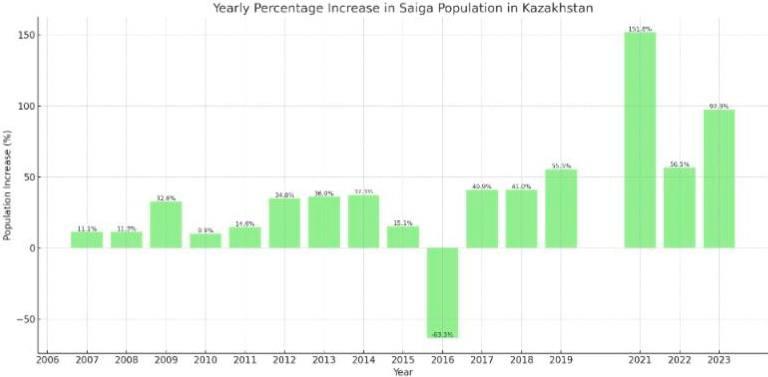
It is no secret that saigas are an important element of the steppe and semi-desert ecosystem, and therefore their conservation is critical. Every ill-considered step brings us closer to losing the country's national heritage.