(3 February 2026 | Source: FBRC)
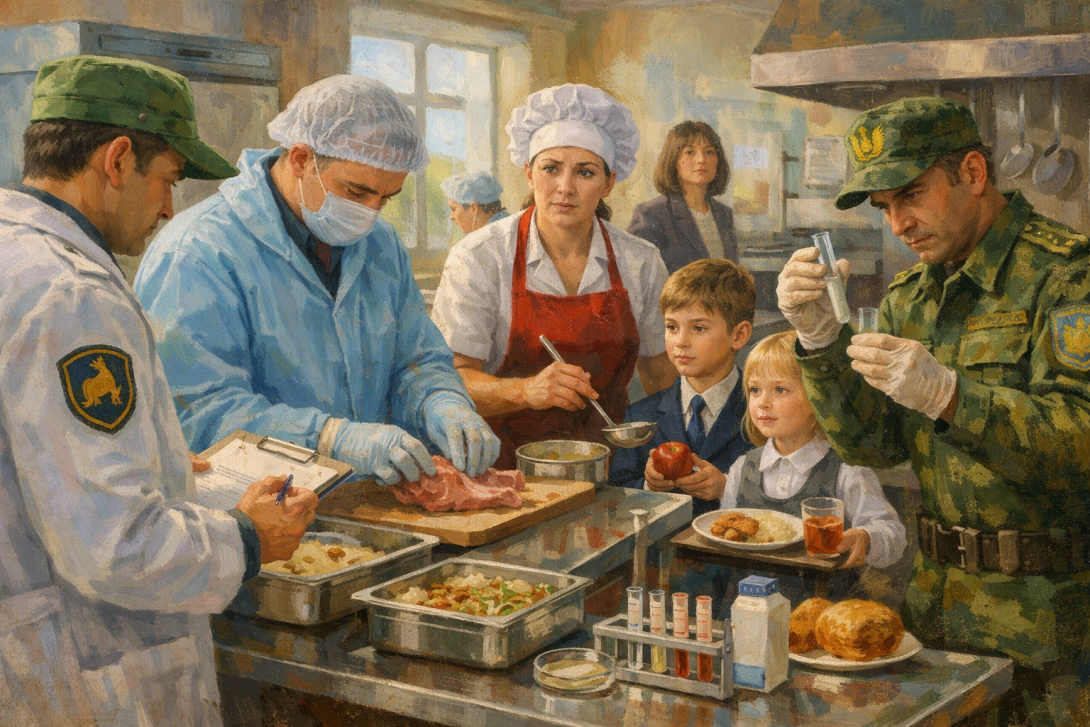
When eight children from the elite school ‘Miras’ in Astana were hospitalised with an acute intestinal infection after lunch in the school canteen on 30 January 2026, many parents asked themselves: who is responsible for what children are fed? Some instinctively assumed it was the responsibility of the sanitary doctors or the Ministry of Education. Others claimed that the Ministry of Agriculture was even responsible for the quality of the food.
Let us try to understand.
FROM FARM TO SCHOOL PLATE
To understand which specific authority is responsible for school canteens, we need to follow the legislative logic. It starts with a simple principle: everything related to products of animal origin is controlled by the veterinary service. The Republic of Kazakhstan Law ‘On Veterinary Medicine’ dated 10 July 2002 classifies all objects of internal trade as objects of state veterinary and sanitary control.
Paragraph 43 of Article 1 of the same law clarifies: internal trade includes not only shops but also catering establishments. And Order No. 264 of the Minister of National Economy of the Republic of Kazakhstan dated 27 March 2015 specifies: a canteen is a catering establishment with self-service.
Thus, a school canteen where children take trays and serve themselves food is legally no different from a factory or office canteen. Consequently, it falls under the control of the veterinary service, which is subordinate to the Ministry of Agriculture (MoA).
DIVISION OF RESPONSIBILITY
It may seem strange that veterinarians control not only slaughterhouses and poultry farms, but also places where food is prepared for people. However, the Republic of Kazakhstan Law ‘On Food Safety’ No. 301 dated 21 July 2007 divides areas of responsibility extremely clearly.
Paragraph 5 of the law determines that food products of animal origin (meat, milk, eggs, fish) are subject to veterinary and sanitary control. Paragraph 24 establishes the opposite rule: sanitary and epidemiological supervision (i.e., ordinary sanitary doctors) is only responsible for those products which do not fall under veterinary control.
In practice, this means that in a school canteen, a vegetable salad is checked by sanitary doctors, whereas a cutlet with buckwheat, for example, is checked by veterinarians. However, since children's food almost always includes products of animal origin, the main control de facto is exercised by the MoA.
DAILY CHECKS ON PAPER
Paragraph 3 of Article 14-1 of the Law ‘On Veterinary Medicine’ establishes that state veterinary and sanitary control at internal trade facilities is carried out daily.
Subparagraph 3 of Paragraph 3 of Article 22 of the same law details that control includes checking compliance with legal requirements by individuals and legal entities. Subparagraph 13 of Paragraph 3 of Article 6 of the Law ‘On Food Safety’ adds that the authorised body in the field of veterinary medicine controls the safety of food products at all stages — from production to circulation.
In Astana, the Chief State Veterinary and Sanitary Inspector of the capital is responsible for this, who, according to Paragraph 3 of Article 16 of the Law ‘On Veterinary Medicine’, has the right to issue veterinary and sanitary conclusions for controlled facilities. For example, in Shymkent, such a list of inspectors was approved by Order No. 50 dated 4 December 2023.
But if control is carried out daily, why were eight children hospitalised on 30 January?
BUREAUCRATIC SAFETY
To operate legally, a school canteen must gather an impressive package of documents. Paragraph 39 of Article 1 of the Law ‘On Food Safety’ lists them: a certificate of state registration, a veterinary and sanitary conclusion, a veterinary certificate, a veterinary reference, a certificate of conformity, a declaration of conformity.
Each document confirms that the products, production processes, equipment and materials comply with legal requirements. The Unified List of Goods Subject to Veterinary Control (Supervision) of Decision No. 317 of the Commission of the Eurasian Economic Union (EAEU) dated 18 June 2010 details exactly what these papers are needed for.
At the same time, while Kazakhstan multiplies requirements and documents, neighbouring Uzbekistan decided to go a different way. On 18 April 2025, President Shavkat Mirziyoyev signed a decree that abolishes mandatory certification for food products and other high-risk items.
Moreover, the Uzbek authorities reduced the list of goods subject to mandatory certification for sanitary-epidemiological, veterinary and quarantine control.
The logic of the reform is simple: papers do not make food safe. Ways are often found to buy certificates, get the necessary stamps, while the actual quality of the products and the sanitary condition of the kitchen do not change. Uzbekistan is betting on simplifying bureaucracy and increasing the responsibility of the food operators themselves.
WHAT IS THE RESULT?
The Ministry of Agriculture, through the system of veterinary and sanitary control, is indeed responsible for the safety of food in schools in Kazakhstan, which follows from the current legislation.
School canteens fall under veterinary control because they serve products of animal origin. Control is supposed to be daily. A multitude of documents is required. Inspectors have the right and duty to check compliance with all requirements.
But sometimes, when a stream of documents does not prevent the poisoning of children in one of the most expensive schools in the capital, the question arises: what is the point of this system? Perhaps it is not about the number of certificates, but the quality of control? Perhaps responsibility is so diluted that no one is actually accountable for the outcome?