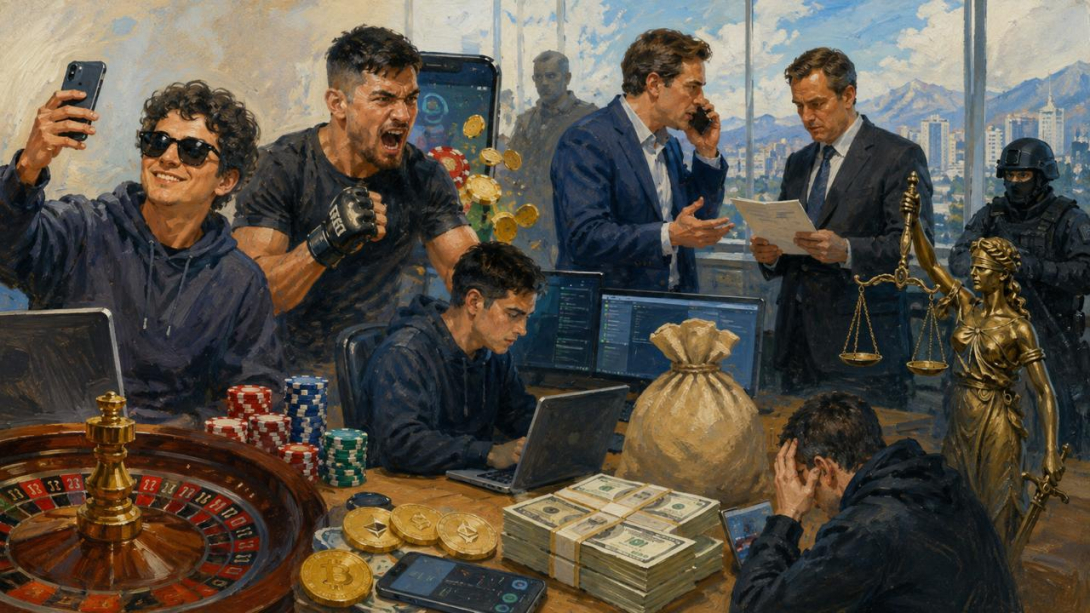
The case of the illegal gambling business operating under the guise of the bookmaker's office "Pin-Up" continues to grow with new figures. Following blogger Kaisar Kamza, who was recently brought to Astana from Vietnam, another influencer has been placed on the wanted list — 26-year-old Makhmud Khikmatov. At the same time as the case expands, so too does the stream of threats directed at FBRK and its founder Kirill Pavlov. Meanwhile, our anonymous bot is receiving information about possible new money withdrawal schemes. What is known about the new figure, and why is the story surrounding Pin-Up provoking such a strong reaction from those it touches? Let's try to make sense of it.
WHAT IS KNOWN ABOUT THE NEW FIGURE
According to reports from journalist Mikhail Kozachkov, more than three months after the active phase of the case began, on 30 March 2026, Makhmud Khikmatov was placed on the wanted list. The Agency for Financial Monitoring (AFM) believes he played a significant role in attracting players to Pin-Up services. It is reported that various public figures, including Kaisar Kamza, were involved in promoting the casino on social media, and that Khikmatov was responsible for liaising with them. This claim cannot yet be directly verified — Khikmatov himself, like Kamza before his detention, has left Kazakhstan.
As Kozachkov writes, Khikmatov never achieved notable fame. Rather, it was scandalous episodes that brought him attention: he took part in fights in the popular pop-MMA league, ending his career with a record of 3 losses in 3 fights. And at the peak of his popularity, the blogger offered anyone willing to place advertising on their body for 30 million tenge, even promising not to remove the tattoo.
It is worth recalling that recently it became known that Kaisar Kamza — a blogger with an audience of around 2 million subscribers on Instagram, who was named a suspect in the illegal gambling case back in January 2026 — had been brought to Kazakhstan. He had managed to leave the country, an Interpol search was launched at the request of the Prosecutor General's Office of Kazakhstan, he was detained in Vietnam in spring, and on 6 August he arrived in Astana from Cam Ranh airport and was placed in a pre-trial detention centre.
Somewhat earlier, in early February 2026, the AFM placed on the wanted list Dmitry Druzhinsky (a US citizen) and Marina Levkovich (Ginzburg) (a Ukrainian citizen) — according to the investigation, they coordinated the operation of online casinos under the brands "Pin-Up" and "PINCO" through a network of affiliated companies, including Bonami LLP, which obtained a bookmaking licence under the Pin-Up-KZ banner, and payment operators Gold Pay LLP and Cyber Pay LLP (later renamed Pinnacle Financial Solutions LLP). The court sanctioned their arrest in absentia.
PRESSURE ON THE FBRK EDITORIAL TEAM
On 25 June, the FBRK website became inaccessible for several hours after the hosting provider received a DMCA complaint — a formal notice of copyright infringement — filed on behalf of Pin-Up via Cloudflare. The apparent trigger was an FBRK article about the search for Druzhinsky and Levkovich, based on an AFM press release.
At the same time, citing data from the Telegram channels "Payment Shield in the CIS" and "VChK-OGPU", FBRK reported that the case involves a Russian citizen, Ilyas Karimov, whom sources describe as a key intermediary responsible for the operational support and payment schemes of Pin-Up in Kazakhstan, and who presents himself as a lawyer and "assistant to the Russian ambassador". According to the same data, he may have been assisted on the technical side by Rustam Iskindirov, co-owner of Prime Agency and Qubit IT Agency. At the same time, as sources noted, despite the criminal case based on signs of organising an illegal gambling business, Karimov does not officially appear in it — no data on his procedural status is available in open sources.
And as the investigation gained momentum, pressure on our editorial team also steadily increased. Recently, we received warnings of threats — both against the publication itself and its founder Kirill Pavlov.
The editorial team has obtained internal correspondence written in an extremely aggressive tone. It discusses possible new methods of pressure on FBRK, including the likely preparation of a collective lawsuit against the publication. The author of several messages is allegedly none other than Ilyas Karimov. In one episode, according to the materials available, he makes it clear that he knows where Kirill Pavlov lives. At the same time, anonymous warnings were sent to the official FBRK email address claiming that Karimov intends to stage a provocation against Pavlov, including plans to "plant a woman" and then report the matter to the police. The anonymous source also claims that several witnesses have already been intimidated. 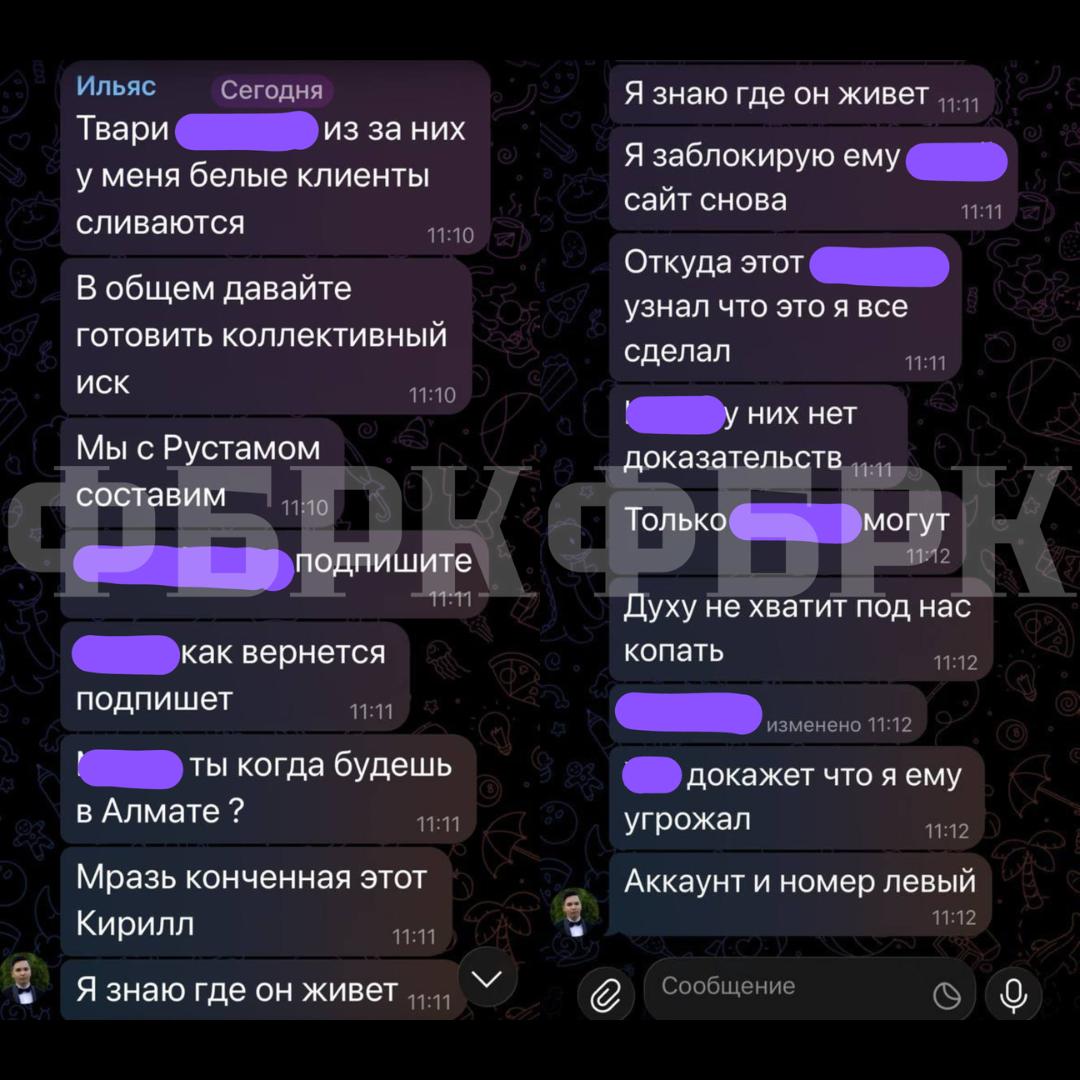
Undoubtedly, all this information requires thorough and independent verification. However, the very intensity of the reaction to the investigation, the nature of the discussions and the attempts at pressure seem no less telling than the circumstances that became the subject of the investigation itself.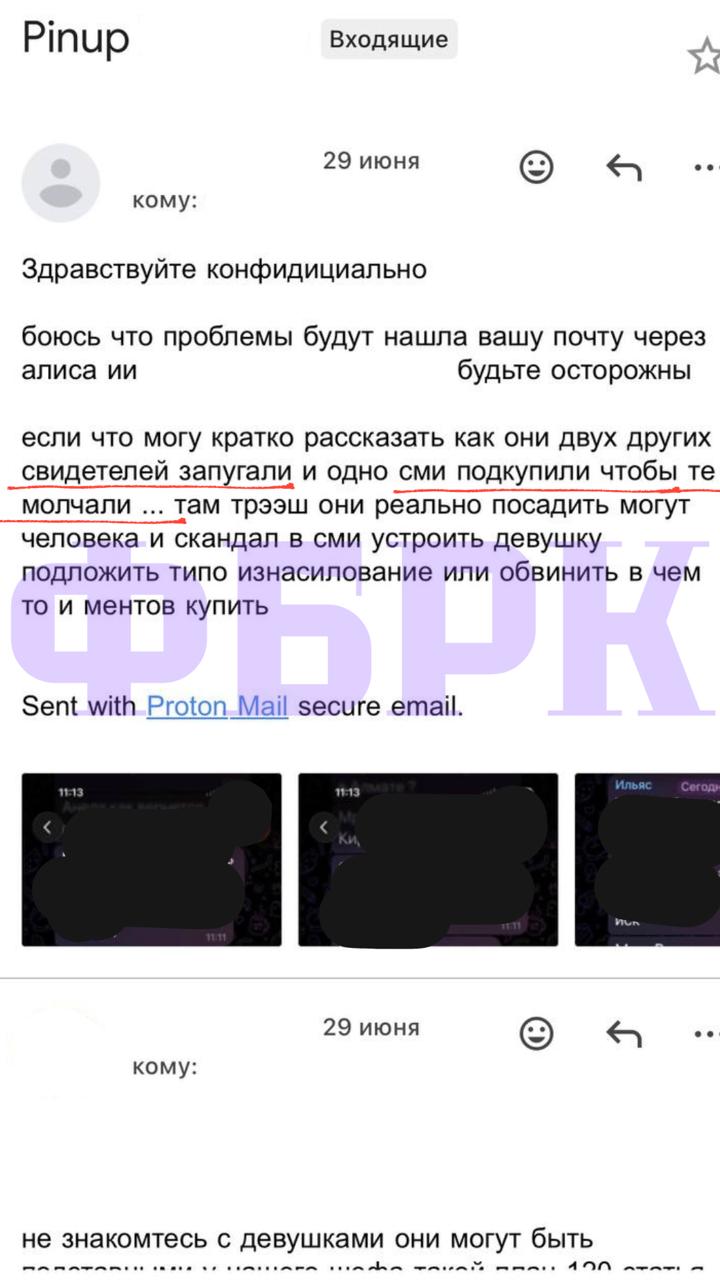
In parallel, a person claiming to be Ilyas Karimov himself contacted the FBRK anonymous bot. In his messages, he confirmed that he had set up a company and "worked on assignments related to Russian representatives, including matters concerning [Russian Foreign Minister Sergei] Lavrov", described himself as a lawyer and "unofficial assistant to the Russian Consul General", and demanded the removal of the FBRK publication.
He also stated that he has an "official contract" with Bonami LLP and other operators in the private bookmaking sector, and warned of his intention to seek the freezing of Kirill Pavlov's accounts through the courts.
It should be noted that at the end of June, Ukrainian media published similar material with far more detailed financial claims about the role of Karimov and Iskindirov, including specific transaction amounts, the turnover of payment companies and a scheme for withdrawing funds through a cryptocurrency exchange. In particular, it was reported that it was Karimov who built the payment infrastructure through which more than 106.5 billion tenge flowed, organised the use of fintech companies and acquiring channels, and coordinated the subsequent conversion of funds into cryptocurrency via the Intebix exchange and their withdrawal beyond Kazakhstan's borders. It is important to note, however, that at the time of publication, Ilyas Karimov is not a defendant or suspect in the criminal case related to the circumstances described.
REPORTS OF NEW SCHEMES: WHAT SOURCES SAY
Alongside the threats, the FBRK anonymous bot is receiving information about possible new methods of withdrawing funds. According to a source, the scheme involves funds from casinos being transferred to cryptocurrency exchanges and then distributed to wallets in other countries, including the USA, Cyprus and the UK. The transactions, the source claims, are split into amounts of around 100–200 million tenge and quickly withdrawn through controlled companies.
The source names a range of legal entities, individual entrepreneurs and commercial services as such payment intermediaries, whose details, it claims, are used to accept payments on behalf of various online casinos. These include Individual Entrepreneur Krutov Ivan Sergeyevich, Individual Entrepreneur Narkova Oksana Aleksandrovna, Individual Entrepreneur Yarmukhametov Aleksandr Vinerovich, the Multitransfer service (via Murmansk Settlement Bank LLC), the Ozon Donations service (Ozon Bank LLC), the "Apelsin" shop, as well as a number of individual entrepreneurs and retail outlets in Kyrgyzstan served through Optima Bank, Demir Bank, O!Bank and Bakai Bank, including Individual Entrepreneur Arystanbayeva Nargiza Temirbekovna, Individual Entrepreneur Ryspekov Kylychbek Bolsunbekovich, Individual Entrepreneur Sulaimanova Asyl-Azhar Kiyalbekovna, the retail outlet 281Shoro and Individual Entrepreneur DALI.
According to the source, it is precisely through such payment details that users top up their accounts at online casinos including Admiral, Gama, Luck More, Tiger, Joy Casino, MostBet and 1xBet, while the payment recipients themselves are formally unconnected to gambling activity.
It should be noted that the authenticity of this information and the role of the named individuals and organisations require independent verification, and their mention does not imply established involvement in unlawful activity.
The source also claims that a portion of the cash is withdrawn directly by Dmitry Druzhinsky — the same figure previously placed on the wanted list by the AFM.
Ultimately, it is for the investigation to separate confirmed facts from theories and establish the role of each of the individuals mentioned. But the more information enters the public domain, the clearer it becomes that the story surrounding Pin-Up is far broader than a case about a single illegal casino.
The FBRK editorial team will continue to monitor developments.