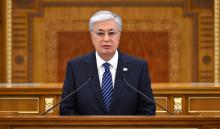
In recent months, the capital has been abuzz with talk of the upcoming construction of a large-scale administrative facility — the new Palace of the Republic.
Information about its construction first emerged in September thanks to a publication by the capital's blogger and activist Yerlan Sakenov.
In early December, the editorial team of FBRK sent official requests to the capital's city administration and the Presidential Property Management Department to learn more about the new project.
Official sources shared the first details of the ambitious initiative.
It will be recalled that it was previously reported that a plot of land covering 57.7 hectares, located at the intersection of F. Ongarsynova Street and Al-Farabi Avenue, had been chosen for the construction of the new administrative facility.
In addition, it was noted that in the capital's master plan, another administrative facility covering 53 hectares was planned next to the future Palace of the Republic.
The Presidential Property Management Department confirmed the address and area of the plot selected for the construction of the Palace of the Republic.
It has been reported that the project is at an early stage: the concept is currently being developed and all necessary documentation is being prepared. In this regard, no further information was provided to us.
As for the future neighbouring facility, we were told that the information regarding it is classified as restricted access.
The capital's Department of Architecture, Urban Planning and Land Relations noted that the permit for survey and design work was issued to the Presidential Property Management Department by the Akimat of Astana city for a period until 14 July 2028.
However, to date, there is no official information regarding the cost of the project, the construction status, or its completion date.
In the context of the construction of the new Palace of the Republic in Astana, many questions arise about the rationality of such a decision. The unprecedented scale of the project represents a significant use of the city's land resources.
At the same time, the lack of public information about the cost, the unclear details regarding the purpose of the second administrative facility, and the absence of a clear justification for the need for such large-scale construction force one to consider the efficiency of using public funds.
From a social and urban planning perspective, the project also raises questions. There are certainly more pressing issues in the city, such as a shortage of social housing, polyclinics, schools, and kindergartens.
Furthermore, allocating such a significant area for administrative facilities will inevitably affect traffic congestion in the area and will require the development of corresponding infrastructure.
However, to date, without a clear understanding of the project's objectives, its cost, and expected outcomes, it is extremely difficult to assess the rationality of such large-scale construction. Moreover, no one has deemed it necessary to present the justification for this flagship project to the public in any way.
The editorial team of FBRK will continue to follow developments.