At the Zhangir Khan West Kazakhstan Agrarian Technical University (WKATU) in Uralsk, an experimental batch of sausage made from saiga meat has been developed. The project is being carried out as part of a scientific initiative by the university's young researchers.
According to the publication ‘Nadezhda’, the raw material is obtained not from wild populations, but from animals raised at the specialised nursery ‘Akboken’, attached to the university. In addition to saiga meat, the recipe includes duck or goose meat—birds also reared at the local nursery.
‘The main goal of our project is to determine the consumer qualities of the product. We first studied the quality indicators of saiga meat, and then strictly monitored safety indicators: microbiological safety, the absence of dangerous E. coli, pathogenic and conditionally pathogenic bacteria in the composition,’ reported the research laboratory ‘Food Safety’.
According to the scientists' estimates, one saiga carcass can yield 13–15 kg of meat. Production follows standard technology: traditional spices—salt, pepper, and garlic—are added to the mince.
‘During the research, we noticed that saiga meat is quite juicy. The finished product can be stored in the refrigerator for up to two weeks,’ the statement reads.
As reported by Informburo.kz, scientists from this very university advocated for the legalisation and regulation of saiga meat processing.
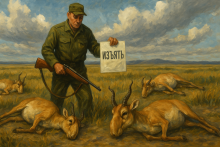
The initiative has provoked a mixed reaction in society. Previously, the Minister of Ecology and Natural Resources, Yerlan Nyssanbayev, announced that scientific justification had been obtained for the mass ‘removal’ of saigas. Scientists recommend removing 20% of animals from the population.
According to data from the Ministry of Ecology, the total number of saigas stands at 3 million 978 thousand individuals: 2.3 million in the Uralsk population, 1.6 million in the Betpak-Dala population, and 78 thousand in the Ustyurt population. Based on these figures, the department intends to ‘remove’ approximately 800 thousand animals, with 40% to be males and 40% females.
Environmentalists and nature conservationists have expressed concern over the plans for the commercial use of saigas, emphasising the need for a thorough study of the long-term consequences for the population of these steppe antelopes.