While Kazakhstan’s veterinary service anxiously monitors outbreaks of livestock disease in Russia’s border regions, one of the country’s most sparsely populated areas has announced a major procurement: 19 modular buildings for veterinary services in the villages of the Ulytau region. Total cost — nearly 500 million tenge.
WHY IS THIS NEEDED
Recently, the FBRK editorial team discussed the systemic weaknesses of Kazakhstan’s veterinary service: a shortage of staff in rural areas, low salaries for specialists, and a lack of infrastructure in remote villages. FBRK founder and agricultural expert Kirill Pavlov believes that for years the state has been “throwing money” at the problem without solving it structurally. The procurement in the Ulytau region appears to be just such an attempt at providing an infrastructural foothold.
Ulytau is one of the least populated regions of Kazakhstan, with vast distances between villages and well-developed livestock farming. Getting from a remote settlement to the district veterinary station is an all-day affair. In such a situation, livestock disease is often detected far too late.
WHAT IS BEING BOUGHT
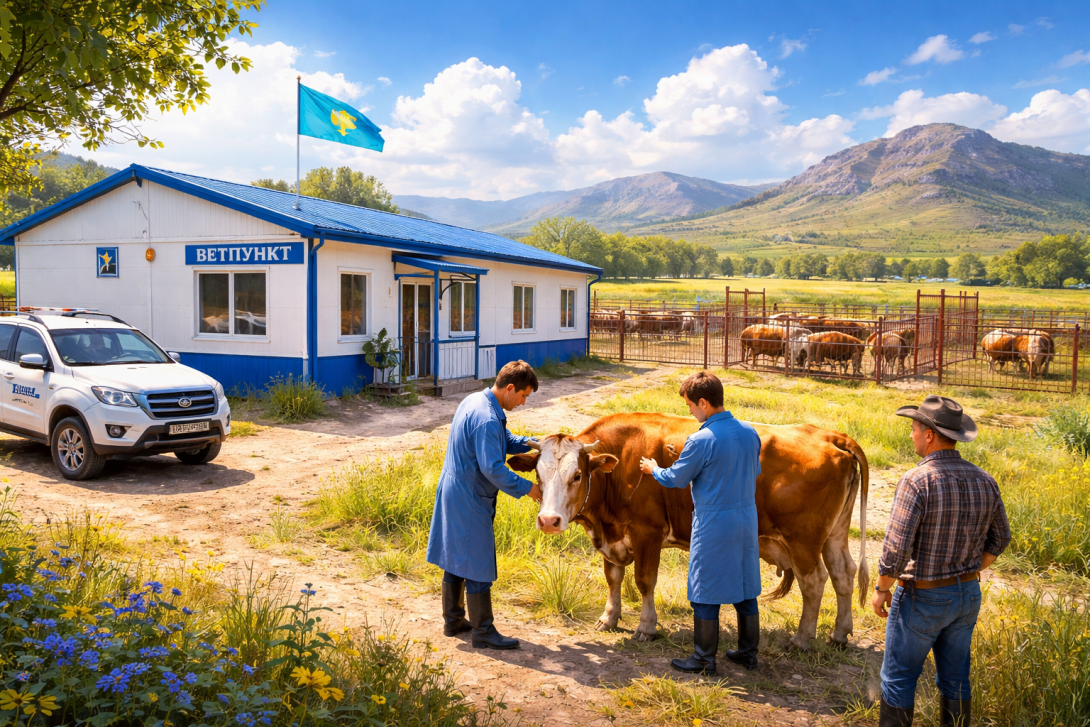
According to the terms of the tender, the veterinary department of the Ulytau region is purchasing two lots. The first is one modular veterinary station for the city of Karazhal, costing 25.8 million tenge. The second is 18 modular veterinary points for the rural districts of Zhezkazgan, Zhangaarqa and Ulytau districts, totalling 465.5 million tenge (unit price — the same 25.8 million tenge).
Each module is a fully self-contained building with an area of no less than 67.6 m², designed to operate at temperatures from −40 to +50°C, with seismic resistance of up to 10 points. Inside, there are six rooms: a foyer, two specialist offices, a storage room, a biological product pantry, and a toilet.
The package includes furniture, air conditioners, a fire alarm system, a water supply and sewerage system with a septic tank, as well as livestock handling equipment: a corral of no less than 600 m², holding pens, and a crush for cattle and horses. The supplier must deliver the project on a turnkey basis within 60 calendar days of signing the contract.
WHO WON
The deadline for applications ended on 13 March 2026. The winner of both lots was Nurly Aspan Kurylys LLP. The company’s director and founder is Yerkebulan Adilkhan. The company has been operating in the market since August 2011 and positions itself as a leading manufacturer of block containers and modular buildings in Kazakhstan.
WHAT IS THE REAL COST
Nearly 26 million tenge per module — is that a lot or a little? The technical requirements are indeed serious: 100 mm thick sandwich panels, a metal frame made of profiled pipe, triple-layer floor insulation, a gable roof, a full set of furniture, air conditioners, a fire alarm system, and all utilities. Plus — an external perimeter fence and livestock handling equipment. The supplier also takes on all installation work and connection to utilities.
A question for construction and public procurement specialists: do you think the price of 26 million tenge is justified given the stated specifications?