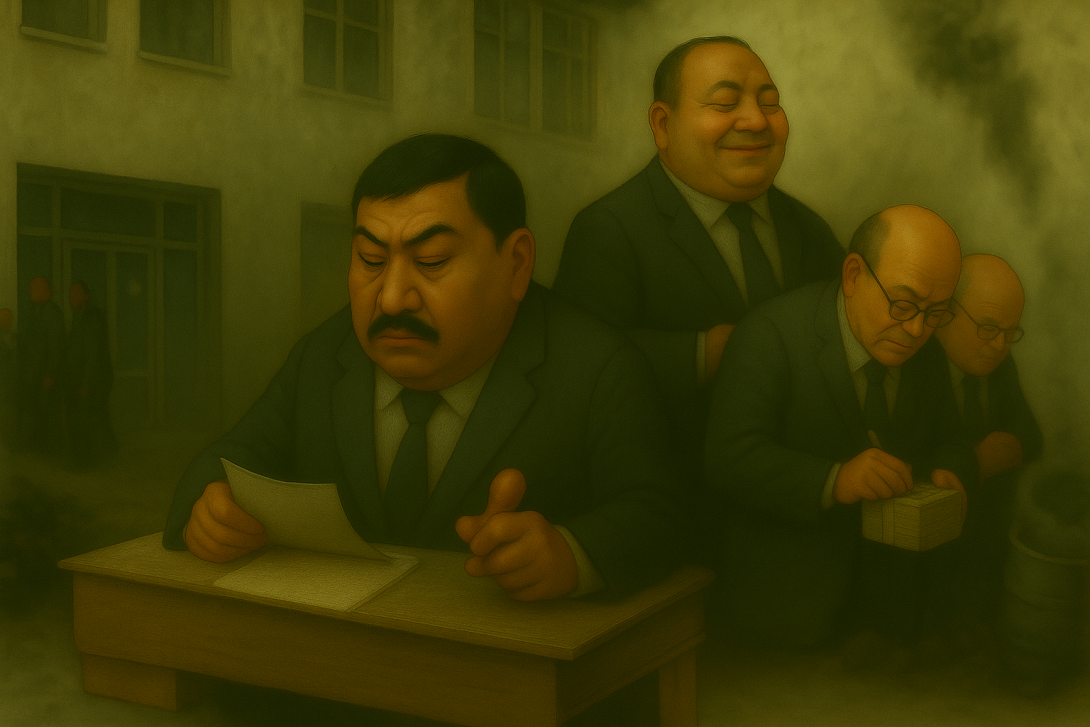
Department of Ecology and the Sanitary and Epidemiological Control Department of Astana have demonstrated a masterclass in sabotaging state control. The former require journalists to first identify the violators of ecological laws, while the latter cannot inspect medical waste due to the company director's absence.
Meanwhile, officials are giving contradictory statements regarding the transfer of documents between departments. The FBRK editorial team has received a series of mutually exclusive responses that demonstrate systemic disorganisation in the sphere of state control in the capital.
ECOLOGICAL LAWLESSNESS ON THE BANKS OF THE ISHIM
The story began in March 2025, when we recorded a large-scale unauthorised dump near the bank of the Ishim River, next to the Sancy residential complex. An area of several hundred square metres was piled high with construction waste, household rubbish, old furniture and organic waste, creating a serious sanitary and epidemiological threat.
You would think the situation is obvious: there are GPS coordinates, photographic evidence, and a specific threat to the environment. Only one thing remains — to conduct an inspection and take action. But no such luck.
“INDICATE THE SPECIFIC SUBJECT”
The Department of Ecology of Astana city demonstrated a truly creative approach to interpreting the law. In their response, officials stated: “Based on the information provided, it is not possible to establish the presence of a specific subject (natural resource user) and a specific facility against which the Department could conduct an unscheduled inspection.”
Simply put, the ecologists demand that journalists themselves carry out an investigation, identify the violator, and then bring them the ready-made results on a silver platter. Only then, perhaps, will they deign to initiate an inspection.
Such logic raises a legitimate question: what, exactly, does the Department of Ecology do? If their function boils down to simply registering the already completed conclusions of private investigations, then why is this body even needed?
UNLAWFUL INTERPRETATION OF THE LAW
The department's position is not only absurd but also contradicts current legislation. Our editorial team correctly pointed out in our objections that officials are unlawfully conflating the concepts of “subject of control” (the entity to be inspected) and “object of control” (the territory where the violation was detected).
According to the Entrepreneurial Code of the Republic of Kazakhstan, the grounds for an unscheduled inspection are appeals from individuals and legal entities regarding violations of legal requirements, provided there are convincing reasons and supporting evidence. Both are present in full.
Moreover, identifying the violator is the result of an inspection, not a mandatory prerequisite for it. The object of control is clearly defined with GPS coordinates and a detailed description of the area with photographic evidence.
MEDICAL WASTE IN A HOMEMADE FURNACE
Meanwhile, an equally revealing story concerning violations of sanitary standards is unfolding. The FBRK, together with the Association of Legal Entities “Euro-Asian Association ‘Green Economy’”, uncovered facts of the supposedly illegal incineration of medical waste on the outskirts of Astana in the Saryarka district. Video footage from a drone captured the process of destroying hazardous waste in a homemade furnace inside a shipping container, accompanied by the emission of dense black smoke and a characteristic chemical smell.
As the FBRK editorial team discovered, the land plot belongs to LLP “Akrys2037”, and LLP “KazMedProf” may be involved in the disposal process. With video and photographic evidence, we contacted the Sanitary and Epidemiological Control Department of the Saryarka district.
NO BOSS — NO INSPECTION
And here the same systemic problem emerged as with the Department of Ecology. The Sanitary and Epidemiological Control Department registered an unscheduled inspection regarding LLP “KazMedProf”, but could not carry it out.
The reason is astonishing in its absurdity: “The Director of LLP “KazMedProf” is absent from the city and is outside it, and no authorised person with the right to sign was left. Consequently, it was not possible to familiarise the head with the order appointing the inspection.”
This creates a fantastical situation: inspectors can only conduct checks if potential violators kindly agree to receive them. No boss on site — no inspection. Apparently, all businesspeople who are violators should now book an appointment with the inspectors in advance.
Based on this “weighty” argument, the inspection was removed from oversight. Medical waste continues to be incinerated in a makeshift furnace, while officials throw up their hands — the director isn't there!
ADMINISTRATIVE SHUFFLE WITH DOCUMENTS
Simultaneously, a classic bureaucratic muddle is unfolding over another dump in the Saryarka district. The Department of Environmental Protection first officially stated: “The material you provided was sent to the RSE ‘Department of Ecology of Astana City’ for consideration of the possibility of opening an unscheduled inspection.”
However, the Department of Ecology categorically denied this information: “Materials concerning the facts of the placement of an unauthorised landfill from the state institution ‘Department of Environmental Protection and Natural Resources of Astana City’ were not received by the department.”
This creates a classic situation: either the department is lying about sending the documents, or the department is losing important materials. In either case, the professionalism of civil servants raises serious doubts.
CONVENIENT HINDSIGHT EXPLANATIONS
The most cynical position comes from the department, which later changed its story. In a new response, officials stated that the dump was “promptly eliminated”, therefore the “need to send materials to the department fell away”. An amazingly convenient explanation for covering up their own incompetence or outright lies.
This raises a legitimate question: if the problem was truly resolved, why wasn't this communicated immediately? Why stage the charade of “sending materials”? And who will be held responsible for providing false information?
FORMAL APPROACH INSTEAD OF RESULTS
Removing an inspection from oversight simply because the director is out of town and did not leave an authorised representative sets a dangerous precedent. It means any business entity can avoid state control by simply being absent.
The department did not use other legal options: sending the order by registered mail, public notification in cases of evasion of document receipt, or initiating measures to ensure the director's appearance through the relevant authorities.
Instead, officials chose the easy path — remove the inspection from oversight and forget about the problem.
A SYSTEMIC PROBLEM OF STATE CONTROL
The story of the violations in Astana is not an isolated incident but a symptom of a systemic problem in the work of the capital's control bodies. Officials have turned the fight against violations into bureaucratic red tape, where every agency tries to shift responsibility to its neighbours or find formal pretexts for inaction.
The Department of Ecology is effectively sabotaging the fulfilment of its direct duties, hiding behind requirements not provided for by law. The Sanitary and Epidemiological Control Department demonstrates astonishing helplessness in the face of a company director's absence. The Department of Environmental Protection shows an astonishing ease in providing contradictory information.
As a result, environmental and sanitary violations remain unaddressed, and citizens receive brush-offs instead of real action to protect their health and the environment.
THE PROSECUTOR'S OFFICE MUST INTERVENE
This situation merits the attention of the prosecutor of Astana city, Yerlan Utegenov. It is within the competence of the prosecutor's office to supervise the implementation of laws by state bodies. In this case, serious questions arise regarding the work of the agencies: one provides contradictory information about sending documents, while others refuse to conduct inspections, citing formal grounds.
According to Article 274 of the Criminal Code of the Republic of Kazakhstan, providing knowingly false information carries criminal liability. Someone among the officials of the Department of Environmental Protection or the Department of Ecology is outright lying to journalists. This requires a prosecutor's investigation.
Furthermore, the de facto refusal to perform official duties could be classified as negligence. Environmental and sanitary violations have continued for months, while officials engage in paperwork instead of real work.
CONCLUSION
The situation in the control bodies of Astana requires immediate intervention by the prosecutor's office. Citizens have the right to quality work from civil servants, not bureaucratic games and mutual recriminations between departments.
It is time to stop demanding that journalists and activists carry out the functions of state inspectors. Inspecting violations is the direct responsibility of the relevant bodies, not a privilege to be earned with a flawless dossier on the violator or the director's presence in the office.
As long as officials sabotage their work under the pretext of “incomplete information” or “the absence of a manager”, the situation with violations in the capital will only get worse. And citizens will be forced to accept that their city is turning into a zone of environmental and sanitary disrepute.