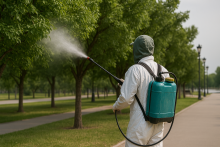
The FBRK editorial team for the fourth consecutive year analyses disinsection in the regions of Kazakhstan and opens its series of materials for 2026.
The first city was Shymkent — here, a pesticide originally developed for agriculture is being used.
WHAT IS THIS PESTICIDE AND WHERE IS IT BEING USED
According to the Department of Agriculture and Veterinary Medicine of Shymkent City, the insecticide 'Thiamethrin SC' is being used in 2026, while biological methods of insect control are not planned.
Disinsection work is scheduled to be carried out in stages from April to August, and information about it is promised to be published on social media and in the media.
'Thiamethrin SC' is a combined insecticide based on thiamethoxam and lambda-cyhalothrin.
According to public data, the pesticide is intended for the protection of agricultural crops — wheat, cotton, potatoes and other plants from pests. It is applied by spraying fields during the growing season and is designed to destroy aphids, beetles, thrips and other agricultural pests.
Thus, this is a typical field pesticide, not a specialised product for the urban environment.
HOW ITS COMPONENTS WORK
Both active substances are neurotoxic insecticides, affecting the nervous system.
Thiamethoxam belongs to the neonicotinoid group and acts on the principle of nicotine, disrupting the nervous system of insects. It penetrates plants and makes them toxic to pests. Neonicotinoids are linked to the decline of bee and other pollinator populations, which is why their outdoor use is banned in European Union countries.
The substance can cause symptoms of acute poisoning in humans — dizziness, vomiting and diarrhoea, and can also affect the liver and kidneys.
Lambda-cyhalothrin belongs to the pyrethroid group and acts quickly, causing insect death immediately upon contact. At the same time, the substance is highly toxic to aquatic organisms and can cause long-term changes in the aquatic environment.
If application conditions are violated, it negatively affects the human cardiovascular and respiratory systems.
WHAT RESEARCH SHOWS
Scientific data indicates that the combination of thiamethoxam and lambda-cyhalothrin can have a strong impact not only on pests but also on other species.
Studies record high mortality rates of beneficial insects, including pollinators, upon contact with neonicotinoids and pyrethroids.
Individual works also point to the impact of neonicotinoids on broader ecosystems, up to bird population declines, which is linked to the destruction of their food supply.
Thus, this is not simply a 'mosquito repellent', but a chemical complex with a significant impact on the entire ecosystem.
A REPEATING PRACTICE
The situation in Shymkent is not an isolated incident. The FBRK editorial team has previously recorded the use of chemical insecticides in the city in previous years.
In 2023, 'Imidor' and 'Engeo' were used, in 2025 — the pesticide 'Cardinal' based on chlorpyrifos and cypermethrin, with the frequency of treatments increased to 10 times per season.
In 2026, the approach remains the same: the city continues to use combined chemical pesticides, and biological alternatives are still not being considered.
WHY THIS MATTERS
The use of agricultural insecticides in urban environments involves fundamentally different conditions of exposure.
Whereas in fields, access for people and animals can be restricted, in the city, treatment is carried out near residential buildings, in courtyards and public spaces, where constant contact with treated surfaces is practically unavoidable.
Given the toxicity of the active substances, the use of such pesticides requires special caution and justification.
The FBRK editorial team urges local executive bodies to take a more responsible approach to selecting pesticides, considering their safety for the population and the environment. Residents, for their part, should pay close attention to information about ongoing treatments and observe safety precautions.