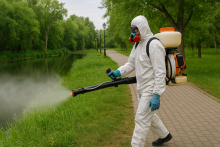
The FBRK editorial team continues to analyse which preparations are used for the disinsection of urban plantings in the regions of Kazakhstan in 2025. A new investigation has shown that Aktobe uses imidacloprid — a systemic insecticide from the neonicotinoid group.
This preparation is banned in the countries of the European Union due to its detrimental effect on pollinating insects, however in Kazakhstan it is permitted for use, but intended mainly for agricultural crops. Despite this restriction, imidacloprid remains in the arsenal of municipal services in the regional centre for urban disinsection, which could pose serious risks to the ecosystem and the health of city residents.
According to an official letter from the Aktobe City Akimat, the supplier of the insecticide is Meda LLP — the winner of the tender for the treatment of green spaces against pests within the city. The company, which specialises in the production of agrochemical products, uses the preparation Imidor (active ingredient - imidacloprid), manufactured in Kazakhstan by Agrokhimiya LLP.
PREPARATION NOT FOR CITIES
Imidacloprid is intended to protect agricultural crops from a wide range of pests — aphids, whiteflies, Colorado potato beetles. Its systemic action allows the substance to be quickly absorbed and distributed throughout the plant, remaining in the tissues for up to 2-4 weeks. However, the use of such a powerful insecticide in an urban environment raises legitimate questions about its expediency and safety.
The preparation is classified as hazard class 3 for humans (moderately hazardous substance), but for bees it is extremely toxic — hazard class 1. Its use requires a restriction on bee flight for 96-120 hours, which is practically unfeasible in urban settings. Moreover, imidacloprid is toxic to aquatic organisms, therefore its use is prohibited closer than 2 km to water bodies.
RISKS FOR THE URBAN ECOSYSTEM
Of particular concern is the proximity of treatment zones to urban water bodies. The Sazdy River flows through Aktobe — the main city artery, used for the improvement of embankments and urban landscaping. 8 km from the city centre lies the Sazdinskoye Reservoir, which is effectively considered a city water body and is actively used by residents as a source of water supply and a recreation area with an equipped beach.
The use of a preparation toxic to aquatic organisms in close proximity to these sites poses a real threat of water pollution, especially given the high persistence of imidacloprid in the environment.
INTERNATIONAL EXPERIENCE AND SCIENTIFIC DATA
Neonicotinoids, to which imidacloprid belongs, are similar in their action to nicotine and have a detrimental effect on various organs and tissues, particularly the liver and kidneys. A 2020 study by American scientists showed a direct link between the use of neonicotinoids and a significant decline in bird populations in the USA. Preparations in this group also lead to the extinction of bumblebees, bees, and other pollinating insects, which was the basis for banning their use in the European Union.
PARTICULARITIES OF USE IN AKTOBE'S CLIMATE
In the conditions of Aktobe's hot summer, imidacloprid retains its effectiveness but requires strict adherence to application regulations: maintaining the temperature regime, absence of wind, protection from evaporation and photolysis. Without these conditions, the effectiveness of the preparation may decrease, and the risks to the environment and human health may increase.
RISKS FOR HUMANS
If application conditions are violated, imidacloprid can cause overstimulation of the nervous system in humans, which manifests as tremor of the limbs, increased body temperature, nausea, difficulty breathing, increased heart rate. In severe cases, convulsions, paralysis, and fatal outcomes are possible.
Of particular concern is the high persistence of the preparation in the environment. In soil, the half-life of imidacloprid ranges from 40 to 997 days depending on conditions, averaging around 190 days. This means the substance can accumulate in the urban environment, creating long-term risks for public health.
THE NEED TO REVISE APPROACHES
Every year in Kazakhstan, cases of human poisoning by disinsection preparations are recorded. For the third consecutive year, the FBRK editorial team analyses which agents are used to treat green spaces in the regions, calling on akimats to take a responsible approach to the issue of disinsection.
Previously, we wrote about the preparations used for disinsection in the Karaganda Region, as well as about the use of the highly toxic insecticide Cypermethrin in children's health camps in the Kostanay Region, which poses a serious threat to children's health.
The use of agricultural pesticides in urban environments requires special justification. If the use of powerful insecticides for crop protection can be justified by economic necessity, then in cities, where people are in close proximity to treated objects, the priority must be public safety.
CONCLUSION
The situation in Aktobe clearly demonstrates the need to develop special regulations for urban disinsection, distinct from agricultural standards. Akimats should consider the possibility of using less toxic alternatives, specifically intended for urbanised areas, where population density is high and water supply infrastructure is developed.
There is also a pressing need to create buffer zones around water bodies and residential areas, where the use of aggressive insecticides should be restricted or completely excluded. Transparency in the selection of preparations and informing the public about treatments being carried out could increase public oversight of urban environmental safety.
The FBRK editorial team will continue to monitor the situation with disinsection in other regions of Kazakhstan, in order to form a complete picture of the practices used and to develop recommendations for their improvement.
To be continued…