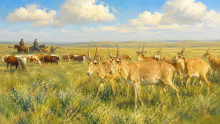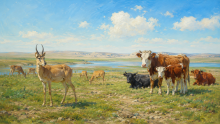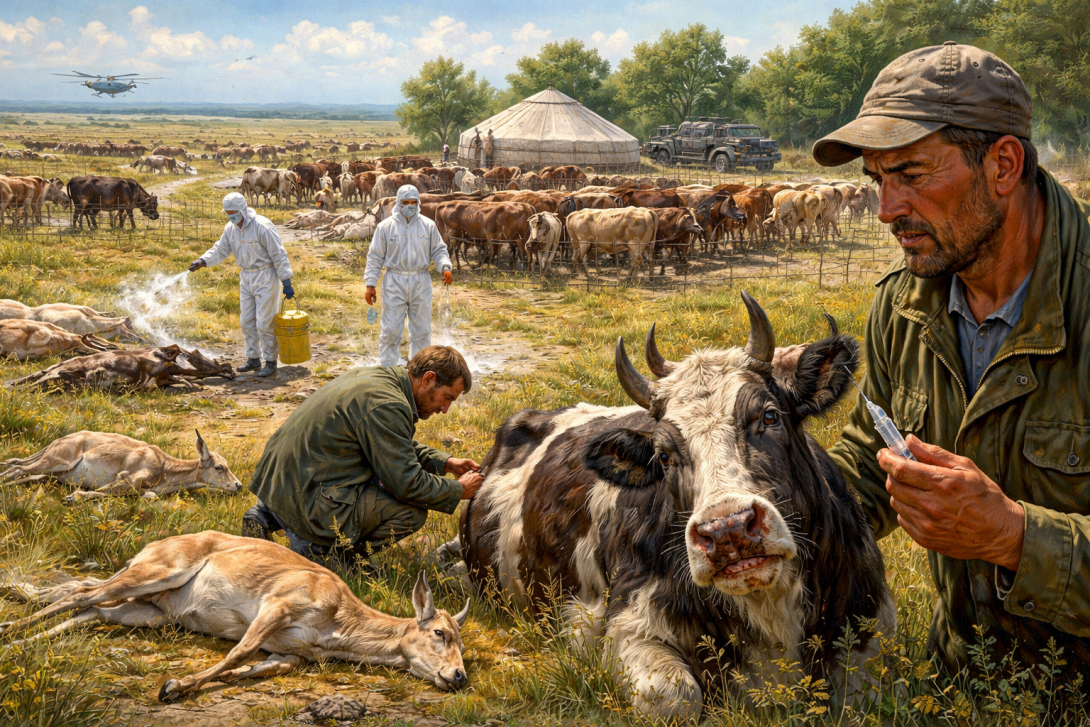
While officials speak of a “stable situation”, saiga antelopes continue to die, farmers buy vaccines with their own money, and mathematical models paint scenarios on a national scale. The gap between the official picture and the reality on the ground is growing every week.
WHAT THE AUTHORITIES ARE SAYING
In early May, Vice-Minister of Agriculture Azat Sultanov reported that the initial diagnosis for some saigas was pasteurellosis. According to him, the situation “remains stable” and there is no danger of mass mortality among farm animals. When asked about documented evidence of disease transmission from saigas to domestic animals, he replied that no such data exists.
Soon after, Vice-Minister of Ecology and Natural Resources Nurken Sharbiev described the saiga deaths as being “within natural limits”. According to his data, 26,000 animals have died across the country, of which 11,000 were in the West Kazakhstan Region (WKR). The expected population size this year could reach 5 million individuals, and the issue of regulation will be decided based on biological justification and the opinion of veterinary services.
At the same time, Vice-Minister of Agriculture Amangaliy Berdalin claims that no cases of foot-and-mouth disease have been detected in Kazakhstan, either among farm animals or wild animals.
It is worth noting that a number of experts are questioning the official diagnosis. Against the backdrop of mass mortality of livestock and saigas, assumptions about the possible spread of foot-and-mouth disease are increasingly being voiced. More on this can be found on the FBRK website and our YouTube channel, “Foundation – Bureau for Corruption Investigation”.
WHAT THE SCENARIO ANALYSIS SHOWS
The independent analytical company Geobox Inc. has published scenario modelling of foot-and-mouth disease outbreaks. The analysis covered 201 districts in Kazakhstan with a time horizon of 180 days. The model uses 8 confirmed locations of saiga deaths, data on 5,484 head of livestock from the official report of the WKR veterinary authorities, as well as a separate outbreak zone in Almaty Region, as a transboundary pathway from Xinjiang.
The authors of the model calculated three scenarios. In the absence of any intervention, a foot-and-mouth disease outbreak by week 25 would affect between 14.3 and 23.1 million animals. Even with early containment (ring culling at week 2) the figure would be up to 21.2 million head. The critical window for intervention is between weeks 2 and 8. After week 12, all scenarios without an effective vaccine converge to a single outcome.
The vaccine available in national stockpiles covers foot-and-mouth disease serotypes O, A and Asia-1. If the strain turns out to be SAT-1, every animal in the country is considered fully susceptible, and then no amount of culling will change the situation; a different vaccine would need to be purchased.
WHAT VETERINARY SCIENCE SAYS
Professor Gaisa Absatirov warns that foot-and-mouth disease is a zoonotic infection, dangerous for humans too. The virus can appear in milk 3–4 days before the first clinical signs and be excreted in milk for up to 23 days. This creates a risk for suckling young and for people consuming unpasteurised dairy products.
WHAT IS HAPPENING ON THE GROUND
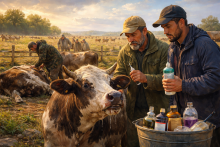
Reports from farmers in the WKR continue to arrive via the FBRK anonymous bot. People are now reporting not only about cattle, but also about goat kids and adult sheep that are limping or unable to get up at all. Livestock breeders complain that the cattle vaccine was administered without indicating the name of the drug, batch number, manufacturer or dose. Some farmers were forced to purchase the vaccine themselves.
They describe the visiting specialists as people who are “feeding them a line”: they diagnose pasteurellosis, yet supposedly administer a vaccine for foot-and-mouth disease.
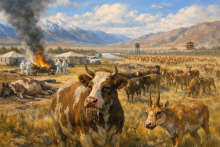
Furthermore, it is reported that thousands of saiga carcasses are simply lying in the steppe, disinfection of farm premises is not being carried out, and the virus itself, according to local observations, continues to mutate and spread. Livestock destruction, according to reports, has already begun in the Taskala District of the WKR. And symptoms characteristic of diseased saigas are now also being noted in roe deer.
And while officials clarify whose remit it is—whether it falls under the Ministry of Agriculture or the Ministry of Ecology—mathematical models are already counting down the weeks to the point of no return.