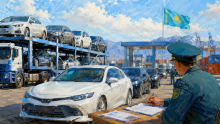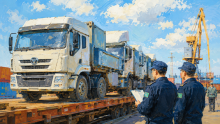
Six tractor units temporarily imported into Kazakhstan by an Atyrau transport company and officially exported back abroad, according to state databases are still listed in Kazakhstan - though now under different owners. At the same time, Russian registries confirm that the same vehicles are still registered in Russia. How the same tractor units ended up simultaneously in two accounting circuits and why this situation still persists is a question that probably could not have gone completely unnoticed by the relevant agencies. Now it remains to be established whether this is a technical glitch or a more systemic problem.
HOW THE SITUATION DEVELOPED
From 2017 to 2021, Vektor Shipping Co LLP, as part of freight transportation, temporarily imported into Kazakhstan six tractor units of various modifications leased from companies in Russia and Belarus. All the vehicles were registered under the temporary import regime - with a specified maximum period of stay in the country and, according to certificates from the administrative police department of the police department (PD) of Atyrau Region, were subsequently deregistered within the established deadlines.
On 20 July 2026, the Specialised Interdistrict Economic Court of the city of Astana received a claim from JSC "Zhasyl Damu", the operator of the extended producer responsibility system, for the recovery from the company of the utilisation fee for all six vehicles. As it turned out, in the database of the Committee of Administrative Police of the Ministry of Internal Affairs of the Republic of Kazakhstan, these same VIN numbers (Vehicle Identification Number - a unique vehicle identification number) are still listed as registered, but no longer to the leasing company, rather to other individuals and legal entities. According to JSC "Zhasyl Damu", the vehicles were placed into free circulation on the territory of Kazakhstan, which is equated to import and entails the obligation to pay the utilisation fee.
The company disagrees with this interpretation. The extracts it obtained from the state vehicle registry of Russia show that the original vehicles with these VINs are still on the registration record in the Russian Federation. That is, the vehicles physically left Kazakhstan and are located where they were returned upon expiry of the lease.
So what is the issue?
WHAT THE DOCUMENTS SHOW
For each of the six numbers, the Russian registry does indeed record current ownership, that is, the vehicles are officially listed in the Russian Federation.
Under the same VINs, the Kazakh database contains active registration cards with different state numbers and different owners.
When comparing the documents, another detail emerges that is hard to ignore. For several vehicles, the date of initial registration of the Kazakh counterpart comes earlier than the official deregistration of the original by the leasing company, or coincides with the start date of the lease agreement for the original vehicle. This produces a paradox, because according to some documents the vehicle is still in its previous legal status, while according to others it has already acquired a new registration history.
Equally telling are the changes in the cards themselves. For two vehicles, the body colour changes from white to blue and from white to red. At the same time, the "special notes" section continues to show the original white colour. Too characteristic a sequence of changes for an ordinary technical error.
Even more interesting is the history of one of the VINs. In the Kazakh system, two separate registration lines can be traced for it - to different individuals and with a gap of several years. However, the official response from the police department of Kyzylorda Region reflects only one of them.
But if registration data can change in this way, while the previous information continues to live in separate fields of the system, how unique is this case? And most importantly - can such methods of "updating" vehicle histories really remain unnoticed by those who have worked with such registries for years?
WHY THE TEMPORARY IMPORT REGIME IS NEEDED AT ALL
The mechanism of temporary import of transport exists precisely for cases such as international freight transportation. A vehicle enters the country not for sale, but to work under a lease or leasing agreement, and must leave the territory upon expiry of the agreed period. As long as this condition is met, the owner does not pay the utilisation fee, customs duties and VAT, which are mandatory for ordinary import of a vehicle for subsequent sale or permanent operation in the country.
This same circumstance turns the temporary import regime into a potentially vulnerable point. If the record of deregistration and export of a vehicle can in one way or another be "linked" to another physical vehicle of the same class, make and model, theoretically a path opens to registering a vehicle without paying the due charges. Of particular note here is the choice of model around which the whole story is built: the DAF XF model in question is one of the most common tractor units in the post-Soviet space, which objectively widens the pool of technically similar vehicles from which a "twin" can be selected.
However, there are grounds to assume that the story of these six tractor units is far from an isolated case. Such "ghost vehicles", which formally exist in some registries, disappear from others and can in practice be used without fulfilling all the tax and registration obligations associated with them, have been discussed for several years now.
Many have surely heard about such schemes in one way or another: market participants, insurers, registration services, law enforcement agencies. And if "ghost vehicles" really do continue to pass through several state systems, leaving behind contradictory registration traces, then the main question is no longer only who changed the data and why. The question is different: how many such vehicles have gone unnoticed, and why has the system that was supposed to detect them still not raised the alarm?
The FBK editorial team will continue to monitor the development of the situation.