
In Kazakhstan, 568 CCTV cameras are aimed at identifying sites of illegal waste storage. This is stated in a written response from the department responsible for environmental control, and it directly contradicts a statement made earlier at a press conference that such cameras were deemed impractical.
WHAT THE MINISTRY SAID IN ITS WRITTEN RESPONSE
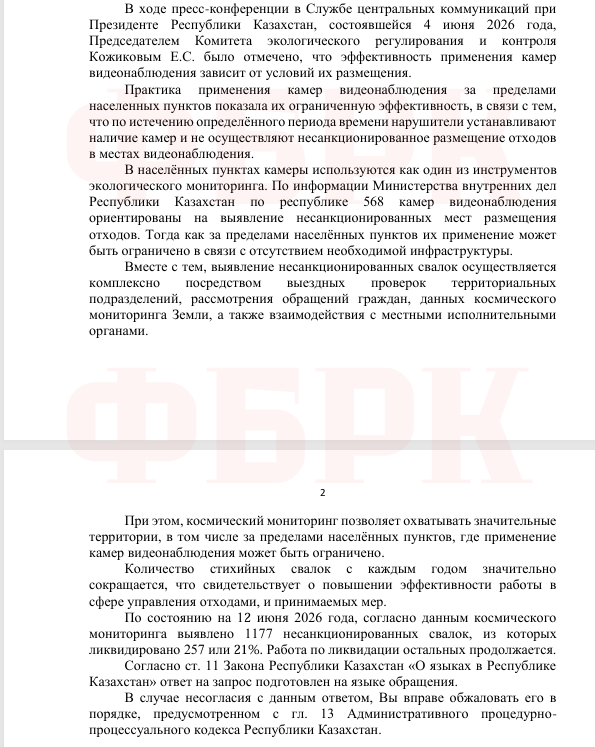
In response to an official request from the FBRK, the Vice-Minister of Ecology and Natural Resources of the Republic of Kazakhstan, Zhomart Aliyev, reported that CCTV cameras in populated areas are used as one of the tools for environmental monitoring. As Aliyev writes, according to information from the Ministry of Internal Affairs of the Republic of Kazakhstan, 568 cameras across the country are specifically aimed at identifying unauthorised waste disposal sites.
The response also provides new data from space monitoring: as of 12 June 2026, 1,177 unauthorised landfills have been identified, of which 257, or 21%, have been cleared.
HOW THIS DIFFERS FROM THE WORDS AT THE PRESS CONFERENCE
On 4 June 2026, at a press conference at the Central Communications Service under the President of the Republic of Kazakhstan, the Chairman of the Committee for Environmental Regulation and Control of the Ministry of Ecology, Yerbolat Kozhikov, stated that installing cameras to monitor landfills was deemed impractical due to the cost.
He also reported that the Ministry of Internal Affairs' cameras are located within populated areas, whereas landfills are identified outside them, and that over the past two years, no instances of unauthorised waste storage had been recorded via the Ministry of Internal Affairs' cameras.
The ministry's written response, received a week later, does not reproduce the argument about infrastructure costs. Instead, it states that outside populated areas the effectiveness of cameras is limited because offenders detect the presence of cameras and do not carry out unauthorised waste disposal in locations under video surveillance.
At the same time, the cameras in populated areas are described in the letter as an active monitoring tool, in contrast to the statement at the press conference about the absence of any landfill detections via the Ministry of Internal Affairs' cameras over the past two years.
WHAT FIGURES ALSO DO NOT MATCH
The letter does not clarify how the new data on 1,177 identified landfills relates to the figures that were cited earlier at the press conference: 884 landfill sites identified by the space monitoring system since the beginning of the year, and a further 488 found during raids. The sum of these two figures exceeds the number in the letter, and the counting period is not specified in either case.
CAN THE WORDS AT THE PRESS CONFERENCE BE TRUSTED?
Within the space of one week, two versions of the official position of the same ministry were given on the same issue. The verbal statement at the press conference and the written response from the same department differ both in explaining the reasons for abandoning the cameras and in assessing their current use. Both documents come from the same ministry and concern the same control tool.
This discrepancy raises the question of the extent to which verbal statements by department representatives at press conferences reflect the official position recorded in the documents of that same department, and whether such statements can be relied upon without subsequent written verification.