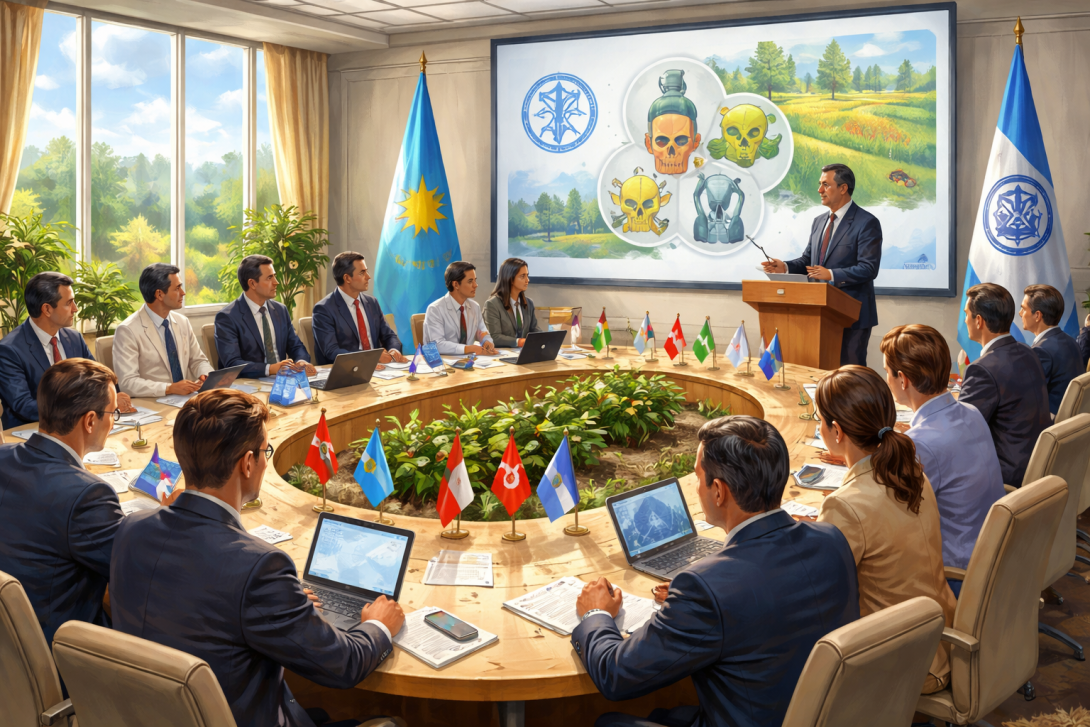
An international meeting was held in Kazakhstan, focusing on the impact of pesticides on human health and the functioning of national systems for responding to chemical poisoning. The event was organised by the Food and Agriculture Organization of the United Nations (FAO).
According to the press service of the Ministry of Agriculture, representatives from Azerbaijan, Kazakhstan, Kyrgyzstan, Tajikistan, Turkey, Hungary, Switzerland and Uzbekistan took part in the discussions.
Participants discussed topics related to reducing the risks associated with pesticide use, as well as issues of inter-agency cooperation and the development of toxicological care.
Deputy Chairman of the Committee of State Inspection in the Agro-Industrial Complex, Murat Irgibayev, presented the experience of establishing and developing a toxicology information centre in Kazakhstan.
According to him, the centre has become a base platform for opening similar units in Shymkent and Karaganda, which provide advisory assistance to the public in cases of chemical poisoning. It was reported that the centres use the international TOXBASE information database, designed for toxicological consultations.
At the same time, the FAO's involvement in research on agricultural and chemical safety in Kazakhstan had previously raised questions.
Recall that in June, the capital's court fined agricultural expert Kirill Pavlov 78,640 tenge (20 MCI) under Article 456-2 of the Administrative Code of the Republic of Kazakhstan ("Dissemination of false information"). The Ministry of Agriculture accused the author of the Telegram channel "Kazakh Chuvash" of inaccurately reporting on the locust situation.
During the court proceedings, lawyer Tapayeva reportedly described the FAO as "some incomprehensible foreign organisation without a licence".
"During the trial, when trying to submit the FAO report as evidence, lawyer Tapayeva stated: 'It's some incomprehensible foreign organisation without a licence,'" the expert wrote.
At the same time, Pavlov noted that several months later, the Ministry of Agriculture accepted equipment from the FAO for locust monitoring and control, including laptops for fieldwork, external drives for storing geodata, batteries for drones, as well as informational materials with recommendations on the safe use of pesticides. This information was published on the official website of state bodies.
The expert points to a contradiction between the stance voiced in court and the subsequent cooperation with the organisation.