(4 February 2026 | Source: Akorda press service)
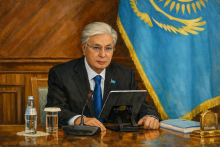
The President of Kazakhstan, Kassym-Jomart Tokayev, has repeatedly spoken about the need to form a national bourgeoisie — a business class that understands its responsibility to society. This is not just about wealthy individuals, but about businesses integrated into the social fabric of the country.
The question is only how realistic this task is for Kazakhstan, where a different model of relations between elites and society has developed over decades.
WHY THE NEED FOR CHANGE AROSE
For many years, big business in the country remained individualised and focused on personal interests. This model created a divide between the elites and society, which, in turn, generated social discontent. The concentration of resources in the hands of a narrow circle without visible returns to society undermined trust in the business class as a whole.
Kassym-Jomart Tokayev identified this problem as systemic. In his view, wealth itself is not the problem — what matters is how it is used. Without social responsibility, businesses risk remaining alien to the majority of the population, which carries not only reputational but also political risks.
HOW IT WORKS IN OTHER COUNTRIES
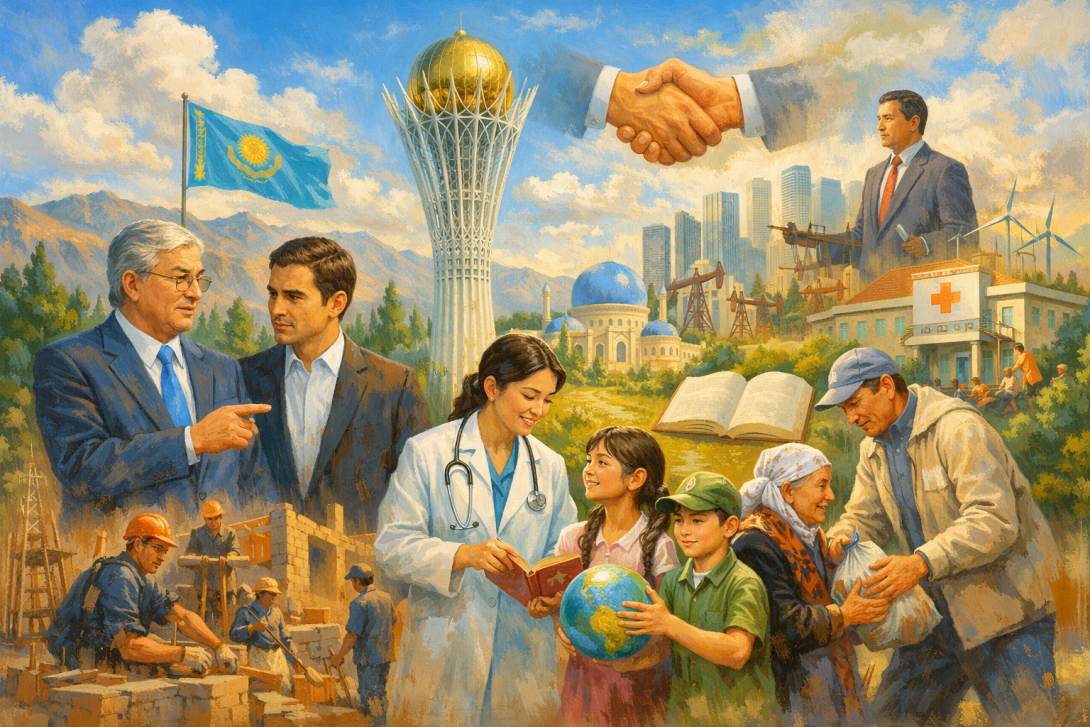
Global experience shows that a successful bourgeoisie has historically combined economic power with social activity. In Europe and the USA, entrepreneurs developed businesses alongside social projects for centuries: creating foundations, schools, universities and hospitals.
This was not pure altruism — such a strategy strengthened public trust and state stability, which ultimately served the interests of the businesses themselves.
This model was formed over decades and relied on robust civil society institutions. In Kazakhstan, such institutions are only just taking shape, and the question is whether this process can be accelerated through political will.
WHAT IS CHANGING IN KAZAKHSTAN
Today, large companies in the country are increasingly taking part in social projects, creating charitable foundations, and supporting educational and healthcare initiatives. Whether this is a deliberate strategy or a response to new state expectations remains to be seen.
However, the President supports the idea of a national bourgeoisie while also setting new standards for the rational use of resources. These initiatives aim to make social responsibility and participation in the country's development part of a new social contract between business and the state.
WHAT THE NATIONAL BOURGEOISIE SHOULD BE
According to the core concept, the national bourgeoisie of the future should be economically strong, institutionally embedded, and inherently social.
This is not a separate elite existing parallel to society, but a class of entrepreneurs who should be invested in public trust and societal development.
This model implies that business does not view social projects as forced charity, but sees them as an investment in stability.
HOW SUSTAINABLE IS THE NEW MODEL
The transition from individualised business to socially responsible enterprise is a lengthy process. In other countries, it took generations and relied on a developed legal system, independent media, and civil society.
In Kazakhstan, these institutions are still being formed, and their resilience will largely determine whether the new model becomes irreversible or remains a mere declaration.
It is worth noting that corporate social responsibility is not only a matter of morality but also a pragmatic calculation. If entrepreneurs truly realise that their well-being depends on social stability, the proposed model stands every chance of taking root. If participation in social projects remains a formal gesture, the gap between the elites and society will simply not disappear.