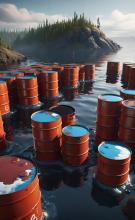
The environmental situation in the Kazakh sector of the Caspian Sea is becoming increasingly alarming. The mass die-off of seals, fish and birds has become commonplace. Each time, the authorities take samples, cite natural causes, and yet the answers are literally floating on the surface in the form of oil slicks.
In just one month, satellites recorded 15 patches of oil-containing pollution. The largest — nearly five square kilometres off the coast of Mangistau — is exactly where dozens of dead seals were soon washed ashore. A coincidence? Hardly. Environmentalists insist on the toxicity of the water and constant emissions from oil platforms.
The main suspect is the North Caspian Operating Company (NCOC) international consortium, which unites ExxonMobil, Shell, Total and Eni. Incidentally, in July, the prosecutor's office of Atyrau region identified excess gas flaring without a permit at NCOC. The fine: 3.6 billion tenge. And in January, a court ordered the recovery of another 3.5 billion for violations at Kashagan. Impressive sums, it seems? For an ordinary person — yes. For multinational corporations with turnovers in the tens of billions of dollars, it is pocket change written off as the cost of doing business.
The statistics announced by Prime Minister Olzhas Bektenov are also telling: over 2022-2024, fines totalling over 61.1 billion tenge were imposed on the largest oil-producing companies. NCOC — 12.4 billion, MangistauMunaiGas — 32.2 billion, Caspian Oil — 13.7 billion, Tengizchevroil — 2.8 billion tenge. The figures are impressive, but something suggests that if fines are issued with enviable regularity, it means the violations continue.
There is speculation that the root of the problem lies in the crippling agreements of the 1990s-2000s, under which the largest offshore projects, including Kashagan, are still being implemented. Up to 98% of the profits from these go to foreign participants; Kazakhstan, according to our sources, makes do with a paltry 2% and will only increase its share from 2036, when the field will already be depleting.
Meanwhile, the costs of infrastructure are covered from the national budget. So, according to information from our sources, for dredging works that disrupted the marine ecosystem, contractors lifted over 20 million tonnes of soil, accelerating the already catastrophic shallowing of the Caspian Sea.
Meanwhile, the sea's water level has dropped by two metres in 18 years, and off the coast of Kazakhstan it has receded by 50 km. At current rates, by 2100 the level could drop by 18 metres.
But the problem is not limited to Kazakhstan. In Azerbaijan, similar disasters are being recorded at fields operated by a consortium led by BP and ExxonMobil. The same slicks, the same outdated technologies and attempts to shift the blame. Corporations take the profits, and the ecosystems pay the price.
It is obvious that the situation requires a radical revision of approaches. It is necessary to introduce real material fines, commensurate with the incomes of the oil giants. This is normal global practice — financial responsibility for damage to nature must be painful for the violators. If the damage is proven, compensation should be calculated not in billions of tenge, but in billions of dollars.
Otherwise, we will continue to watch the Caspian Sea disappear along with its inhabitants, as a unique ecosystem that people have used for millennia turns into a poisoned industrial zone. For now, in this confrontation between business interests and survival issues, the latter is clearly losing.
One can only wonder: how many more dead seals must wash ashore before the decision-makers understand the simple truth — you cannot toast the sea with oil. Though, perhaps for some of those involved, even this prospect does not seem problematic — after all, they certainly won't have to drink the water from the Caspian.
To recall, at the beginning of July this year, a fish kill was recorded on the Caspian coast in the Mangistau region. This year alone, dead animals have been found repeatedly on the Caspian coast: on 1 May — the remains of 88 seals; on 9 May — dozens of dead seals and birds; and at the end of May, in the Fort-Shevchenko area, 117 dead seals were found over two days.