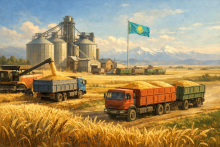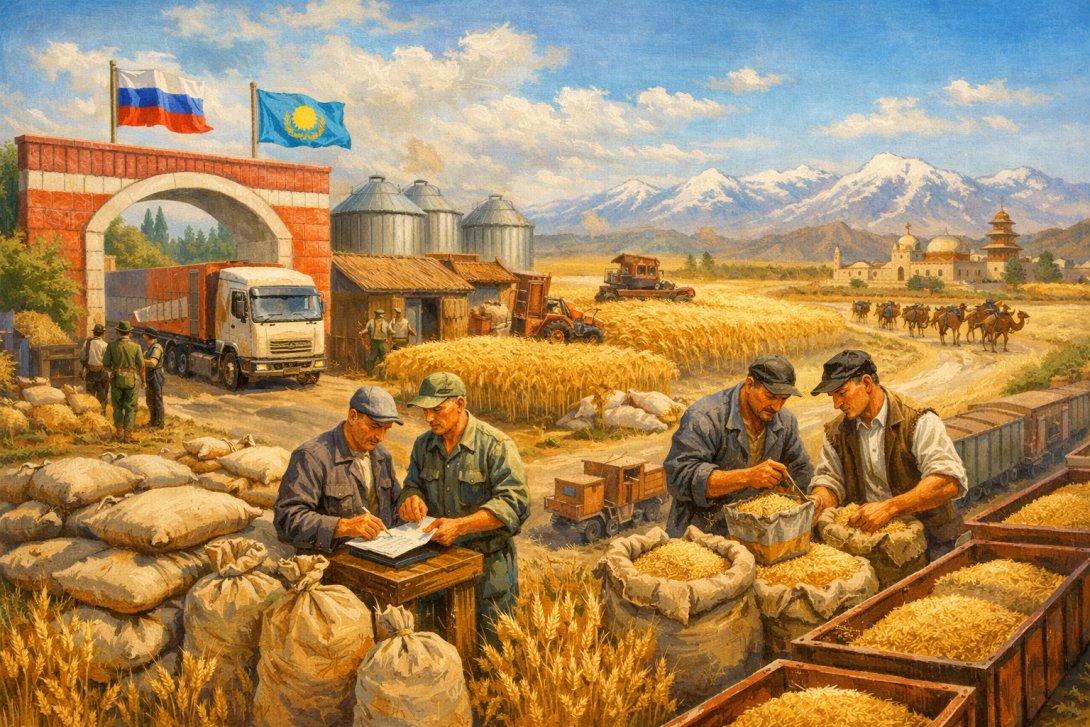
For a decade, from 2013 to 2023, official statistics from the Ministry of Agriculture (MoA) of the Republic of Kazakhstan and independent estimates from the United States Department of Agriculture (USDA) matched to within 0.3 million tonnes. In 2024, the gap suddenly reached 2.8 million tonnes for wheat and 4 million tonnes for all grain. The calculation methodologies did not change. Something else did — the scale of a scheme in which Russian grain is imported without paying VAT, registered on fictitious peasant farms as a domestic Kazakh harvest, and then re-exported to Central Asian countries under Kazakh certificates of origin. The editorial board of FBRK decided to investigate what is happening.
FACTUAL BASIS
According to official data from the MoA of the Republic of Kazakhstan, the wheat harvest in 2024 amounted to 18.6 million tonnes, and in 2025 — already 20.3 million tonnes. However, the USDA field attaché in Astana estimated the 2024 result at 15.8 million tonnes — a gap of +2.8 million tonnes from the official figure. The Grain Union of Kazakhstan (GUK) — an industry body uniting market participants themselves — estimates the 2024 harvest at 16.5 million tonnes, and sets the forecast for 2025 at 17.2 million tonnes against the official 20.3 million tonnes. The European Union's satellite monitoring system, JRC MARS, in October 2024 predicted a harvest level of +30% above the five-year average, giving a range of 16.5–17.0 million tonnes, but by no means the official 18.6 million tonnes.
For the overall grain balance, the picture is even more striking. The official figure for 2024 is 26.5 million tonnes, whereas the USDA estimated calculation stands at around 22.5 million tonnes. The gap of 4 million tonnes has been growing for the second consecutive year and, in scale, coincides with the documented volume of Russian grain that enters the country annually through official and shadow channels. This coincidence is no accident.
HOW THE SCHEME WORKS
According to information from FBRK's anonymous industry sources, at the first stage, Russian grain crosses the Kazakhstan-Russia border by road, rail, or river transport. A key point is that there are no weighbridges on the Russia-Kazakhstan road, only checkpoints for people. According to USDA field specialists' estimates, Kazakhstan's budget losses from understated grain shipment weights in 2023 ranged from $750 to $800 million.
At the second stage, the imported grain is registered with a peasant farming enterprise, often fictitious, as being 'grown on the territory of Kazakhstan'. Agricultural accounting in the country is based on farmers' self-declarations at the district akimat level. No satellite or physical verification is provided for. Districts aggregate the incoming data and pass it to the MoA. This is how Russian grain turns into a 'Kazakh harvest' in the official reports.
At the third stage, it is sold or exported to Uzbekistan, Tajikistan, and Afghanistan with Kazakh certificates of origin, bypassing the transit railway tariff of JSC "NC "Kazakhstan Temir Zholy" (KTZ), estimated at $85 million per year.
It is also significant that the infrastructure for such operations was created long before 2024. The state policy document on the concept for developing the agro-industrial complex (AIC) for 2021–2030 notes that about 42% of agricultural cooperatives were created fictitiously — to obtain state subsidies. This means the scheme scaled up using an already established and tested system.
CONTEXT: THE GREY CHANNEL EXISTED LONG BEFORE THE RECORD FIGURES
The basic 'grey' flow of Russian grain through Kazakhstan is estimated at 1.5–2 million tonnes per year and has been operating at least since 2019–2020. As early as February 2021, analysts from USDA FAS Astana noted in a memorandum 'inflated data from the northern regions' and 'unrecorded trade with Russia', which increased the apparent volume of domestic production.
In January–June 2024 alone, 1.3 million tonnes of Russian wheat officially arrived in Kazakhstan — declared as feed for poultry farms or raw material for flour mills. For comparison, the entire domestic annual grain consumption in the country is around 1.7 million tonnes. Thus, in half a year, 76% of the country's annual consumption arrived through legal channels.
An additional structural factor is Russia's monopolistic position as a supplier. In 2023, the President of the Russian Federation, Vladimir Putin, at the Forum of Interregional Cooperation, stated that Russia supplies 98% of Kazakhstan's grain imports of wheat and barley. This means that understating imports from Russia automatically translates into overstating domestic production.
OFFICIAL ADMISSIONS
However, the most interesting aspect here is not even the independent estimates, but the actions and words of the Kazakh government itself. Over 20 months — from April 2023 to December 2024 — Kazakhstan introduced four consecutive bans on wheat imports. Each time, the official wording directly stated the reason: eliminating grey schemes for importing wheat and its re-export from regions bordering Russia. The full chronology of bans is recorded by the Organisation for Economic Co-operation and Development (OECD).
The most straightforward official admission came in November 2024, when the Prime Minister of the Republic of Kazakhstan, Olzhas Bektenov, in a response to a parliamentary request, stated that the introduced ban limits the re-export of Russian grain to Uzbekistan and China. In other words, the highest executive official of the country confirmed the fact of re-export of Russian grain as Kazakh grain — and the need for administrative measures to stop it.
Equally revealing is that the bans were introduced cyclically and each time did not definitively solve the problem. This indicates either a systemic inability of control mechanisms, or, more likely given the documented scale of corruption at customs, partial resistance from structures interested in maintaining the scheme.
AN AGRONOMIC CONTRADICTION: A RECORD HARVEST — AND POOR QUALITY GRAIN
Independent of statistical calculations, the official data is contradicted by agronomic logic alone. The stated wheat yield for 2024 (1.52 tonnes/ha) is the second-highest result in the entire observation history. The historical maximum (1.66 tonnes/ha) was recorded in 2011 under favourable weather conditions.
In 2024, the conditions were fundamentally different: 50% of sowing was completed in June due to May floods, the southern regions suffered from summer drought, rains in early September and frosts in October deteriorated grain quality. The USDA field attaché estimated the yield at 1.19 tonnes/ha — 28% lower than the official figure.
The final agronomic contradiction lies in the quality indicators. The share of third-class (food-grade) wheat in the 'record' year of 2024 was 56%, and in the even more 'record' year of 2025, it fell to 40% — despite protein levels being lower than in 2024. A similar conclusion was reached by the Pavlov Analytical Centre, which checked how the crops looked from satellite.
The basic agronomic pattern is this: a record harvest due to good moisture means high grain filling and high protein content. Poor quality in a 'record year' is an agronomic contradiction that requires explanation.
SYSTEMIC VULNERABILITY OR DELIBERATE POLICY?
The key question here is this: is what is happening a consequence of the weakness of state institutions, or, at least in part, the result of a conscious managerial choice?
On one hand, the structural weakness of the statistical system is neither a secret nor new. Farmers' self-declaration without verification, the absence of weighbridges at the state border, 42% fictitious cooperatives according to the MoA of the Republic of Kazakhstan's own admission — all of this creates an environment where abuses are not just possible but technically simple. As early as 2021, the USDA pointed to systematic overstatement of data from the northern regions — three years before the 'record' figures of 2024.
On the other hand, the scale of the gap and the speed of its appearance indicate something more than the passive incapacity of the system. The scheme operates through an established mechanism with known participants, known routes, and known financial benefits. According to open data, the total financial losses to the Kazakh economy from the scheme amount to around $500 million per year: $57 million — unpaid VAT, $85 million — the KTZ transit tariff, $350 million — price losses for Kazakh agricultural producers. These losses become someone else's income.
The decade-long period of zero divergence between official and independent estimates (2013–2023) is a fundamentally important argument. The methodologies of the USDA and the MoA of the Republic of Kazakhstan did not change. This means that explaining the new gap by methodological differences is impossible: therefore, the data changed, not the method of measuring it. Finally, one cannot ignore the fact that the Ministry of Agriculture of Kazakhstan itself acknowledged the problem of fictitious cooperatives in a policy document but, apparently, has still not resolved it. This creates a legal and regulatory environment in which the scheme is reproduced not despite the system, but because of it.
The consequences of the identified scheme are significant on several levels. For Kazakh grain producers — primarily farmers from Kostanay, Akmola, and North Kazakhstan regions, which account for about 80% of the country's harvest — dumping from cheap Russian grain, formally recorded as domestic, creates direct price competition. It is 'price losses for producers' that constitute the largest share of the total damage.
For buyer countries, Uzbekistan, Tajikistan, and Afghanistan, the scheme violates grain traceability: food programs tied to the Kazakh certificate of origin effectively receive Russian grain. This creates risks within sanctions compliance for those operators who deal with Russian grains.
For international market analysts, inflated Kazakh statistics distort global estimates of the grain supply balance. The global USDA balances, based on government data, potentially contain 4–6 million tonnes of fictitious production for Kazakhstan, which, given the scale of the world grain market, is a significant margin of error. Finally, for the Kazakh state budget, annual losses from the scheme amount, according to available estimates, to at least $140 million (VAT + KTZ tariff) — based only on items that can be documented.
The ten-year period of zero divergence between official and independent estimates, after which the gap abruptly reached 4 million tonnes in 2024; the fourfold confirmation by the government of Kazakhstan of the existence of 'grey re-export schemes'; the documented absence of weighbridges at the state border; the admission by the MoA of the Republic of Kazakhstan itself that 42% of cooperatives were created fictitiously — all of this together points to a systemic nature of the problem that goes beyond technical accounting glitches.
The main open question, namely the upper limit of the falsification, without any doubt requires satellite audit of harvested areas and a cross-border customs analysis of data from the Federal Customs Service (FCS) of Russia and the Bureau of National Statistics of the Republic of Kazakhstan. Both tools are technically available. The question is who and when will decide to use them.