While residents of the Russian villages of Butyrki and Koty film cows' carcasses tumbling out of a lorry on the road to incineration, thousands of kilometres away geneticists are discovering that the foot-and-mouth disease outbreak that has reached China and Mongolia is almost indistinguishable from a vaccine strain from half a century ago. Whether this is a coincidence or not, there is as yet no official answer from either Russian or international veterinary services.
WHAT IS HAPPENING IN IRKUTSK OBLAST
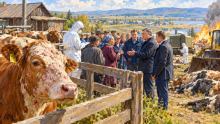
Quarantine in the Irkutsk municipal district of Russia was introduced back on 3 September, officially because of lumpy skin disease. By 7 September, in the villages of Butyrki and Koty, officials had begun seizing livestock: over two days, more than 100 head were destroyed. From the night of 8 September, the carcasses began to be burned on the bank of the Sarafanka river, with smoke drifting towards the villages.
On 11 September, a video appeared in the local chat showing animal bodies falling out of a lorry onto the road. The day before, women residents of Butyrki had blocked it to stop carcasses being driven past a children's playground.
In parallel, livestock also began to be seized in the village of Turskaya. Owners are not given documents about the diagnosis, are made to sign a non-disclosure undertaking, and outwardly healthy animals are also being destroyed.
Veterinary epidemiologist Svetlana Shchepetkina stated that the clinical picture, the speed at which the disease is spreading and the actions of the state veterinary service correspond not to the order on dermatitis, but to the Russian Ministry of Agriculture's procedure for foot-and-mouth disease.
"This is not a fight against disease — it is an attempt to hide the disease by destroying animals. <…> Not protection of exports, but the destruction of the wellbeing of tens of thousands of families and of the village as a whole," Shchepetkina stressed.
A similar story previously unfolded in Novosibirsk oblast, where the authorities, after weeks of silence, explained the slaughter of livestock as pasteurellosis.
FOOT-AND-MOUTH DISEASE HAS REACHED ASIA
Serotype SAT1 has historically been associated with Southern Africa, but since 2025 it has been rapidly expanding its geography: Iraq, Kuwait, Egypt, Azerbaijan, Israel, Cyprus, Palestine, and in 2026 — for the first time — China and Mongolia. Within the serotype, two topotypes circulate: SAT1/I from East Africa and the rarer SAT1/III, which, according to data from the World Reference Laboratory for FMD (WRLFMD), was recorded in Iran and Turkey in November 2025, and then in Cyprus, in Greece, in two provinces of China and in Mongolia's Bayan-Ulgii in spring 2026.
Interestingly, the SAT1/III sequences are more than 99% identical to the BOT/1/77 strain — the reference virus used as the master seed strain in the production of vaccines against foot-and-mouth disease. The laboratory itself frames this as an open question: improper inactivation of the vaccine or a leak from a production facility.
According to a separate genotyping report by WRLFMD, a December sample from the Azerbaijani city of Agstafa showed around 99.7% similarity to the 1977 Botswana sample — even though over the past half-century, evolution in Africa itself should have noticeably altered the virus's genotype.
Such a high degree of similarity to a half-century-old reference strain suggests rather that the virus did not evolve naturally in the field, but remained "preserved" for a long time under production or laboratory conditions. Researchers link the phylogenetic root of this SAT1/III branch to Turkey, meaning the possible leak most likely occurred there or in neighbouring countries.
THE VIRUS'S ROUTE
The theory of an "escaped" vaccine strain relates primarily to the region around Turkey. There is also an Azerbaijani trace here. On 29 October 2025, Azerbaijan sent WOAH an immediate notification of a SAT1 outbreak — roughly the same period when livestock was being transported through the country from Europe to Kazakhstan. And if the virus really did spread along a route through Turkey and the Caucasus, Azerbaijan turns out to be not just another point on the outbreak map, but a possible link on the path to Central Asia.
It is not yet known whether the suspected leak was accidental and exactly how the strain began to spread. But within a year it travelled from Turkey to China and Mongolia, coming ever closer to Central Asia. Could this same route have brought the virus directly to Kazakhstan? Or has it already?