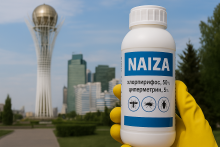
The FBRK editorial team continues its series on what preparations are used during treatment to protect against leaf-eating and sucking pests in the regions of Kazakhstan, and what impact they can have on living organisms, including humans.
We have previously written about what is still being used to poison residents of Astana city, Uralsk city, Atyrau city, as well as East Kazakhstan, Pavlodar, Kyzylorda and Karaganda regions. In this part, we will tell you what preparations are used for disinsection in the Zhetysu region.
According to the Department of Energy and Housing and Communal Services of the Zhetysu region, 12.8 million tenge was allocated for disinsection in Taldykorgan city. Treatment of green spaces is carried out from May to August with the preparations "Kolorit" and "Flex Expert". The active ingredient of "Kolorit" is "Acetamiprid".
- "Acetamiprid" belongs to the class of neonicotinoids, which were developed by modifying nicotine, and have a detrimental effect on various organs and tissues, especially the liver and kidneys. Compared to other neonicotinoids, the substance is moderately toxic to mammals, bees and fish, but extremely toxic to birds.
In 2013, the European Food Safety Authority (EFSA) stated that "Acetamiprid" could pose a threat to the development of the human nervous system. During its research, EFSA found that "Acetamiprid" can negatively affect the development of neurons and brain structures responsible for learning and memory.
The active ingredient of "Flex Expert" is "Deltamethrin", about the harmful effects of which we have written repeatedly before.
To remind you:
- "Deltamethrin" is a potential allergen and can cause asthma in some people. In acute poisoning, a person experiences uncoordinated movements, shortness of breath, swelling, headache, convulsions, vomiting, and difficulty breathing. The substance is not only toxic to warm-blooded animals and humans, but also extremely toxic to bees.
Currently, "Deltamethrin" is considered an outdated insecticide, as many insects, particularly mosquitoes and bed bugs, have become insensitive to it. For example, it is noted that about 88% of bed bugs in the USA have genes that block the action of "Deltamethrin".
According to the list of pesticides permitted for sale and use on the territory of the Republic of Kazakhstan, "Kolorit" is a banned preparation. Meanwhile, the preparation "Flex Expert" is permitted for use in treating agricultural crops and areas infested with locusts.
In Tekeli city, 7.3 million tenge was allocated for the treatment of green spaces. Disinsection is scheduled for June using the preparation "Karat Super", which contains the substance "Lambda-cyhalothrin".
To remind you:
- "Lambda-cyhalothrin" irritates mucous membranes, negatively affects the human cardiovascular system and can lead to pulmonary edema. The substance is very toxic to aquatic organisms, causing long-term changes in the aquatic environment. "Lambda-cyhalothrin" is deadly to bumblebees, bees and other pollinating insects.
According to the list of pesticides permitted for sale and use on the territory of the Republic of Kazakhstan, the preparation "Karat Super" is permitted for use in treating agricultural crops, apple trees and areas infested with locusts.
In the Sarkan district of the Zhetysu region and in Sarkan city, disinsection cost the budget 2 million tenge. Treatment was carried out in April with the preparation "Borey Neo", the active ingredients of which are "Alpha-cypermethrin" and "Imidacloprid".
To remind you:
- "Alpha-cypermethrin" is moderately toxic to earthworms, practically non-toxic to birds, but very toxic to fish, aquatic invertebrates and bees. The substance has moderate persistence in soils.
"Alpha-cypermethrin" can be toxic to humans and animals if it is used incorrectly or in large doses. In cases of poisoning with "Alpha-cypermethrin", loss of coordination, convulsions, salivation, and lacrimation are observed.
- "Imidacloprid" belongs to the class of neonicotinoids, which are similar in their action to nicotine and have a detrimental effect on various organs and tissues, to a greater extent on the liver and kidneys.
"Imidacloprid" is characterised by high persistence in soil: the half-life process takes up to 100 days. When absorbed by plants, "Imidacloprid" breaks down within 2-3 weeks. The substance is moderately toxic to warm-blooded animals and humans, highly toxic to birds and deadly to bees.
According to the list of pesticides permitted for sale and use on the territory of the Republic of Kazakhstan, the preparation "Borey Neo" is permitted for use in treating agricultural crops.
The Department of Energy and Housing and Communal Services of the Zhetysu region also reports that 693 thousand tenge was allocated for disinsection in the Kerbulak district, and 10 million tenge in the Koksu district. However, the preparations that will be used for disinsection have not yet been determined.
Meanwhile, funds for disinsection in the Aksu, Alakol, Karatal, Eskeldi and Panfilov districts were not allocated.
To remind you, in May last year we wrote that during disinsection in the Zhetysu region, the preparations "Lyatrin", "Herold" and "Diuron" were used, the active substances of which are deadly for freshwater invertebrates, including crustaceans and molluscs.
And in July 2023, when treating green spaces for ticks in the region, they used the preparation "Favorit", which contains substances that are extremely toxic not only to fish and aquatic invertebrates, but also to bees.
A hot summer season lies ahead, which means that the FBRK editorial team will likely still have to figure out what the country intends to use to poison locusts, which often pose a threat to Kazakh agricultural lands and indeed to the country's plant life in general.
To be continued…